


Views: 294 Author: ZHENYIBIO Publish Time: 2026-10-31 Origin: Site
Content Menu
● Powder vs. Liquid Cosmetic Active Ingredients: What Is the Difference?
>> What Is a Powder Cosmetic Active Ingredient?
>> What Is a Liquid Cosmetic Active Ingredient?
● Quick Comparison: Powder and Liquid Cosmetic Actives
● Compare Active Content Before Comparing Ingredient Prices
>> Standardization Matters More Than Physical Form
>> Calculate the Required Ingredient Dose
● Evaluate Solubility and Formula Compatibility
>> Match the Ingredient to the Formula Phase
>> Test the Finished Formula, Not Just a Beaker Solution
● Compare Stability Under Real Processing and Storage Conditions
>> Powder Stability Is Not Guaranteed
>> Liquid Stability Depends on the Complete Delivery System
● Assess Microbiological Risk Without Assuming Either Format Is Safe
● Understand What Botanical and Fermentation Evidence Actually Shows
>> Match Evidence to the Commercial Ingredient
>> Evaluate Fermentation-Derived Actives by Specification
● Compare Total Manufacturing Cost, Not Just Purchase Price
● A Practical Qualification Workflow for OEM and ODM Projects
>> Step 1: Define Non-Negotiable Requirements
>> Step 2: Request a Comparable Technical Package
>> Step 3: Run Matched Bench Trials
>> Step 4: Validate the Selected Formula
>> Step 5: Confirm Pilot-Scale Reproducibility
● Assess Sustainability Across the Whole Ingredient System
● Build Your Next Formula With ZHENYIBIO TECHNOLOGY INC
>> Are Powder Cosmetic Active Ingredients Stronger Than Liquids?
>> Can I Replace a Liquid Active With a Powder Directly?
>> Which Format Is Better for Sensitive-Skin Products?
>> Do Powder Actives Need Preservatives?
>> Are Liquid Actives Easier to Manufacture With?
>> What Should I Send a Supplier Before Requesting Samples?
Choosing between a powder and a liquid cosmetic active ingredient starts with one question: which format delivers the required performance in your finished formula? For skincare brands, wholesalers, and manufacturers, the answer affects stability, manufacturing efficiency, purchasing costs, and the evidence supporting product claims.
At ZHENYIBIO TECHNOLOGY INC, our focus combines plant-derived cosmetic actives with modern biofermentation technology. Our approach to ingredient selection is straightforward: compare verified performance, not physical appearance or price per kilogram alone.
A concentrated powder may offer formulation flexibility. A prepared liquid may simplify production. Neither format automatically delivers better results. This guide explains how to evaluate both options for practical, commercially scalable cosmetic development.

A powder cosmetic active ingredient is supplied in a dry particulate form. It may be a purified compound, a standardized botanical extract, a fermentation-derived material, or an active incorporated into a carrier.
Powder does not necessarily mean pure. A botanical extract powder may contain drying aids, encapsulation materials, or other supporting ingredients. Its declared active content must therefore be checked rather than assumed.
A liquid cosmetic active ingredient may be dissolved, dispersed, suspended, or emulsified in a carrier.
Common botanical extraction solvents and liquid carriers include water, glycerin, glycols, ethanol, and vegetable oils. The carrier influences compatibility with the finished product.
Importantly, a liquid dispersion is not the same as a true solution. Some liquid ingredients require mixing before use, while others may precipitate when diluted or exposed to a different pH.
The following table provides a screening framework, not a substitute for individual product specifications.
| Selection factor | Powder format | Liquid format |
|---|---|---|
| Active concentration | May offer a concentrated grade; verify assay | Depends on active loading and carrier |
| Incorporation | May require dissolution, dispersion, or hydration | May simplify dosing when compatible |
| Stability concerns | Moisture uptake, oxidation, caking | Precipitation, oxidation, microbial susceptibility |
| Manufacturing | Requires suitable weighing and powder handling | Requires suitable pumping and mixing |
| Formula flexibility | Can provide greater carrier flexibility | Introduces its existing carrier system |
| Logistics | Can reduce carrier weight shipped | May involve transporting substantial carrier |
| Purchasing comparison | Evaluate cost per usable active | Evaluate cost per usable active |
The strongest candidate is the format that meets your specifications with the lowest overall technical and commercial risk.
Two ingredients with the same botanical name are not necessarily equivalent.
Plant part, growing conditions, extraction solvent, processing, and drying can affect extract composition. Compare:
- Botanical identity and plant part.
- Extraction or fermentation process.
- Declared marker compounds and assay methods.
- Active concentration as supplied.
- Carriers, preservatives, and processing aids.
- Batch acceptance limits.
For complex botanical extracts, a marker compound can support consistency without representing every constituent responsible for performance.
Consider a hypothetical formula targeting 0.10% of a specified marker compound.
If a powder contains 50% marker compound, the required ingredient addition is 0.20%. If a liquid contains 5%, the required addition is 2.00%.
For a 100 kg batch:
| Hypothetical ingredient | Marker concentration | Ingredient required |
|---|---|---|
| Powder | 50% | 0.20 kg |
| Liquid | 5% | 2.00 kg |
These are illustrative calculations, not recommended usage rates or evidence of equal efficacy.
The comparison is valid only when the assay basis and marker identity are comparable. Equal marker delivery does not establish equivalent composition, skin delivery, or finished-product benefits.
Start with the formula architecture.
A water-based serum needs an active that dissolves or remains appropriately dispersed in its aqueous system. An anhydrous oil requires oil compatibility or a deliberately engineered dispersion.
A liquid botanical ingredient carried in water and glycerin should not be assumed suitable for a facial oil. Equally, a fine powder should not be assumed water-soluble.
Request specific information about:
- Solubility or dispersibility.
- Suitable carrier systems.
- Recommended addition sequence.
- Processing temperature.
- Working pH range.
- Mixing and hydration requirements.
An ingredient may dissolve in water yet become unstable after electrolytes, surfactants, polymers, or other actives are introduced.
Check the complete formula for haze, sediment, crystallization, viscosity changes, color shifts, and odor changes.
A useful development question is: "Does the ingredient remain uniformly incorporated at the intended concentration throughout storage?" Initial clarity alone cannot answer it.
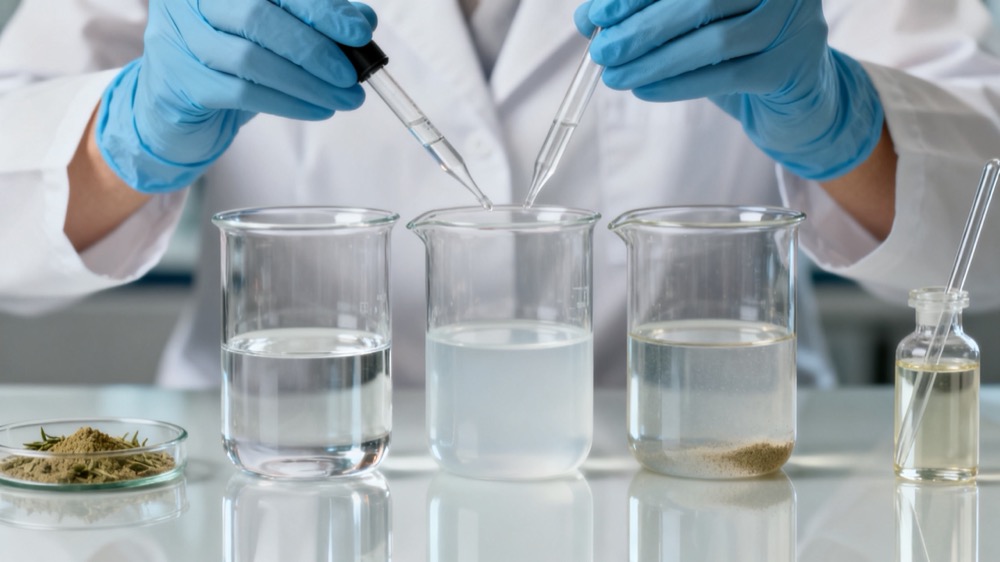
Drying can help stabilize certain ingredients, but powders still require suitable handling and packaging.
Potential problems include:
- Moisture absorption and caking.
- Oxidation after repeated opening.
- Poor redispersion.
- Loss of sensitive constituents during processing.
- Inconsistent dosing caused by handling losses.
The relevant evidence is stability data for the specific commercial grade—not a general statement that powders last longer.
A well-designed liquid system may improve handling or protect sensitive constituents. Encapsulation and other delivery technologies can also influence stability.
However, carrier composition, oxygen exposure, pH, temperature, and packaging remain important.
Request storage instructions, shelf-life justification, and information on stability after opening. For manufacturing, confirm whether heating, prolonged mixing, or hold times affect the active.
Neither accelerated testing nor supplier shelf life should be treated as proof that the finished cosmetic will remain stable in its final package.
Powder is not synonymous with sterile. Likewise, a liquid is not automatically microbiologically high risk simply because it contains water.
The assessment should consider available water, pH, composition, manufacturing conditions, packaging, and intended use.
For applicable finished cosmetics, preservation efficacy testing helps evaluate antimicrobial protection. ISO 11930 provides a reference framework, while microbiological risk assessment informs the testing strategy.
Ask suppliers for:
- Microbiological specifications.
- Relevant batch test results.
- Preservation information.
- Storage and handling precautions.
A preserved raw material does not prove that the finished formula is adequately protected. Dilution and interactions with other ingredients can change the overall preservation system.
A published study on a plant does not automatically substantiate every extract made from that plant.
Review whether the research concerns the same species, plant part, extraction method, composition, concentration, and application route.
Keep evidence categories distinct:
- Laboratory antioxidant testing describes activity under test conditions.
- Cell-based research explores biological responses.
- Human studies assess outcomes in people under defined conditions.
- Finished-product testing evaluates the marketed formulation.
These categories answer different questions. They should not be presented as interchangeable proof.
For a fermentation-derived cosmetic active, determine exactly what is supplied: a filtrate, lysate, isolated compound, or another defined material.
Then assess its composition, processing, preservation, and supporting evidence.
Do not infer that a fermentation-derived ingredient contains living microorganisms, or that "fermented" alone establishes superior efficacy or sustainability. Physical format is only one part of the ingredient's identity.
A practical purchasing model includes more than the quoted price:
Total batch cost = ingredient purchase cost + freight + handling + processing + testing + waste.
A lower-priced liquid may require a higher addition level. A concentrated powder may require extra dissolution time, equipment, or operator controls.
For an illustrative comparison, suppose:
- Powder costs USD 200/kg and contains 50% marker.
- Liquid costs USD 30/kg and contains 5% marker.
Their purchase costs per kilogram of marker are USD 400 and USD 600, respectively.
That calculation does not settle the decision. The liquid could still be commercially preferable if it reduces processing costs or avoids a difficult dissolution step.
Compare equivalent delivered content first, then evaluate total manufacturing performance.
Document the product type, target benefit, destination markets, packaging, appearance, sensory profile, and manufacturing limits.
Separate mandatory requirements from preferences. An incompatible carrier is a rejection criterion; a slightly longer mixing time may be manageable.
For each candidate, request:
- Technical data sheet and safety data sheet.
- Full ingredient composition and applicable INCI information.
- Certificate of analysis and assay method.
- Contaminant and microbiological specifications.
- Recommended usage and processing guidance.
- Stability information and available efficacy evidence.
Confirm which documents apply to the exact grade being purchased.
Compare candidates in the same base formula using a justified dose basis.
Record processing time, temperature, mixing conditions, appearance, pH, viscosity, and any losses. Include a base-formula control where useful.
Evaluate physical and chemical stability, packaging compatibility, microbiological protection, and relevant performance claims.
Set acceptance criteria before reviewing results. Otherwise, teams risk rationalizing an attractive prototype that does not meet commercial requirements.
A laboratory success may not transfer directly to production.
Verify addition sequence, mixing capability, powder wetting, liquid transfer, hold times, and batch uniformity using representative equipment.
For wholesalers, also establish batch traceability and technical-document control so downstream customers receive consistent information.
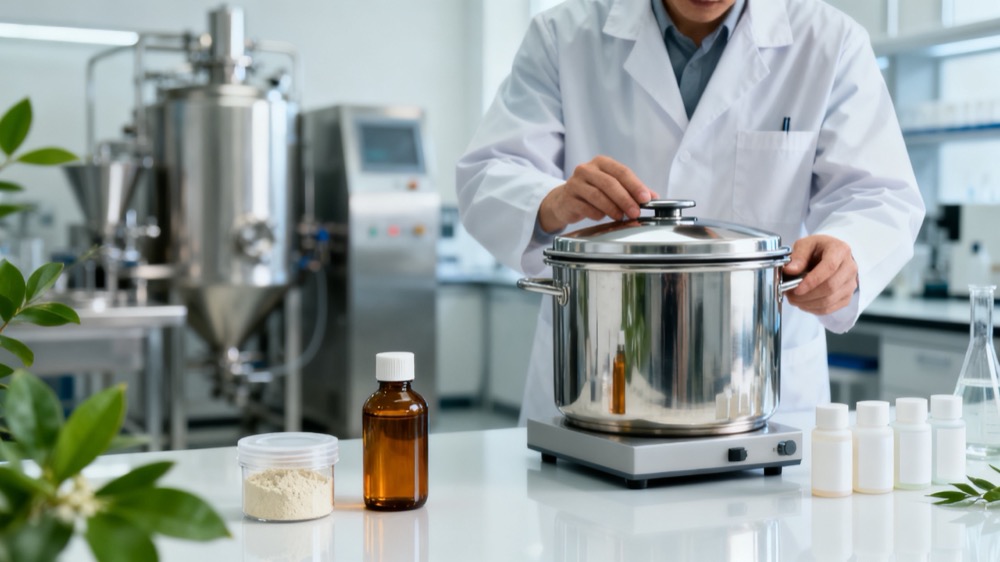
A powder can reduce the mass of carrier transported, but drying also consumes resources.
A liquid may avoid a drying stage while increasing shipping weight. Neither format deserves an automatic environmental advantage.
Ask for evidence covering feedstock sourcing, extraction or fermentation inputs, solvent management, drying, packaging, transport, and waste.
Make comparisons on a meaningful basis, such as equivalent usable active delivered—not simply one kilogram of powder versus one kilogram of liquid.
Where lifecycle data are unavailable, describe the limitation rather than turning a plausible benefit into a verified environmental claim.
For your next botanical or fermentation-derived cosmetic project, begin with a clear technical brief rather than a predetermined format.
Contact ZHENYIBIO TECHNOLOGY INC with your application, target benefit, preferred ingredient form, manufacturing constraints, and destination markets. Request an OEM or ODM discussion focused on candidate specifications, sample evaluation, and an appropriate validation plan.
The objective is a defensible ingredient choice that works in your formula—and remains practical when production scales.
Not necessarily. Strength depends on the specified active concentration and composition. A powder may contain carriers, while a liquid may be highly concentrated. Compare the commercial specifications and assay basis.
Usually, substitution requires reformulation and testing. Adjust the dose, account for removed carriers, confirm dissolution, and reassess stability and preservation. Matching a marker concentration alone does not establish full equivalence.
Neither format is inherently better. Evaluate the complete ingredient composition, impurities, carriers, preservatives, intended concentration, and finished-product tolerability. Physical form alone cannot establish suitability for sensitive skin.
The raw material requires a microbiological risk assessment. After incorporation into a water-containing cosmetic, the finished product requires its own protection assessment. A dry starting material does not remove that responsibility.
They can be, particularly when supplied in a compatible, stable system. However, suspensions may need agitation, viscous liquids may be difficult to transfer, and some liquid carriers can restrict formulation options.
Provide the product type, target benefit, intended markets, formula pH, processing limits, preferred carrier, packaging, and expected order volume. This helps narrow the selection to technically relevant candidates.
1. Michalak, M. (2023). "Plant Extracts as Skin Care and Therapeutic Agents." *International Journal of Molecular Sciences*. Covers botanical extraction, compositional variability, skin-related research, and limitations of translating evidence into applications. [pmc.ncbi.nlm.nih]
2. Bandyopadhyay, A., et al. (2026). "Plant-based ingredients in cosmetic science: Current …" *International Journal of Cosmetic Science*. Reviews plant-derived cosmetic ingredients and delivery approaches, including technologies intended to improve stability and delivery. [onlinelibrary.wiley]
3. International Organization for Standardization. *ISO 11930:2019—Cosmetics—Microbiology—Evaluation of the antimicrobial protection of a cosmetic product*. Defines the preservation-efficacy testing framework and its relationship to overall antimicrobial protection. [cdn.standards.iteh]
4. Microchem Laboratory. "ISO 11930—Preservative Effectiveness Test." Explains the purpose and practical structure of cosmetic preservation challenge testing. [microchemlab]
5. Innov'ia. "Ensuring Active Ingredient Stability for High-Performance Cosmetics" (2025). An industry technical overview of formulation conditions, encapsulation, drying, and ingredient-stabilization approaches. [innov-ia]


