


Views: 237 Author: ZHENYIBIO Publish Time: 2026-10-21 Origin: Site
Content Menu
● What Does MOQ Mean When Choosing a Cosmetic Ingredients Supplier?
● Why Cosmetic Ingredient Suppliers Set Minimum Order Quantities
>> Production and Quality-Control Requirements
>> Botanical and Fermentation Specifications
● Calculate Your Actual Cosmetic Ingredient Requirements
>> An Illustrative Botanical Serum Calculation
● Evaluate Minimum Order Quantities Against Usable Shelf Life
>> Calculate Inventory Coverage
● Compare Total Cost, Not Just Price per Kilogram
● Review Technical Documentation Before Accepting an MOQ
● Use a Sample-to-Production Qualification Process
>> Stage 1: Define Acceptance Criteria
>> Stage 2: Evaluate the Sample
>> Stage 3: Run a Representative Pilot
>> Stage 4: Approve Commercial Supply
● Negotiate Lower MOQs Without Sacrificing Reliability
● Score Suppliers Before Making the Final Decision
● Connect Sustainable Ingredient Sourcing With Inventory Planning
● Plan Your Next Ingredient Order With ZHENYIBIO TECHNOLOGY INC
>> 1. What Is a Good MOQ for Cosmetic Ingredients?
>> 2. Should I Always Choose a Low-MOQ Cosmetic Ingredients Supplier?
>> 3. Can Different Cosmetic Ingredients Be Combined to Meet One MOQ?
>> 4. Are MOQ Requirements Different for OEM and ODM Projects?
>> 5. How Can I Reduce the Risk of Buying Too Much?
>> 6. Does an Ingredient Sample Guarantee Commercial-Batch Consistency?
Evaluating minimum order quantities when choosing a cosmetic ingredients supplier means looking beyond the smallest quantity available. The right MOQ should match your formulation requirements, realistic sales forecast, ingredient shelf life, and working capital. A lower price per kilogram offers little value if the material expires before you can use it.
For brands, wholesalers, and manufacturers sourcing botanical actives or fermentation-derived ingredients, this decision also involves technical documentation, batch consistency, and scale-up readiness.
My recommended approach is straightforward: assess an MOQ as a purchasing commitment, not simply a supplier requirement. The following framework explains how to compare offers and build a more resilient sourcing plan.

A minimum order quantity is the smallest amount a supplier agrees to sell under specified commercial conditions. However, an ingredient quotation may contain several different minimums.
| MOQ Type | What It Covers | What Buyers Should Clarify |
|---|---|---|
| Product MOQ | One ingredient or grade | Does each concentration require a separate order? |
| Packaging MOQ | A specific container size | Can smaller sealed packs replace one large drum? |
| Production MOQ | A dedicated manufacturing run | Is the material stocked or made to order? |
| Customization MOQ | A proprietary extract or blend | Does the minimum apply to each specification? |
| Order-value minimum | Total invoice value | Can different ingredients share one order? |
Do not assume that a sample size, standard pack size, and manufacturing batch size are interchangeable.
For OEM and ODM projects, distinguish the raw-material MOQ from the finished-product MOQ. A manageable ingredient order does not automatically make a customized skincare production run commercially viable.
Understanding the reason behind an MOQ helps you negotiate the right variable.
A dedicated extraction or fermentation campaign may involve equipment preparation, processing, cleaning, testing, and batch release. These activities create costs that do not decrease proportionally with order size.
Ask whether the quoted minimum reflects an actual production constraint or a commercial preference. A stocked ingredient may offer different purchasing options from a custom-manufactured active.
Smaller orders can require additional filling, labeling, and handling. Some materials also need protective packaging or controlled storage.
Instead of requesting a lower kilogram price immediately, ask whether standard packaging would make a smaller order feasible.
"Plant extract" is not a complete purchasing specification. Plant species, plant part, extraction solvent, carrier, and marker-compound concentration can define materially different products.
Likewise, fermentation-derived materials may differ in composition, concentration, preservation, and downstream processing. Compare equivalent specifications before comparing their minimum order quantities.
Start with a production forecast rather than the supplier's preferred pack size.
A useful planning equation is:
Ingredient required=Finished-product mass×Ingredient inclusion rate
Use the inclusion rate for the commercial material as supplied—not automatically for its isolated active component.
Suppose a brand plans to manufacture 10,000 serum units, each containing 30 grams of product.
- Finished-product mass: 300 kilograms.
- Botanical ingredient inclusion rate: 2%.
- Theoretical ingredient requirement: 6 kilograms.
- Illustrative 10% purchasing allowance: 0.6 kilograms.
- Initial purchasing requirement: 6.6 kilograms.
The allowance is a planning assumption, not an industry standard. Adjust it using actual sampling requirements, transfer losses, pilot consumption, and production experience.
If the supplier's MOQ is 25 kilograms, the order exceeds this initial requirement by 18.4 kilograms.
The next question is not whether the supplier offers a discount. It is whether you have a credible, technically compatible plan for consuming that balance.
For wholesalers, perform this calculation across confirmed customer demand, while avoiding double-counting speculative orders.
An acceptable MOQ must fit the period during which the ingredient can actually be used.
Request written confirmation of:
- Manufacturing date and assigned expiry or retest date.
- Minimum remaining shelf life at delivery.
- Unopened storage conditions.
- Handling instructions after opening.
- Relevant temperature, light, or oxygen sensitivity.
- Whether transport excursions require technical assessment.
An expiry date and a retest date are not interchangeable. Do not assume that testing automatically authorizes use beyond an expiry date.
If a 25-kilogram order supports average consumption of 2 kilograms monthly, it represents 12.5 months of inventory.
Compare that coverage with the usable time remaining after transit, receiving checks, and any internal release process.
Then test a slower-sales scenario. At 1 kilogram monthly, the same order represents 25 months of inventory.
This downside calculation often reveals more than the supplier's volume discount. Where appropriate, ask about smaller sealed containers to reduce repeated opening of the entire quantity.
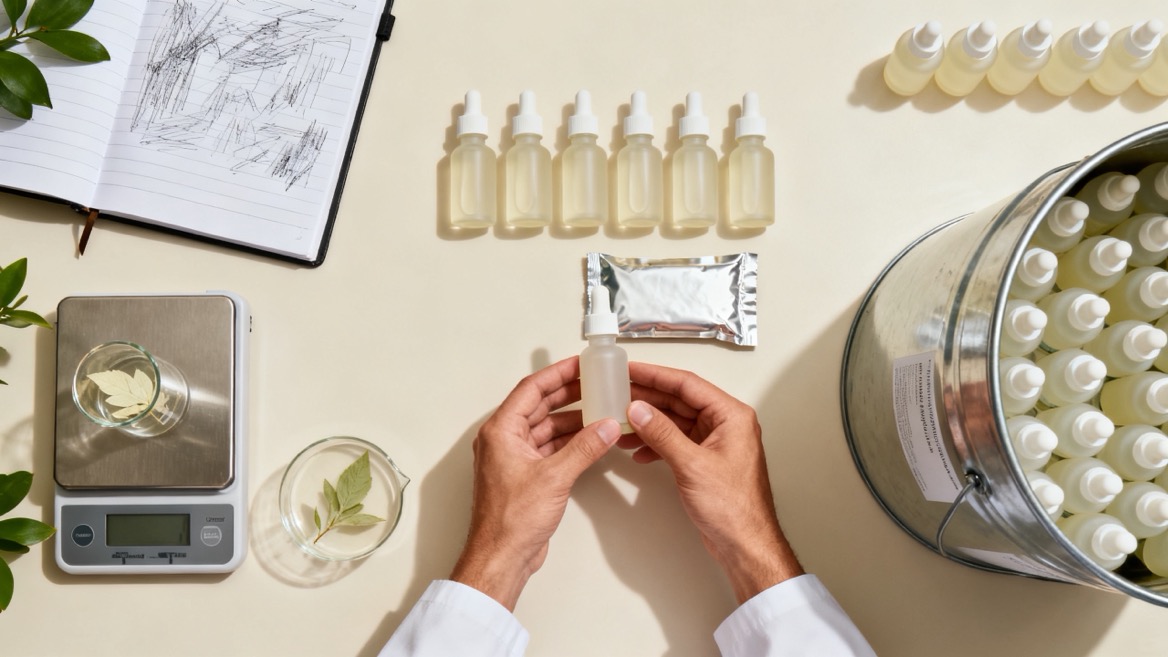
A low-MOQ cosmetic ingredients supplier can offer better economics despite a higher unit price.
Consider this hypothetical comparison:
| Purchasing Factor | Supplier A | Supplier B |
|---|---|---|
| Minimum order | 25 kg | 5 kg |
| Ingredient price | $80/kg | $100/kg |
| Material purchase | $2,000 | $500 |
| Freight and import costs | $300 | $150 |
| Illustrative annual consumption | 10 kg | 10 kg |
| Orders needed for annual consumption | One | Two |
| Cash paid for material and freight | $2,300 | $1,300 |
| Inventory remaining after consumption | 15 kg | 0 kg |
Supplier A offers the lower ingredient price, but Supplier B requires less cash under these assumptions.
The remaining 15 kilograms from Supplier A is not automatically a loss: it may retain value if future demand and shelf life support its use. Equally, that value should not be assumed.
Build a total-cost comparison covering:
1. Material and packaging charges.
2. Freight, insurance, duties, and clearance.
3. Incoming inspection and testing.
4. Storage and inventory financing.
5. Expected disposal or write-off exposure.
6. Reordering effort and supply-interruption risk.
For concentrated actives, also compare the cost at the validated formulation dosage. Different concentrations are not necessarily equivalent, and concentration alone does not establish equivalent performance.
A commercially attractive minimum is not enough if your technical team cannot qualify the ingredient.
Request a documentation package appropriate to the material, application, and destination market:
- Product specification and International Nomenclature of Cosmetic Ingredients naming.
- Batch-specific certificate of analysis.
- Safety data sheet, where applicable.
- Composition details, including carriers and preservatives.
- Relevant microbiological and impurity information.
- Storage, shelf-life, and handling guidance.
- Available safety, efficacy, and formulation-support data.
For botanicals, clarify identity, plant part, origin, and standardization where relevant. For fermentation-derived ingredients, request information sufficient to understand composition and assess process-related impurities.
U.S. cosmetic safety obligations include maintaining adequate safety substantiation. In the European Union, the cosmetic product safety report addresses composition, stability, microbiological quality, impurities, and other safety considerations.
Supplier documentation supports that work; it does not replace the finished-product safety assessment.
When reviewing efficacy claims, distinguish laboratory findings from human studies, and ingredient-level evidence from evidence on your finished formulation.
A small sample should answer technical questions before a large order creates financial exposure.
Document the properties your formula requires: appearance, odor, solubility, processing compatibility, and relevant specification limits.
Check the proposed dosage and processing conditions against supplier guidance.
Run appropriate formulation trials and stability screening. Assess whether the ingredient affects color, viscosity, odor, or preservation.
A promising bench sample is a reason to continue qualification—not proof of commercial readiness.
Confirm how the material behaves with your equipment and manufacturing process.
Ask whether the sample represents the same grade and process intended for commercial supply. Record any differences.
Agree on specifications, release documentation, traceability, change notification, and procedures for nonconforming deliveries.
This sequence makes MOQ negotiation more productive because both parties understand what the buyer is committing to purchase.
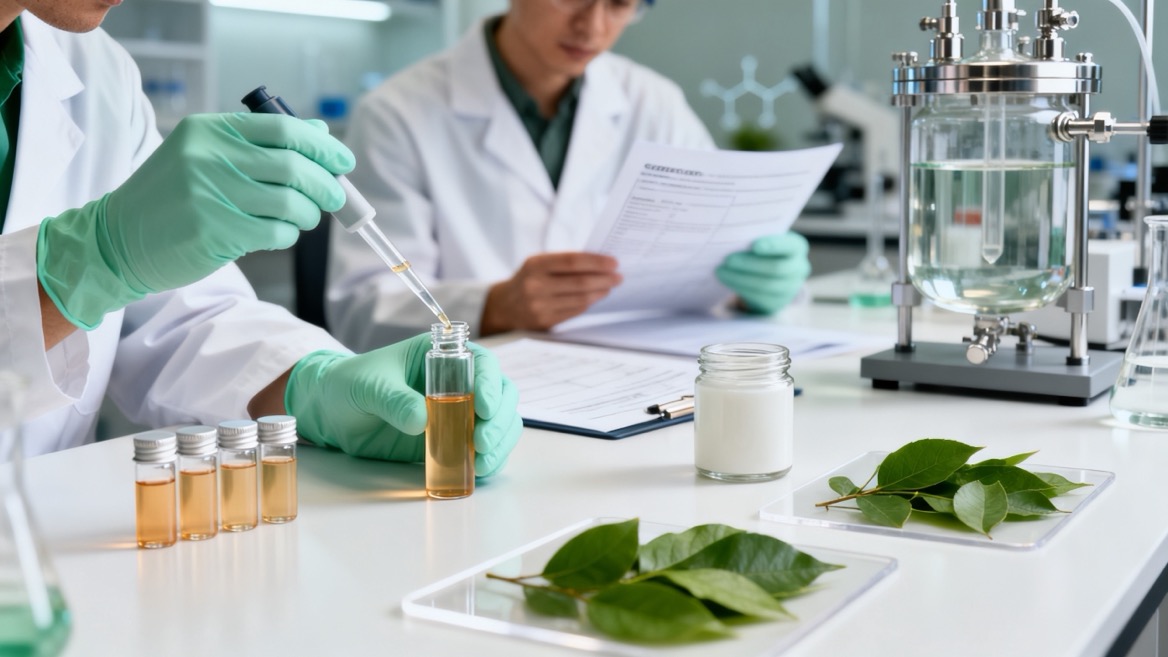
The strongest negotiation explains your demand profile and offers an operationally workable alternative.
Possible arrangements include:
- A paid qualification quantity before commercial commitment.
- Standard grades instead of custom specifications.
- Smaller quantities at a transparent surcharge.
- Scheduled deliveries against an agreed commitment.
- Shared order-value minimums across eligible ingredients.
- Standard container sizes that reduce repacking work.
For staged deliveries, clarify who owns undelivered stock, when payment becomes due, and how shelf life will be managed. Splitting shipments does not necessarily reduce your total purchasing obligation.
A practical request might read:
> "Our initial requirement is 6.6 kilograms for a botanical serum launch. Please quote qualification and commercial quantities, standard packaging options, and the conditions for staged delivery. We will provide an updated forecast after pilot approval."
This is more actionable than asking for the "lowest MOQ" without technical or commercial context.
Use mandatory qualification gates first. Reject offers that cannot meet essential safety, identity, specification, or traceability requirements.
Then compare qualified suppliers using a weighted scorecard.
| Evaluation Area | Suggested Weight |
|---|---|
| Technical suitability and documentation | 30% |
| MOQ fit and inventory exposure | 25% |
| Delivery reliability and replenishment | 20% |
| Total purchasing cost | 15% |
| Technical support and change control | 10% |
These weights are a proposed decision tool, not an industry benchmark. Adjust them for your business.
A new brand may prioritize cash exposure. An established manufacturer may place greater weight on replenishment reliability. Score each category consistently and record the evidence behind the rating.
For botanical and biotechnology-based ingredients, sustainability assessment should extend beyond the production story.
Ask about traceability, relevant sourcing practices, packaging, transport, and available environmental data. Life-cycle assessment can help evaluate impacts across defined stages rather than relying on a single "natural" or "fermented" claim.
Do not assume fermentation automatically makes every ingredient environmentally preferable. Comparisons depend on process inputs, energy, yield, and assessment boundaries.
MOQ planning also matters: purchasing material that becomes unusable creates avoidable waste. However, smaller shipments may introduce additional transport or packaging impacts. Evaluate these trade-offs rather than treating either larger or smaller orders as universally better.
ZHENYIBIO TECHNOLOGY INC focuses on natural plant-active cosmetic ingredients, combining botanical knowledge with modern biofermentation technology and supporting international OEM and ODM projects.
To make an MOQ discussion useful, prepare your target ingredient, intended application, proposed dosage, destination market, launch volume, packaging requirements, and replenishment forecast.
Contact ZHENYIBIO TECHNOLOGY INC with this brief to request product-specific MOQ, sample, documentation, and customization information. Confirm all commercial and technical conditions in writing before approving an order.
A good MOQ fits validated production demand, usable shelf life, and available working capital. There is no single quantity suitable for every ingredient or business.
No. Evaluate technical suitability and documentation first, then compare inventory exposure, replenishment reliability, and total cost. A low minimum cannot compensate for an unsuitable ingredient.
Sometimes an order-value minimum allows this. Product-specific production or packaging minimums may still apply. Request written confirmation for each ingredient and grade.
They can be. Custom formulations, ingredient blends, packaging, and finished-product production may each have separate minimums. Ask for a quotation that distinguishes these commitments.
Validate demand conservatively, calculate ingredient consumption, test slower-sales scenarios, and confirm remaining shelf life. Explore qualification quantities or staged deliveries without overlooking contractual obligations.
No. Samples support evaluation, but commercial consistency requires agreed specifications, batch documentation, traceability, and appropriate incoming controls.
1. U.S. Food and Drug Administration. "Modernization of Cosmetics Regulation Act of 2022 (MoCRA)." Primary regulatory source for cosmetic safety-substantiation responsibilities and supporting records. [fda]
2. European Parliament and Council. "Regulation (EC) No 1223/2009 on Cosmetic Products," particularly Annex I. Primary source for cosmetic safety-report requirements covering composition, stability, microbiological quality, and impurities. [health.ec.europa]
3. European Commission. "Commission Implementing Decision 2013/674/EU: Guidelines on Annex I to Regulation (EC) No 1223/2009." Guidance explaining raw-material purity, unintended substances, and the importance of supplier data. [eur-lex.europa]
4. Croda. "Life Cycle Assessment (LCA)." Industry methodology overview describing assessment boundaries, process inputs and outputs, and environmental-impact evaluation across the ingredient life cycle. [croda]
5. Croda Beauty. "Zero Ambiguity." Industry example of transparent environmental assessment using defined methodologies, disclosed limitations, product carbon footprints, and life-cycle assessment. [crodabeauty]
6. MakingCosmetics. "Certificate of Analysis: Quince Fruit Extract." Illustrative supplier analytical document; included as a documentation example, not as evidence of universal ingredient specifications. [makingcosmetics]


