


Views: 219 Author: ZHENYIBIO Publish Time: 2026-10-16 Origin: Site
Content Menu
● Introduction: Spain's Position in Sialic Acid Powder Procurement
>> Barcelona and Catalonia: A Relevant Beauty-Industry Ecosystem
● Selection Criteria: How This Supplier Shortlist Was Built
>> 1. Confirmed Product Identity
>> 2. Manufacturing and Origin Transparency
>> 4. Certification Relevance and Validity
>> 5. Technical and OEM/ODM Support
● Top Five Sialic Acid Powder Sourcing Options for Buyers in Spain
>> 1. ZHENYIBIO TECHNOLOGY INC — Cosmetic Ingredient Manufacturing and Customization Discussions
>>> Company Background and Markets
>>> Sialic Acid Powder Offering
>>> Core Strengths
>> 2. CymitQuimica — Barcelona-Based Access to Multiple Sialic Acid Brands
>>> Company Background and Markets
>>> Sialic Acid Powder Offering
>>> Core Strengths
>> 3. Merck / Sigma-Aldrich — Research and Method-Development Procurement
>>> Company Background and Markets
>>> Sialic Acid Powder Offering
>>> Core Strengths
>> 4. TCI / TCI Europe — Clearly Specified Specialty Chemical Supply
>>> Company Background and Markets
>>> Sialic Acid Powder Offering
>>> Core Strengths
>>> Company Background and Markets
>>> Sialic Acid Powder Offering
>>> Core Strengths
● Supplier Comparison: Capacity, MOQ, Certifications, and Purchasing Fit
● Technical Buyer's Guide: What to Specify Before Requesting Prices
>> Define the Grade by Its Intended Use
>> Compare Production Routes Without Assuming Sustainability
>> Use Relevant Compliance Evidence—not CE or RoHS as Ingredient Credentials
● The Overlooked Purchasing Trap: Purity Is Not Always Active Content
● Common Procurement Problems and How to Avoid Them
>> Problem 1: A Distributor Is Presented as a Factory
>> Problem 2: A Sample Does Not Represent Commercial Supply
>> Problem 3: Biological Importance Is Used as Proof of Cosmetic Performance
>> Problem 4: Storage Instructions Are Generalized Across All Grades
>> Problem 5: A Low MOQ Is Confused with Reliable Scale-Up
● A Practical Sample-to-Contract Procurement Process
>> Stage 1: Send a Complete Technical Request
>> Stage 2: Review Documents Before Testing
>> Stage 3: Test the Sample in the Actual Formula
>> Stage 4: Place a Controlled Pilot Order
>> Stage 5: Agree on Long-Term Controls
● Select the Supplier That Fits Your Development Stage
● FAQs
>> 1. How Can We Verify That a Supplier's ISO Certificate Has Not Expired?
>> 2. Can We Replace Our Approved Cosmetic Ingredient with a 99% Research Reagent?
>> 3. Does a CosIng Listing Make Sialic Acid Automatically Acceptable in an EU Cosmetic?
>> 4. How Do We Verify an Animal-Free Fermentation Claim?
>> 5. Can Several Small Shipments Avoid REACH Registration?
Selecting a long-term sialic acid powder supplier requires more than comparing prices or accepting a high-purity claim. Professional buyers need to establish who manufactures the material, how each batch is released, whether the documentation supports the intended application, and how reliably the supplier can move from samples to repeat commercial orders.
This guide evaluates five sourcing options relevant to Spanish buyers, using product identity, manufacturing transparency, quality-control documentation, technical support, customization potential, and supply-chain practicality as the main criteria.
One distinction matters from the outset: suppliers accessible to buyers in Spain are not necessarily manufacturers located in Spain. The companies below include a China-based cosmetic ingredient manufacturer, a Barcelona-based chemical marketplace, and international chemical suppliers with European sourcing channels. They should not be presented as five Spanish sialic acid fermentation factories.

Spain offers an established beauty-industry ecosystem rather than a publicly documented concentration of dedicated sialic acid powder production plants.
According to STANPA's industry review published in April 2026, Spain's domestic cosmetics and perfumery market reached approximately €11.8 billion in 2025, increasing 5.8% over 2024. Cosmetics and perfume exports reached €10.124 billion, up 5.58%, while the sector recorded a positive trade balance of €3.849 billion. These figures describe the broader beauty industry—not Spanish sialic acid production or exports.
For ingredient buyers, this distinction is important. A substantial cosmetics industry creates opportunities for formulation development, distribution, testing, and contract manufacturing, but it does not establish that a particular active ingredient is manufactured domestically.
Barcelona provides a useful procurement environment through its chemical distribution businesses and beauty-sector collaboration network. Beauty Cluster connects companies, organizations, and knowledge centers across the beauty value chain, while Barcelona-based CymitQuimica provides access to multiple acetylneuraminic acid brands.
The practical advantage is access to different stages of product development:
- Small quantities for screening and analytical work.
- Multiple supplier specifications for comparison.
- Connections across formulation, ingredients, and finished-product development.
- European commercial channels for purchasing and documentation.
However, a local distributor's address should never be confused with the manufacturing origin of its products.
This is an application-based shortlist, not a market-share ranking or a claim that every company offers equivalent manufacturing services.
A supplier should identify the exact substance rather than quote "sialic acid" without clarification.
For the material discussed here, the principal identifiers are:
| Identification field | Expected information |
|---|---|
| Chemical name | N-Acetylneuraminic acid |
| Common abbreviations | Neu5Ac, NANA |
| CAS number | 131-48-6 |
| Molecular formula | C11H19NO9 |
| Molecular weight | Approximately 309.27 g/mol |
| EC number | 205-023-1 |
These identifiers appear in the reviewed commercial product documentation. Nevertheless, "sialic acids" describes a wider family, so buyers should specify N-acetylneuraminic acid rather than rely on the family name alone.
Qualification should establish whether the seller is:
- The actual manufacturer.
- An authorized distributor.
- A marketplace connecting buyers with several brands.
- A reseller sourcing from an undisclosed upstream producer.
Each model can be useful, but the supporting documents and commercial responsibilities differ.
A meaningful specification should extend beyond headline purity. Request the analytical method, assay basis, water content, impurity controls, microbiological limits, and any application-specific contaminant testing.
The reviewed catalogs illustrate why this matters: products may state HPLC purity, titration purity, or purity on an anhydrous basis. These descriptions are not automatically interchangeable.
Company certificates should be checked for the correct legal entity, manufacturing address, scope, issuing body, and current status. A certificate covering trading activities does not necessarily cover fermentation or purification.
Similarly, a general food-safety certificate does not establish that a particular batch is suitable for a cosmetic formulation.
For a cosmetic brand, customization may involve specification alignment, ingredient blends, packaging, formulation guidance, or finished-product development.
For a laboratory supplier, customization may mean a special pack size or a bulk quotation. These are different services and should not be grouped under an undefined "OEM" label.
Buyers should request realistic information on:
- Product-specific annual capacity.
- Available capacity reserved for the customer.
- Minimum order quantity.
- Standard and expedited lead times.
- Batch-release timing.
- Change-notification procedures.
- Repeat-order pricing and logistics responsibilities.
Where the reviewed sources do not disclose these figures, this guide marks them as unverified rather than substituting estimates.
ZHENYIBIO TECHNOLOGY INC states that it was established in 2012 and is located in Xi'an's High-tech Industrial Development Zone, China. Its company profile describes a business dedicated to natural plant-active cosmetic raw materials and related ingredient solutions, with products sold in more than 50 countries across Asia, Europe, and the Americas.
It is therefore an international manufacturing option for Spanish buyers—not a Spain-based factory.
The company's product page lists sialic acid powder as N-acetylneuraminic acid, CAS 131-48-6, with a stated purity of 98%. Its FAQ describes production by microbial fermentation and characterizes the material as animal-free.
These are supplier-declared attributes. Buyers should request a product-specific manufacturing statement, recent batch documentation, and origin declarations before using them in procurement specifications or brand communications.
One issue deserves clarification during qualification: the product description uses the term "synthetic," while its FAQ describes microbial fermentation. The supplier should explain the actual production route in a signed document so that purchasing, formulation, and claims teams use consistent terminology.
ZHENYIBIO's published company profile reports a 10,000-square-meter production area and a 1,500-square-meter research and development center. It also describes quality-control activities covering assay, water content, heavy metals, residual solvents, and microbiology, including cooperation with external testing organizations. These are company-reported capabilities rather than independently audited findings in this review.
For small and medium-sized cosmetic brands, its potential value lies in discussing ingredient procurement and technical development with one supplier. Its published materials describe formulation guidance, logistics support, and customized ingredient concentrations or blends.
Relevant discussions can include:
- Alignment of ingredient specifications with a customer's formula.
- Customized active blends and concentrations.
- Formulation compatibility support.
- Packaging and batch-documentation requirements.
- A development pathway from evaluation samples to commercial orders.
The company describes support extending from raw materials to finished cosmetic products, but buyers should obtain a project-specific statement of work. Custom sialic acid specifications, finished-product manufacturing arrangements, testing responsibilities, intellectual-property ownership, and minimum orders should be agreed separately.
Request current certificate copies rather than relying solely on website labels. The company profile contains inconsistent historical ISO designations, making verification of the actual certificate standard, number, scope, and validity particularly important.
Also request product-specific capacity and MOQ. Facility size is not a substitute for sialic acid production capacity.
ZHENYIBIO is a relevant candidate for buyers seeking a potentially cost-efficient, development-oriented commercial partner. However, price competitiveness, communication efficiency, flexibility, and delivery performance should be measured through quotations, technical-response quality, and a pilot order—not assumed from promotional descriptions.
CymitQuimica was founded in Barcelona in 2000. Its history describes a transition from printed catalogs to an online catalog and then a research-oriented marketplace. It connects laboratories with manufacturers of chemical and biological products.
Its role is primarily sourcing and distribution rather than evidence of in-house sialic acid manufacturing.
CymitQuimica's CAS 131-48-6 page lists multiple brands and specifications, including TCI, Biosynth, Larodan, and other suppliers. The reviewed listings include milligram and gram packs, alongside an Indagoo listing with pack options extending to 10 kg.
A large catalog pack is useful commercial information, but it does not prove stock availability, annual capacity, cosmetic suitability, or the marketplace's control over production.
Its main advantage is comparison. Buyers can examine different purities, analytical descriptions, brands, and pack sizes through a Spanish commercial interface.
This makes CymitQuimica useful for:
- Early-stage sourcing.
- Comparing evaluation materials.
- Obtaining laboratory quantities.
- Identifying possible larger-volume supply routes.
The reviewed sources do not establish a dedicated sialic acid OEM/ODM manufacturing service. Treat it as a sourcing channel unless a specific project proposal states otherwise.
For long-term orders, request the upstream manufacturer's identity, batch traceability, applicable specifications, and confirmation that the supplied grade supports the intended use.
Merck traces its founding to 1668. Its Sigma-Aldrich catalog includes N-acetylneuraminic acid for biochemical and related research applications. The founding date refers to the parent company, not to a Spanish sialic acid plant.
For Spanish procurement teams, this is an international catalog supplier to evaluate through the appropriate regional sales channel; the product page reviewed here is not a Spain-specific stock confirmation.
Sigma-Aldrich product A0812 is described as synthetic N-acetylneuraminic acid with purity of at least 95% on an anhydrous basis. The reviewed page lists pack sizes from 25 mg to 1 g and links to another product, A2388, described as at least 98% by HPLC and originating from *Escherichia coli*.
This demonstrates why buyers must qualify the exact product number. Different grades under the same chemical name can have different origins and analytical specifications.
The catalog provides explicit product identifiers and application information, making it useful for controlled laboratory purchasing and method-development work.
It should not automatically be treated as a source of certified quantitative reference material. If a certified reference standard is required, request documentation establishing that status.
The reviewed sialic acid listing does not establish cosmetic OEM/ODM services.
This option is most relevant to research, identity comparison, and analytical development. Buyers considering commercial cosmetic use should confirm intended-use suitability, bulk availability, and supporting documentation separately.
Tokyo Chemical Industry describes itself as a specialty organic chemical manufacturer operating since 1946. Its European safety documentation identifies TCI Europe N.V. in Belgium as the supplier for N-acetylneuraminic acid product A0639.
TCI material also appears in the Barcelona-based CymitQuimica catalog, providing a documented sourcing route relevant to Spain.
Product A0639 has published specifications covering HPLC purity, neutralization titration, appearance, and specific optical rotation. The reviewed specification gives a minimum HPLC purity of 98.0 area% and titration purity of 98.0% calculated on an anhydrous basis.
This is useful because it provides more information than a standalone "98% purity" statement.
TCI is relevant for buyers who prioritize chemical specification clarity and small-scale development materials. Its EU safety data sheet identifies the product's use as a laboratory reagent and gives storage instructions including freezer storage and protection under inert gas.
TCI advertises bulk solutions for chemical reagents generally. However, that does not establish a specific cosmetic OEM/ODM service or guaranteed bulk availability for A0639.
Before scale-up, confirm whether the quoted product supports commercial cosmetic use, which documents will be provided, and whether the same specification can be maintained across larger orders.
Thermo Fisher Scientific was formed on November 9, 2006, through the merger of Thermo Electron and Fisher Scientific. Its Spanish Fisher Scientific catalog lists N-acetylneuraminic acid under the Thermo Scientific Chemicals brand.
This is a laboratory-oriented supply option with a Spain-specific catalog presence, not evidence of Spanish production.
The Spanish listing is titled "N-Acetylneuraminic acid, 99%," while the specification shown in the search result gives a minimum purity of 98.5%. A corresponding Thermo Fisher product page specifies HPLC purity of at least 98.5%, white to off-white powder, and specific optical rotation.
The purchasing lesson is straightforward: contractual acceptance should follow the specification and lot certificate, not the rounded product title.
This option is relevant to laboratories conducting ingredient screening, formulation research, or analytical investigations through an established purchasing catalog.
The reviewed product documentation does not establish cosmetic OEM/ODM manufacturing support. Treat the offering as a catalog reagent unless the supplier provides a separate agreement covering another intended use.
Confirm the exact SKU and current documentation, especially where legacy Acros Organics or Alfa Aesar names appear. Thermo Fisher explains that some products retain references to these earlier portfolios.
The table separates published information from items requiring a quotation or audit. Catalog pack sizes are not necessarily contractual minimum order quantities.
| Supplier | Role and location | Publicly stated sialic acid specification | Product-specific capacity | MOQ or published pack information | Certification and documentation position | Most relevant purchasing role |
|---|---|---|---|---|---|---|
| ZHENYIBIO TECHNOLOGY INC | China-based cosmetic ingredient manufacturer | 98%; microbial fermentation and animal-free attributes stated by supplier | Not disclosed in reviewed sources | MOQ requires quotation | Company reports ISO, Halal, Kosher, and GMP-related credentials; current scope and validity require verification | Commercial ingredient sourcing and customization discussions. zhenyibio+1 |
| CymitQuimica | Barcelona-based marketplace and sourcing channel | Multiple brands and grades | Upstream capacity not established | Milligram packs through selected kilogram listings; exact MOQ requires confirmation | Documentation and certifications depend on the upstream producer and SKU | Comparing brands, evaluation packs, and potential bulk routes. cymitquimica+1 |
| Merck / Sigma-Aldrich | International chemical catalog supplier | A0812: ≥95%, anhydrous basis | Not disclosed for the reviewed SKU | Listed packs: 25 mg–1 g | Product-specific specification available; relevant site certificates and intended-use status require confirmation | Research and method development. sigmaaldrich |
| TCI / TCI Europe | International manufacturer; European supplier in Belgium | A0639: ≥98.0 area% HPLC; titration specification also published | Not disclosed for A0639 | Reviewed catalog packs include 100 mg, 1 g, and 5 g | EU SDS identifies laboratory-reagent use; relevant certifications require confirmation | Specification-led laboratory procurement. tcichemicals+2 |
| Thermo Fisher / Fisher Scientific Spain | International supplier with Spanish catalog | Reviewed 99%-named product: ≥98.5% HPLC | Not disclosed for reviewed product | Reviewed corresponding listing includes 25 mg and 100 mg | Product specifications available; commercial-use and certification scope require confirmation | Evaluation materials through a Spanish purchasing channel. fishersci+1 |
No defensible capacity ranking can be produced from the reviewed public information. Request annual output, available output, production scheduling, and recent delivery performance before comparing manufacturing strength.
"Research grade," "cosmetic grade," and "food grade" should not replace a written specification.
Start by defining the project:
- Laboratory screening.
- Cosmetic formulation development.
- Commercial cosmetic production.
- Another separately regulated application.
A high-purity laboratory reagent is not automatically supported for commercial cosmetic use. TCI's EU safety documentation, for example, explicitly identifies laboratory-reagent use.
For a cosmetic project, ask the supplier to provide:
1. Exact identity and manufacturing origin.
2. Assay method and acceptance range.
3. Water-content specification.
4. Relevant impurity and contaminant controls.
5. Microbiological specifications.
6. Storage conditions and supported shelf life.
7. Safety and formulation-support documentation.
8. Written suitability information for the intended application.
ZHENYIBIO describes its product as fermentation-derived, while other reviewed products have different origin descriptions.
Ask for the actual manufacturing route and associated controls. For fermentation-derived material, useful qualification questions include the production organism, animal-derived processing aids, purification steps, and evidence supporting origin claims.
"Fermentation-derived" does not by itself establish a lower environmental footprint. A sustainability assessment should request evidence on energy use, water consumption, process yield, waste treatment, and the basis of any comparative claim.
RoHS concerns hazardous substances in electrical and electronic equipment. It is not a general environmental certification for cosmetic raw materials. EU guidance also connects CE marking within that framework to equipment in scope, not to a standalone sialic acid powder.
For this procurement, prioritize chemical identity, safety documentation, applicable chemical obligations, and the finished cosmetic product's safety assessment.
The European Commission states that CosIng is informational and has no legal value. An ingredient's appearance in the database does not mean it has been approved for cosmetic use.
Likewise, do not treat a raw-material document package as a substitute for assessing the completed formulation.
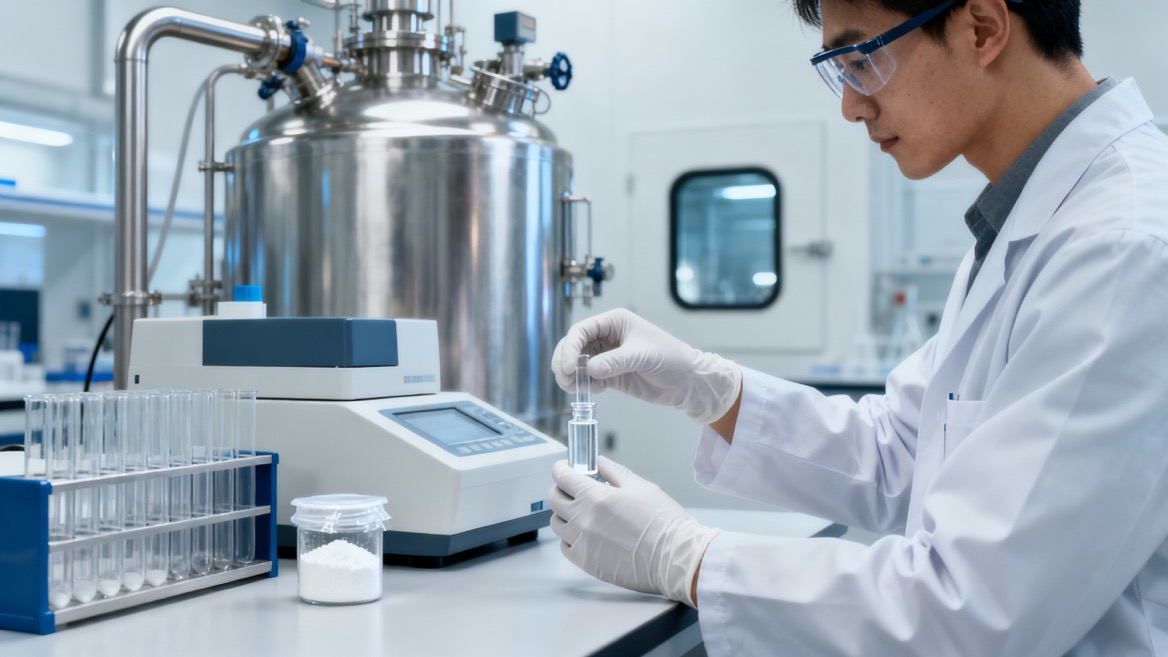
An important but frequently underexplained sourcing issue is the difference between chromatographic purity and the amount of active ingredient delivered in the purchased powder.
The reviewed TCI specification separately reports HPLC area purity and titration purity calculated on an anhydrous basis. Sigma-Aldrich also uses an anhydrous-basis specification for A0812. Those qualifiers materially affect comparison.
Before accepting two powders as equivalent, ask:
- Is the reported value HPLC area%, mass assay, or another measure?
- Is it reported as received or after correcting for water?
- Which impurities does the method detect?
- Are inorganic residues or added carriers controlled separately?
- Is the method suitable for distinguishing relevant related compounds?
A useful internal rule is to compare cost per conforming quantity of active material—not simply price per kilogram of powder.
For long-term purchasing, add another safeguard: lock the approved manufacturing site, production route, specification, and test methods into the quality agreement. Otherwise, a seller could change the upstream source while continuing to quote the same chemical name.
This is especially important when purchasing through a marketplace or reseller, where the commercial counterparty and actual producer may differ.
Avoid qualification documents that identify only the seller.
Request the legal manufacturer's name, production-site address, and batch traceability. If confidentiality prevents disclosure, determine whether an independent audit can verify the site.
Ask for samples tied to identifiable production lots rather than an untraceable "premium sample."
Where practical, evaluate more than one lot and retain sealed reference samples. Agree that commercial deliveries must meet the same approved specification.
Supplier catalogs describe Neu5Ac's roles in glycoconjugates and biological research. That information does not establish clinical efficacy for a particular topical formula.
Request evidence relevant to the proposed concentration, formulation, and claim. Distinguish ingredient-level experiments from testing on the finished product.
Reviewed products have specific storage requirements, including freezer storage and inert-gas protection for certain reagent grades.
Use the instructions for the exact SKU and grade. Before shipment, agree on packaging, acceptable transport conditions, shelf-life remaining on arrival, and the response to temperature excursions.
A small evaluation order establishes accessibility, not production strength.
Before signing a supply agreement, request evidence of available capacity, normal production campaigns, batch sizes, reorder lead times, and contingency arrangements.
Include:
- Intended application and destination market.
- Required quantity for evaluation and annual forecast.
- Target assay and reporting basis.
- Required origin declarations.
- Packaging preferences.
- Documentation requirements.
- Delivery location and commercial terms.
This reduces quotations based on incompatible grades.
Reconcile the specification, SDS, sample label, and certificate of analysis.
The chemical identifiers, supplier identity, lot number, and storage instructions should agree. Clarify inconsistencies before investing in formulation trials.
Evaluate the properties that matter to the finished product, such as dissolution, appearance, pH behavior, compatibility, and stability under the intended development protocol.
Do not extrapolate a successful water-solubility check into full formulation compatibility.
Use a pilot order to assess:
- Technical response time.
- Document accuracy.
- Batch consistency.
- Packaging integrity.
- Delivery performance.
- Handling of deviations.
This is also the appropriate stage to test claims of flexible service and efficient communication.
The supply agreement should define approved specifications, sampling and release procedures, change notification, complaint handling, and responsibilities for rejected or nonconforming material.
For imports from outside the EEA, confirm the applicable REACH position. Registration generally applies when a manufacturer or importer reaches one tonne per year of a substance, subject to applicable exemptions and arrangements. Below that threshold, other obligations can still apply.

The five companies serve different procurement needs.
ZHENYIBIO TECHNOLOGY INC is relevant to commercial cosmetic ingredient sourcing and customization discussions. CymitQuimica offers a Barcelona-based route for comparing brands and pack sizes. Merck/Sigma-Aldrich, TCI, and Thermo Fisher provide catalog materials useful for research and evaluation, with commercial cosmetic suitability requiring separate confirmation.
For long-term cooperation, prioritize an approved specification, a known manufacturing origin, repeatable batch quality, verified documentation, and demonstrated delivery performance.
To discuss a sialic acid powder project with ZHENYIBIO TECHNOLOGY INC, send your intended application, required specification, evaluation quantity, annual forecast, and delivery destination. Request a current sample package, representative batch certificate, manufacturing-origin statement, applicable certificates, and a project-specific OEM/ODM proposal. The company publishes alexxue@zhenyibio.com as its contact address.
Obtain the complete certificate, including its number, legal entity, covered sites, standard, scope, issuing body, and validity dates.
Search the certificate number or company name in IAF CertSearch and review the status and scope. The platform supports checking whether certificates are active, suspended, withdrawn, or expired.
If a record cannot be located, contact the issuing certification body directly. A missing search result should trigger investigation, not an automatic accusation of fraud.
Also verify that the certificate covers the relevant activity. Certification of distribution does not establish certification of the upstream manufacturing operation.
Not on purity alone.
Compare the complete specifications, production origin, impurity controls, intended-use documentation, storage requirements, and formulation performance. Reviewed reagent listings show that product descriptions and purity reporting differ across SKUs.
A replacement should pass your change-control process and be reviewed by the responsible technical and safety teams.
No. The European Commission explicitly states that an INCI name appearing in CosIng does not mean the ingredient is approved for cosmetic use. The applicable Cosmetics Regulation, its annexes, and the finished product's safety assessment remain decisive.
Ask for the exact material identity and have its proposed use assessed within the complete formulation.
Request a signed, product-specific declaration covering the production process, media, processing aids, and relevant cross-contact controls.
ZHENYIBIO's product page makes an animal-free fermentation claim, but the public statement alone does not disclose every process input.
If the claim is commercially important, define what "animal-free" means in your purchasing specification and establish the supporting documentation required for each supplier.
Splitting shipments does not change the annual substance quantity relevant to a particular importer's registration obligations.
The threshold concerns annual manufacture or import of the substance, not the size of an individual delivery. EU guidance also states that certain obligations continue below one tonne per year.
Confirm the importer of record, aggregate quantities, any applicable exemption, and whether an only representative arrangement covers the supply.
1. STANPA: Spain’s 2025 Cosmetics and Perfumery Industry Review, Published April 2026 — Market and export figures for the wider Spanish beauty sector.
2. Beauty Cluster: Organization and Industry Network — Collaboration across the beauty-industry value chain.
3. European Commission: Cosmetic Ingredient Database — Ingredient information and the limitations of CosIng.
4. European Union: Registering Chemicals Under REACH — Manufacturer and importer registration obligations.
5. ECHA: The One-Tonne Annual Registration Threshold — Guidance on annual substance quantities.
6. European Commission: RoHS Directive — Scope of restrictions for electrical and electronic equipment.
7. IAF CertSearch: Certificate Verification — Verification of accredited certification status and scope.


