


Views: 237 Author: ZHENYIBIO Publish Time: 2026-10-14 Origin: Site
Content Menu
● Why Source L Theanine Powder from China?
>> A Manufacturing Ecosystem with Several Production Routes
>> Regional Clusters Support Different Purchasing Priorities
>> What the Latest Market Evidence Actually Shows
● Selection Criteria: How to Evaluate a Qualified Supplier
● Technical Essentials Before Comparing Manufacturers
>> Purified L-Theanine and Standardized Tea Extract Are Different Products
>> Chemical Purity Does Not Automatically Establish L-Form Purity
>> CE and RoHS Are Not Appropriate Ingredient Quality Benchmarks
● Top 10 L Theanine Powder Manufacturers and Supply Candidates in China
>> 1. ZHENYIBIO TECHNOLOGY INC — A Candidate for Smaller Brands Seeking Development Support
>> 2. Zhejiang Tianrui Chemical Co., Ltd. — A Specialist for Documentation-Led Bulk Procurement
>> 3. Henan Julong Biological Engineering Co., Ltd. — A Fermentation-Oriented Volume Candidate
>> 4. Sichuan Tongsheng Amino Acid Co., Ltd. — An Amino-Acid Chemistry Candidate
>> 5. Zhejiang Quzhou Joy Chemical Co., Ltd. — A Specialist Ingredient Candidate
>> 6. Hangzhou Qinyuan Natural Plant High-Tech Co., Ltd. — A Candidate for Standardized Tea Ingredients
>> 7. Hunan Sunfull Bio-Tech Co., Ltd. — A Tea-Extract Portfolio Candidate
>> 8. Xi'an Lyphar Biotech Co., Ltd. — A Broad Ingredient-Sourcing Candidate
>> 9. Hunan Nutramax Inc. — A Botanical Supply-Chain Candidate
>> 10. Zhejiang Zhenyuan Biotech Co., Ltd. — An Emerging Biotech Candidate
● Comparison Table: Capacity, MOQ, and Certification Evidence
● Buyer's Guide: From Initial Inquiry to Approved Supplier
>> Verify the Factory Before Negotiating a Long-Term Contract
>> Use a Sample-to-Production Qualification Sequence
>> Compare Landed Cost, Not Just Price per Kilogram
>> Define Logistics and Change Control
● Insider Pitfall: A Valid Certificate Can Still Cover the Wrong Product
● Match the Supplier to the Project
● FAQs
>> 1. How Can I Check Whether a Manufacturer's ISO Certificate Has Expired?
>> 2. Does a 99% HPLC Result Prove That the Powder Is 99% L-Theanine?
>> 3. Can Fermentation-Derived L-Theanine Be Labeled Natural or Organic?
>> 4. Does a Supplier's GRAS Notice Cover My Product Automatically?
>> 5. What Should I Do If the Sample Passes but the Commercial Batch Fails?
Choosing an L Theanine Powder manufacturer requires more than comparing prices and purity percentages. For procurement managers, the central question is whether a supplier can consistently deliver the right material, from a traceable production site, with documentation that supports its intended application.
A useful supplier assessment therefore starts with five dimensions: manufacturing identity, certification validity, research capability, batch-level quality control, and delivery reliability. Customization matters as well, particularly for smaller brands that need technical communication and development support rather than a standard bulk shipment.
China offers a substantial sourcing base across botanical extraction, amino-acid chemistry, and biotechnology. A January 2026 industry report from Prof Research identifies China as a major production hub for both tea-derived and synthetic L-theanine, while highlighting the commercial importance of enzymatic and biosynthetic production routes.
This guide examines ten Chinese manufacturing and supply candidates, explains their different strengths, and provides a practical framework for qualifying a long-term partner.

L-theanine sourcing is not a single-process industry. Buyers may encounter material extracted from tea, manufactured through chemical synthesis, or produced using enzymatic or fermentation-related technologies. These routes differ in feedstocks, impurity profiles, economics, and the documentation needed to support origin claims.
China's advantage lies in the coexistence of these capabilities. A procurement team can investigate botanical specialists for tea-derived ingredients, amino-acid manufacturers for purified material, and biotechnology companies for fermentation-based supply.
However, a manufacturer's location does not establish how its particular L-theanine batch was produced. The production route must be confirmed at product and site level.
The companies examined here illustrate several regional concentrations:
- Zhejiang has specialist L-theanine and chemical-processing businesses, including Tianrui and Joy Chemical.
- Shaanxi, particularly Xi'an, has botanical and cosmetic-ingredient suppliers, including ZHENYIBIO and Lyphar.
- Hunan has established tea-extract and botanical-ingredient businesses, including Sunfull and Nutramax.
- Sichuan contributes amino-acid manufacturing expertise through Tongsheng.
- Henan contributes industrial fermentation capability through Julong.
A trade review published in March 2026 identified Shandong, Zhejiang, Shaanxi, Shanghai, and Yunnan as China's five leading plant-extract exporting provinces or municipalities in 2025. This describes the broader botanical-extract sector, not L-theanine alone.
Prof Research's January 2026 report estimates the global L-theanine market at approximately USD 80 million–130 million in 2026, with estimated growth in the 6.0%–9.5% range. These are commercial research estimates, not official customs totals or audited industry revenues.
The China Chamber of Commerce for Import & Export of Medicines & Health Products also described China as the largest producer and exporter of plant extracts at its July 2025 industry forum. Again, that statement concerns the broader extract industry and should not be presented as an L-theanine-specific market-share figure.
For buyers, the practical implication is straightforward: China offers a broad supplier base, but supplier qualification remains more important than national market positioning.
The shortlist uses six screening dimensions. These are procurement criteria, not claims that every company has passed a factory audit.
| Evaluation dimension | Evidence buyers should request | Why it matters |
|---|---|---|
| Manufacturing identity | Business license, production-site address, explanation of owned and outsourced processes | Distinguishes the actual producer from an export intermediary |
| Product identity | Specification, production route, batch COA, analytical methods | Confirms that quotations describe equivalent materials |
| Quality systems | Current certificates, scope, issuing body, covered site | Prevents reliance on expired or unrelated credentials |
| Technical capability | Impurity controls, method validation, development support | Supports formulation work and investigation of deviations |
| Supply reliability | Available capacity, batch schedule, release timeline, contingency plan | Separates theoretical capacity from deliverable supply |
| Customization | Written scope covering blending, packaging, specifications, or finished products | Prevents misunderstanding of OEM/ODM services |
The governing principle is traceability: commercial claims should connect to a specific legal entity, production site, product, and batch.
China's 2025 botanical-extract good manufacturing practice standard, T/CCCMHPIE 1.106-2025, provides a useful sector-specific reference. Its scope includes production management, testing, storage, transportation, traceability, recalls, and document control. It is a group standard, not proof that a particular supplier complies with it.
A tea extract containing 20% L-theanine is not interchangeable with a purified powder containing 98% or 99% L-theanine.
For example, Hangzhou Qinyuan publishes a theanine specification of 20%–60%, while ZHENYIBIO lists tea-derived options of 20%–98% and synthetic and microbial-fermented options at 99%. Buyers should obtain the exact specification applicable to their quotation rather than relying on a general product-page headline.
Define the following before requesting prices:
- Intended application: cosmetic, food, beverage, supplement, or research.
- Required assay and whether it is reported on an as-is or dry basis.
- Production route and permitted origin claims.
- Limits for moisture, microbial contamination, heavy metals, and relevant process impurities.
- Requirements for caffeine and other tea constituents.
- Physical properties needed for the formulation.
The "L" in L-theanine identifies a particular stereochemical form. A total-theanine result does not necessarily establish the proportion of L-theanine versus D-theanine.
Published analytical research demonstrates that theanine enantiomers can be separated and quantified using a chiral derivatization method followed by reversed-phase HPLC. Ask whether the supplier's method actually distinguishes the two forms.
This distinction is especially important when evaluating an unfamiliar process or changing manufacturing sites.

CE marking and RoHS should not be treated as primary certifications for bulk L Theanine Powder. RoHS concerns hazardous substances in electrical and electronic equipment, while CE marking applies to products covered by relevant European harmonization legislation. Neither provides a general certification of cosmetic-ingredient purity.
More relevant evidence includes applicable quality-system certificates, food-safety systems where appropriate, product specifications, safety documentation, and batch testing.
Environmental claims also need precision. An environmental management certificate does not, by itself, prove that an ingredient is organic, carbon-neutral, or produced using a particular feedstock.
Established: 2012
Location: Xi'an, Shaanxi
Reported markets: Asia, Europe, and the Americas, with sales in more than 50 countries.
ZHENYIBIO TECHNOLOGY INC focuses on natural plant-active cosmetic raw materials and related ingredient solutions. Its company profile reports a 10,000-square-meter production area and a 1,500-square-meter research and development center. These figures describe its overall facilities, not dedicated L-theanine capacity.
Its L Theanine Powder page lists THEANINE as the INCI name and presents tea-derived, synthetic, and microbial-fermented options. This creates a useful starting point for buyers comparing origin requirements and different formulation specifications.
The company reports testing capabilities covering assay, moisture, heavy metals, residual solvents, and microbiology, alongside cooperation with third-party testing organizations. These are supplier-reported capabilities that should be verified through current batch documents and laboratory reports.
For emerging cosmetic brands, ZHENYIBIO's proposed fit is a development-oriented relationship: specification selection, ingredient sourcing, formulation discussions, and coordinated customization. Its OEM/ODM offer should be translated into a written project scope covering responsibilities, trial quantities, packaging, testing, and deliverables.
Procurement perspective: Consider ZHENYIBIO when communication efficiency and support for smaller development projects matter. Evaluate cost-effectiveness through a like-for-like quotation; publicly available information does not establish that it has the lowest price or MOQ.
Verification priority: Confirm which site performs each production stage, the selected material's route, current certificate scope, and the exact OEM/ODM activities included.
Established: Not conclusively verified in the reviewed sources
Location: Longyou, Zhejiang
Reported markets: Business relationships in more than 30 countries and regions.
Tianrui specializes in the research, manufacture, and technical service of L-theanine and related amino-acid products. Its published company description reports quality systems aligned with ICH Q7 guidance, together with ISO 22000, ISO 14001, HACCP, Kosher, and Halal credentials. Current validity and product coverage still require verification.
An important documentary reference is GRAS Notice 501. FDA's inventory identifies it as chemically synthesized L-theanine and records a "no questions" response dated July 30, 2014; supporting industry documentation identifies Tianrui as the notifier. This should not be described as blanket approval of every product, application, or supplier.
Customization fit: Discuss agreed ingredient specifications, bulk packaging, and technical documentation. Finished-product private-label services are not established by the reviewed evidence.
Verification priority: Match the purchased material's process, specification, and intended use to the relevant regulatory documentation.
Established: 1997; its supplier profile reports development into bio-fermentation products from 2008
Location: Ruzhou, Henan
Market positioning: Industrial ingredient supply, including an international distributor listing for fermentation-derived L-theanine.
Julong's portfolio includes amino acids and other fermentation-related ingredients. Its profile reports a large overall industrial site, while published patent information identifies a method for producing L-theanine through fermentation using an engineered bacterium.
Prof Research's 2026 report cites an L-theanine production-capacity figure of 372 tons. The public description does not clearly establish the time basis or independently demonstrate currently available output, so this figure should be treated as report-cited capacity rather than a confirmed annual supply commitment.
Customization fit: Investigate industrial specifications, bulk supply programs, packaging, and scheduled deliveries. Do not assume consumer-product ODM capability.
Verification priority: Ask for demonstrated output, available allocation, maintenance schedules, and process-specific quality documentation.
Established: 2003
Location: Deyang, Sichuan
Market positioning: Amino acids, derivatives, and biochemical ingredients; detailed export-market shares were not verified.
Tongsheng's relevance is its specialization in amino-acid research and production. It is also included among the vendors examined in the 2026 L-theanine industry report. That supports its inclusion as a candidate, but not a claim that it leads the market by capacity or quality.
Customization fit: Discuss ingredient specifications and technically defined supply requirements. The reviewed evidence does not establish turnkey finished-cosmetic or supplement manufacturing.
Verification priority: Request the current L-theanine specification, production-site details, chiral-purity method, and certification package.
Established: Not verified in the reviewed sources
Location: Quzhou, Zhejiang
Market positioning: L-theanine for food-ingredient applications; principal export destinations were not verified.
Joy Chemical's published supplier profile identifies L-theanine production as its specialty. The company also appears in Prof Research's 2026 competitive landscape, where specialist Chinese chemical producers are discussed in relation to scalable and cost-focused supply.
Its narrow product focus makes it worth investigating when the requirement is a clearly defined bulk ingredient rather than a broad botanical purchasing basket.
Customization fit: Seek written confirmation of packaging, assay, and impurity specifications. Public evidence reviewed here does not establish finished-product private labeling.
Verification priority: Confirm the legal entity, active production address, current output, and certificates rather than relying on historical claims about manufacturing scale.
Established: Not verified in the reviewed sources
Location: Hangzhou, Zhejiang
Market positioning: Tea-processing ingredients; current principal export destinations were not verified.
Qinyuan describes itself as an integrated tea deep-processing enterprise combining research, industry, and trade. Its theanine page publishes a 20%–60% L-theanine specification.
That specification is the key purchasing distinction. Qinyuan may fit a project seeking a standardized tea ingredient, but buyers should not assume its published material is equivalent to 98%–99% isolated L-theanine.
Customization fit: Discuss tea-extract composition and standardization targets. Confirm whether higher-purity products are available and where they are produced.
Verification priority: Examine caffeine, catechins, color, carrier content, solubility, and active concentration alongside the theanine result.
Established: 2008
Location: Changsha, Hunan
Market positioning: Botanical ingredients for dietary supplements, beverages, cosmetics, and pharmaceuticals; destination-specific sales shares were not verified.
Sunfull's published portfolio includes L-theanine alongside EGCG, epicatechin, theaflavins, and tea polysaccharides. Its company profile reports ISO 9001, ISO 22000-HACCP, Kosher, and Halal credentials.
This breadth can be useful when a purchasing program involves multiple tea-derived ingredients rather than a single purified amino acid.
Customization fit: Discuss standardized botanical ingredients and coordinated multi-ingredient supply. Finished-product manufacturing should be confirmed separately.
Verification priority: Determine whether the quoted L-theanine is tea-extracted or produced by another route and verify the applicable certificate scope.
Established: Reported as 2001 in its company profile published through CPHI
Location: Xi'an, Shaanxi
Market positioning: Plant extracts and high-technology chemicals; current principal export markets were not verified.
Lyphar's published materials discuss L-theanine, and its company profile describes research and manufacturing activity in plant extracts and chemicals. Its broad portfolio can make it relevant to buyers consolidating several ingredient purchases.
However, a product article is not equivalent to evidence of dedicated L-theanine production. Manufacturing responsibility must be established before treating the company as the direct producer of a particular batch.
Customization fit: Investigate ingredient specifications, packaging, and sourcing coordination; confirm OEM/ODM capability project by project.
Verification priority: Clarify owned versus partner-manufactured processes. Public directories also show conflicting establishment dates, making business-license verification appropriate.
Established: 2008
Location: Changsha, Hunan
Reported market infrastructure: A wholly owned sales subsidiary in Los Angeles serving its international botanical business.
Nutramax reports planting bases and botanical-extract factories, with a particularly visible focus on natural sweeteners. It also appears in a commercial L-theanine market report's supplier list.
These facts support consideration as a botanical sourcing candidate, but they do not prove dedicated L-theanine manufacturing capacity. Buyers should distinguish its general extraction infrastructure from the production arrangements for the exact product being offered.
Customization fit: Discuss botanical ingredient sourcing and coordinated supply. Dedicated L-theanine customization and finished-product ODM services require written confirmation.
Verification priority: Establish current product availability, the manufacturing site, and whether L-theanine is produced internally or sourced through a partner.
Established: Not verified in the reviewed sources
Location: Shaoxing, Zhejiang
Market positioning: Biotechnology-produced L-theanine; principal commercial export markets were not verified.
FDA's 2026 inventory identifies Zhenyuan as the notifier for GRAS Notice 1311 concerning L-theanine produced by *Escherichia coli* CICC 11189s. This provides a specific process-related documentary lead.
A September 2026 regulatory discussion stated that FDA had not yet completed its review at that time. Buyers must check the live record before making any claim about the notice's current status. Submission alone is not equivalent to a completed "no questions" response.
Customization fit: Investigate process-specific ingredient supply and technical documentation. Finished-product OEM/ODM capability is not established by the reviewed sources.
Verification priority: Confirm commercial readiness, demonstrated capacity, process controls, and the current regulatory record.
| Company | Main sourcing focus | Public capacity information | L-theanine MOQ | Certification or regulatory evidence |
|---|---|---|---|---|
| ZHENYIBIO | Cosmetic ingredients and development support | Reports 10,000 m² overall production area; no dedicated L-theanine output figure | Quote required | Reports ISO 22000, quality-system, Kosher, and Halal credentials; verify current documents. zhenyibio |
| Tianrui | Specialist purified L-theanine | Current available output not verified | Quote required | Reports ISO 22000, ISO 14001, HACCP, Kosher, and Halal; GRN 501 is a relevant product-process reference. ingredientsnetwork+1 |
| Henan Julong | Fermentation-based bulk supply | 2026 report cites 372 tons; time basis and availability need confirmation | Quote required | Current certificate scope not verified. researchandmarkets |
| Tongsheng | Amino-acid manufacturing | Not verified | Quote required | Current L-theanine certificate package not verified. businessresearchinsights+1 |
| Joy Chemical | Specialist L-theanine | Not verified | Quote required | Current certificate package not verified. chemicalregister |
| Qinyuan | Standardized tea ingredients | Not verified | Quote required | Published 20%–60% theanine specification; current certificates not verified. hzqinyuan |
| Sunfull | Tea-extract portfolio | Dedicated L-theanine capacity not verified | Confirm product-specific MOQ | Reports ISO 9001, ISO 22000-HACCP, Kosher, and Halal. sunfullbio |
| Lyphar | Broad ingredient portfolio | Dedicated L-theanine capacity not verified | Quote required | Current product/site certificate scope not verified. cphi-online |
| Nutramax | Botanical supply-chain integration | Dedicated L-theanine capacity not verified | Quote required | General botanical infrastructure reported; product-specific credentials need confirmation. nutra-max |
| Zhenyuan | Biotech-produced L-theanine | Commercial output not verified | Quote required | FDA GRN 1311 identifies a specific production process; check current review status. hfpappexternal.fda+1 |
A quotation should distinguish sample quantity, stock-product MOQ, custom-production MOQ, and finished-product MOQ. A packing size is not automatically a minimum order commitment.
Ask the supplier to map the complete manufacturing chain:
1. Where are extraction, synthesis, or fermentation performed?
2. Where are purification, drying, blending, and packing performed?
3. Which legal entity releases the batch?
4. Which stages are subcontracted?
5. Does the certification cover those sites and activities?
For management-system certificates, use the issuing certification body and an accredited-certificate verification platform. IAF CertSearch allows searches by company name or certificate number and displays status, scope, issuing body, and covered details.
A live video visit can help establish identity, but it does not replace a qualified audit when the purchasing risk warrants one.
A practical qualification plan is:
- Agree on the specification before requesting a sample.
- Obtain a sample linked to an identifiable production lot.
- Test identity, assay, relevant impurities, and application performance.
- Compare results with the supplier's COA.
- Validate a pilot batch or first commercial lot.
- Define release criteria and change-control obligations before repeat orders.
For cosmetics, test the material in the intended formulation rather than assuming that oral-use evidence establishes topical performance. A 2025 scientific review cautions that evidence supporting many L-theanine health claims remains limited or inconsistent; ingredient sourcing should not turn preliminary research into unsupported finished-product claims.
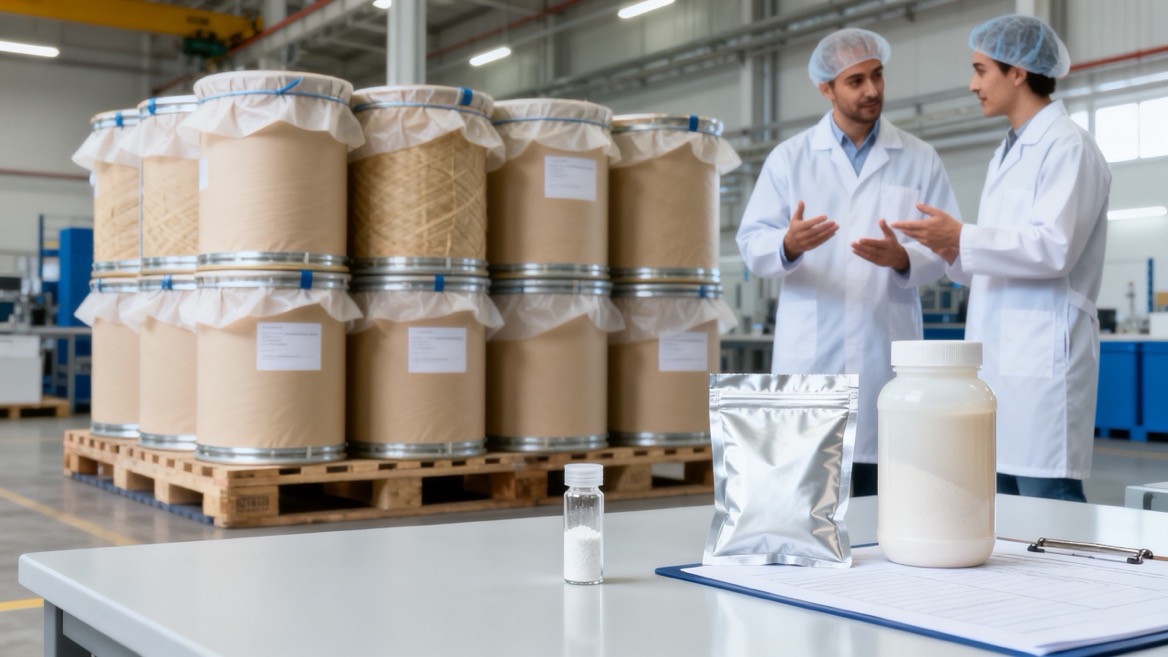
Build the comparison around equivalent materials and include:
- Assay and moisture basis.
- Freight and insurance.
- Applicable import duties and taxes.
- Independent testing.
- Repacking or additional documentation.
- Inventory requirements.
- Rejection, return, and replacement arrangements.
Comparing a 20% standardized extract with a 99% purified ingredient solely by powder price produces a misleading result. Their active concentrations and accompanying constituents differ materially.
Request packaging specifications, recommended storage conditions, shelf-life support, lot-label examples, and transport documentation.
Have the importing broker confirm classification using the actual composition and production information. Do not assume that every tea extract and isolated L-theanine product uses the same customs classification.
The quality agreement should also require notification before changes to production site, feedstock, manufacturing route, analytical method, or packing arrangement. The 2025 botanical-extract manufacturing standard's coverage of storage, transport, traceability, and document control offers a useful framework for these discussions.
One of the most consequential sourcing risks is certificate substitution: a supplier presents a genuine credential, but it covers a different ingredient or process.
The American Botanical Council's May 2026 industry alert describes a case involving 98% L-theanine marketed as organic. According to the alert, the certifier had not approved that high-purity product as organic, although the supplier had an organic green-tea extract certification. The alert also reports analytical investigation of the material's origin.
The purchasing lesson is broader than organic claims:
- A certificate for green-tea extract does not automatically cover isolated L-theanine.
- A general factory credential does not prove the origin of a particular batch.
- A high assay does not prove botanical extraction.
- "Natural," "fermented," and "organic" require different supporting evidence.
To reduce this risk, connect the certificate to the exact product name, manufacturing site, approved scope, and batch records. When origin is commercially important, discuss appropriate analytical verification with a qualified laboratory. The ABC alert specifically recommends analytical scrutiny of natural-origin claims.
The most useful shortlist depends on the purchasing requirement.
Tianrui, Joy Chemical, Tongsheng, and Julong provide different specialist manufacturing leads. Qinyuan and Sunfull deserve attention for tea-ingredient projects. Lyphar and Nutramax require clear confirmation of product-specific manufacturing arrangements, while Zhenyuan offers a newer biotech process to investigate. ZHENYIBIO is positioned for buyers seeking cosmetic-ingredient support and a development-oriented relationship.
Before selecting any company, confirm the actual manufacturing site, exact grade, production route, available capacity, current certificates, and batch-release evidence.
For a project-specific discussion with ZHENYIBIO TECHNOLOGY INC, send your intended application, destination market, required assay, origin preference, trial quantity, and customization requirements. Request the applicable specification, sample-linked COA, current certification documents, and written OEM/ODM scope before approving a purchase.
Request the complete certificate, including its number, standard, legal entity, site, scope, issuing body, and validity dates.
Search the certificate number or company name in IAF CertSearch and confirm the status with the issuer when necessary. Review suspension and withdrawal status, not just the printed expiry date. A certificate covering trading activity is not equivalent to one covering manufacture at the quoted site.
Not necessarily. Ask what the assay measures, how it is calculated, and whether the method separates L-theanine from D-theanine.
A validated enantiomer-specific method is needed to establish the stereochemical composition. Published work demonstrates separation and quantification of the two forms using chiral derivatization and HPLC.
Also clarify whether "99%" means calibrated content, dry-basis assay, or chromatographic area percentage.
Do not infer either claim from the word "fermentation."
Require a process description and market-specific justification for a natural claim. For organic positioning, require product-specific certification and confirm coverage directly with the certifier. The documented 2026 organic-labeling alert shows why a certificate for another tea ingredient is insufficient.
No. Review the substance specification, production process, intended uses, and use levels relevant to the notice.
FDA's inventory distinguishes chemically synthesized L-theanine, tea-extracted L-theanine, and a newer biotech-produced material. These are specific records, not a universal certificate for every L-theanine powder or application.
An oral food-use record also does not establish cosmetic efficacy.
First confirm that the results are comparable: sampling, analytical method, reference standard, moisture basis, and laboratory procedures may affect interpretation.
Then examine batch identity, production records, subcontracting, and any changes in site or process. Keep retained samples and define investigation, rejection, replacement, and corrective-action responsibilities in the quality agreement.
The 2025 botanical-extract manufacturing standard explicitly addresses traceability, nonconforming products, recalls, and document control, making those subjects appropriate elements of supplier qualification.
- ZHENYIBIO company profile and L Theanine Powder product page—supplier-reported facilities, capabilities, and available product options. [zhenyibio]
- China Chamber of Commerce for Import & Export of Medicines & Health Products: "18th Natural Extract Innovation and Development Forum," July 2025—industry context and export-sector discussion. [cccmhpie.org]
- China Chamber of Commerce for Import & Export of Medicines & Health Products: T/CCCMHPIE 1.106-2025 announcement—botanical-extract manufacturing and quality-management scope. [cccmhpie.org]
- China Traditional Chinese Medicine News: "2025 Plant Extract Import and Export Trade Observation," March 2026—broader botanical-export geography, not L-theanine-specific statistics. [cntcm.com]
- U.S. FDA GRAS inventory: L-theanine entries, including GRN 501—check the substance, process, response, and intended-use details. [cfsanappsexternal.fda]
- U.S. FDA GRN 1311: Biotechnology-produced L-theanine notified by Zhejiang Zhenyuan Biotech—check the current record before relying on its status. [hfpappexternal.fda]


