


Views: 264 Author: ZHENYIBIO Publish Time: 2026-10-10 Origin: Site
Content Menu
● Silk Peptide vs. Dimethicone: The Essential Differences
● What Is Silk Peptide in Hair Care?
>> Why Molecular Weight and Active Content Matter
>> What Hydrolyzed Silk Can Contribute
● What Is Dimethicone in Hair Serums?
>> Why Dimethicone Creates Slip
>> What Dimethicone Does Not Prove
● Silk Peptide vs. Dimethicone for Hair Serum Performance
>> Smoothness, Detangling, and Shine
>> Frizz Control and Humidity Resistance
>> Fine Hair, Damaged Hair, and Residue
● Formulation Compatibility: Why Silk Is Not a Drop-In Silicone Replacement
>> Developing a Silicone-Free Silk Peptide Hair Serum
>> Combining Silk Peptide and Dimethicone
● Safety, Natural Origin, and Vegan Positioning
>> Natural Silk Is Not Plant-Based
● Sustainability and Silicone Regulation: Separate the Questions
>> Dimethicone Is Not D4, D5, or D6
● A Practical Benchmarking Protocol for Premium Hair Serums
>> Step 1: Establish Four Prototypes
>> Step 2: Standardize the Test Conditions
>> Step 3: Measure Consumer-Relevant Outcomes
>> Step 4: Match Claims to Results
● OEM and ODM Purchasing: Compare More Than Price per Kilogram
● Build the Serum Around a Verifiable Promise
>> Is silk peptide better than dimethicone for damaged hair?
>> Can silk peptide replace dimethicone completely?
>> Is a silk peptide hair serum vegan?
>> Does dimethicone always cause buildup?
>> Can silk peptide and dimethicone be used together?
>> Does either ingredient guarantee heat protection?
Silk peptide vs. dimethicone is more than a natural-versus-synthetic debate. For premium hair serums, it is a choice between different conditioning mechanisms, formulation requirements, and brand promises. Silk-derived peptides offer protein-based conditioning, while dimethicone delivers surface lubrication and a smooth finish. Neither automatically creates the better product.
My starting point for this comparison is performance: what should the serum do, for which hair type, and under what conditions? That approach helps brands avoid attractive ingredient stories that fail to translate into noticeable results.
For ZHENYIBIO TECHNOLOGY INC, a manufacturer focused on botanical actives and modern biofermentation, the distinction also matters commercially. Traditional silk is animal-derived—not a plant active—and should be positioned transparently within any OEM or ODM development brief.

| Comparison point | Silk peptide | Dimethicone |
|---|---|---|
| Ingredient identity | Peptides obtained by hydrolyzing silk proteins | Synthetic silicone polymer |
| Common label terminology | Hydrolyzed Silk; exact identity depends on the material | Dimethicone |
| Main conditioning approach | Protein-based conditioning with grade-dependent film behavior | Surface lubrication and film formation |
| Formulation fit | Typically water-based systems | Silicone-compatible systems or suitable emulsions |
| Sensory direction | Softness; finish depends on peptide grade and formula | Slip, smoothness, and gloss |
| Vegan suitability | Conventional silk is not vegan | Generally compatible with vegan positioning; verify the full formula |
| Replacement potential | Not a direct, universal dimethicone substitute | Not a substitute for a protein-conditioning story |
| Main development question | Does this grade improve the finished serum? | Does this viscosity and dose deliver the desired finish? |
The practical conclusion is straightforward: silk peptide and dimethicone can serve different roles. A silicone-free serum requires a redesigned conditioning system, not simply a one-for-one ingredient swap.
Silk peptide is a commercial description rather than one universally standardized cosmetic ingredient. It generally refers to smaller protein fragments produced through silk hydrolysis.
Silk contains two principal proteins: fibroin and sericin. Hydrolysis breaks proteins into smaller fragments, using processes such as acid, alkaline, or enzymatic treatment.
For purchasing teams, the important details are the declared ingredient name, protein source, molecular-weight distribution, and active content.
Two materials sold as "silk peptide" may behave differently.
The Cosmetic Ingredient Review safety assessment describes supplier materials with average molecular weights of approximately 300 and 650 daltons. It also documents different aqueous supply concentrations. These are examples, not specifications that apply to every commercial grade.
Smaller fragments and larger protein fractions can behave differently in a formula. However, a low molecular weight alone does not prove superior penetration, stronger hair, or better consumer results.
Request the actual specification instead of relying on the product name.
Hydrolyzed silk is recognized as a hair-conditioning ingredient. In a suitable serum, it can contribute to a protein-based conditioning system and help support a softer hair feel.
The limits deserve equal attention:
- Ingredient functionality does not prove finished-product efficacy.
- Conditioning should not be described as permanent structural repair.
- General protein research cannot establish the performance of one silk grade.
- A silk-containing serum needs its own testing before making quantified claims.
The strongest silk peptide story connects ingredient identity with demonstrated product benefits.
Dimethicone is a silicone polymer, also known as polydimethylsiloxane. Cosmetic grades vary in viscosity, so the ingredient name does not describe one identical sensory experience.
In hair care, silicone films can reduce friction, improve smoothness, and enhance shine. Dimethicone is therefore useful when a premium serum must spread easily and leave an immediately polished finish.
Damaged hair surfaces can generate more friction during handling. Lubricating the surface helps strands move past one another with less resistance.
Dimethicone supports this surface-conditioning approach. Its contribution depends on viscosity, concentration, delivery system, and the other ingredients.
A serum can consequently feel lightweight or substantial while listing the same silicone ingredient.
Dimethicone is not evidence of permanent hair repair. Nor does its presence establish a specific heat-protection temperature or a guaranteed duration of frizz control.
Those claims require testing on the finished product.
Its synthetic origin also does not make it inherently unsafe. Published safety assessments support dimethicone's cosmetic use under the practices evaluated.
For immediate slip, dimethicone is a logical benchmark because lubrication is central to its function.
Silk peptide may contribute softness and conditioning, but formulators should not assume that it reproduces a silicone serum's glide. The supporting emollients, conditioning agents, and film-forming ingredients matter.
Compare finished formulas using:
- Wet and dry combing measurements.
- Blinded sensory evaluation.
- Standardized photography or gloss measurement.
- Consistent application doses.
A "silky" description should reflect the whole experience, not the ingredient name.
Frizz performance depends on the complete formulation and the environment in which it is used.
Dimethicone's film-forming behavior can support smoothing, but the outcome remains formula-dependent. Silk peptide alone should not be presented as equivalent humidity protection without comparative evidence.
For a silicone-free anti-frizz serum, assess the broader conditioning system under controlled humidity. Include repeated applications and evaluate whether the finish remains acceptable.
Fine hair often requires a lower-residue finish. Chemically treated hair may need more substantial conditioning.
Neither requirement automatically selects silk peptide or dimethicone. Dose, deposition, and the overall formula determine whether hair feels soft, coated, limp, or manageable.
Similarly, buildup is not an inevitable consequence of every dimethicone serum. Evaluate repeated use alongside the intended cleansing routine. A silicone-free formula can also leave unwanted residue.
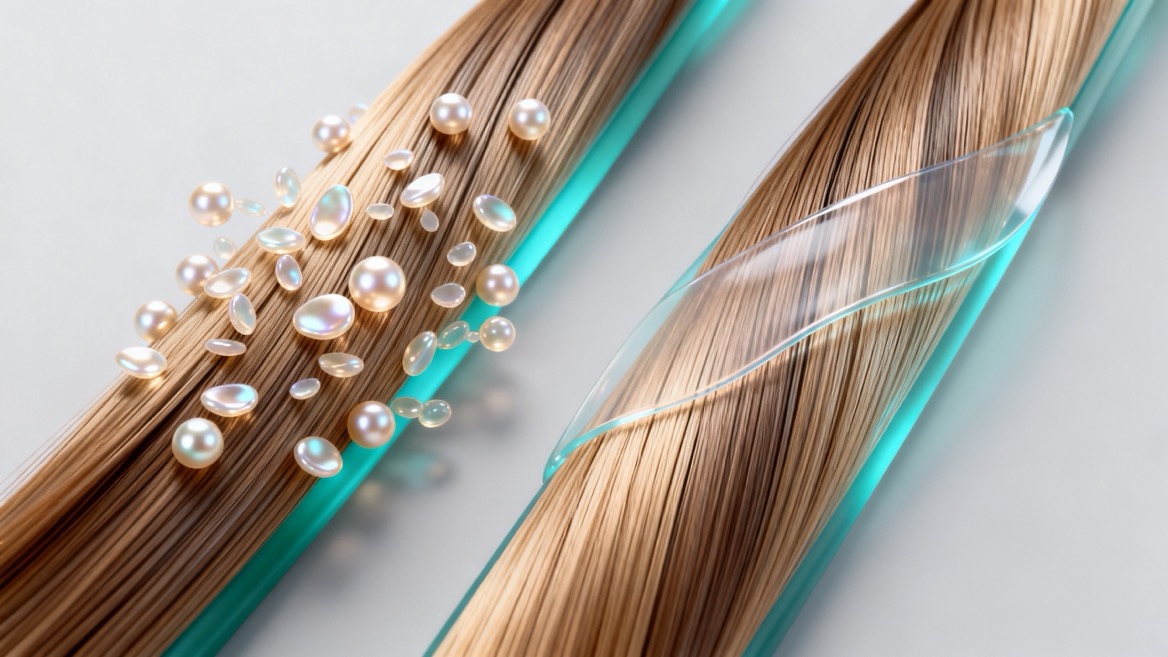
Hydrolyzed silk is commonly supplied as a water-soluble material. Dimethicone requires a compatible formulation environment or an appropriate emulsification system.
That difference affects product architecture.
An anhydrous silicone serum cannot necessarily accept an aqueous silk solution without changes to stability, appearance, preservation, and packaging.
A useful development sequence is:
1. Define the target finish: lightweight, creamy, glossy, or barely perceptible.
2. Confirm the silk grade's active content and processing requirements.
3. Build a compatible water-based or emulsified system.
4. Select supporting conditioning ingredients.
5. Test preservation, stability, sensory quality, and package compatibility.
There is no universal silk peptide dosage suitable for every serum. Start with the supplier's grade-specific guidance, then optimize through trials.
A hybrid serum is another valid option when the brand does not require silicone-free positioning.
The development hypothesis is complementary functionality: protein-based conditioning alongside silicone lubrication.
Nevertheless, "synergy" remains a claim to demonstrate. Compare the hybrid against silk-only, dimethicone-only, and base formulas before attributing additional benefits to the combination.
The published silk protein assessment concluded that eight reviewed ingredients were safe under the practices and concentrations described. It found insufficient information for two others: MEA-Hydrolyzed Silk and Silkworm Cocoon Extract.
These distinctions matter. A conclusion about Hydrolyzed Silk should not be extended indiscriminately to every silk-related ingredient.
Finished-serum safety also depends on preservatives, fragrance, impurities, exposure, and the complete formulation.
Conventional cosmetic silk comes from silkworm-derived material. It is not botanical and does not fit a conventional vegan claim.
For ZHENYIBIO's plant-active positioning, this creates a clear decision:
- Use traditional silk with transparent animal-origin disclosure.
- Develop a silk-free botanical conditioning concept.
- Investigate a documented fermentation-derived protein option.
A fermentation-derived material should not be called vegan silk merely because fermentation appears in its manufacturing story. Verify identity, feedstocks, processing inputs, and applicable certification criteria.
"Natural" and "synthetic" are insufficient environmental assessments.
For silk, relevant questions include sourcing, recovery of textile by-products, hydrolysis inputs, wastewater treatment, and traceability.
For dimethicone, assess manufacturing information, environmental fate, residual cyclic siloxanes, and the overall formula.
Neither ingredient name alone proves a lower environmental footprint.
D4, D5, and D6 are cyclic siloxanes. They are chemically distinct from the linear polymer dimethicone.
Commission Regulation (EU) 2024/1328 extends restrictions on these cyclic substances. For leave-on cosmetics, the relevant provisions apply after 6 June 2027, with a restriction threshold of 0.1% by weight for each respective substance, subject to the regulation's provisions.
This is not a blanket ban on dimethicone.
For export projects, request residual cyclic-siloxane documentation and assess the actual finished formula against destination-market requirements.
Rather than selecting an ingredient through preference alone, use a controlled comparison.
This proposed workflow is a development framework—not a report of ZHENYIBIO test results.
Compare:
- A conditioning base without either ingredient.
- A silk peptide prototype.
- A dimethicone benchmark.
- A hybrid prototype, if commercially relevant.
Keep supporting ingredients comparable where technically possible. Document unavoidable differences in formulation architecture.
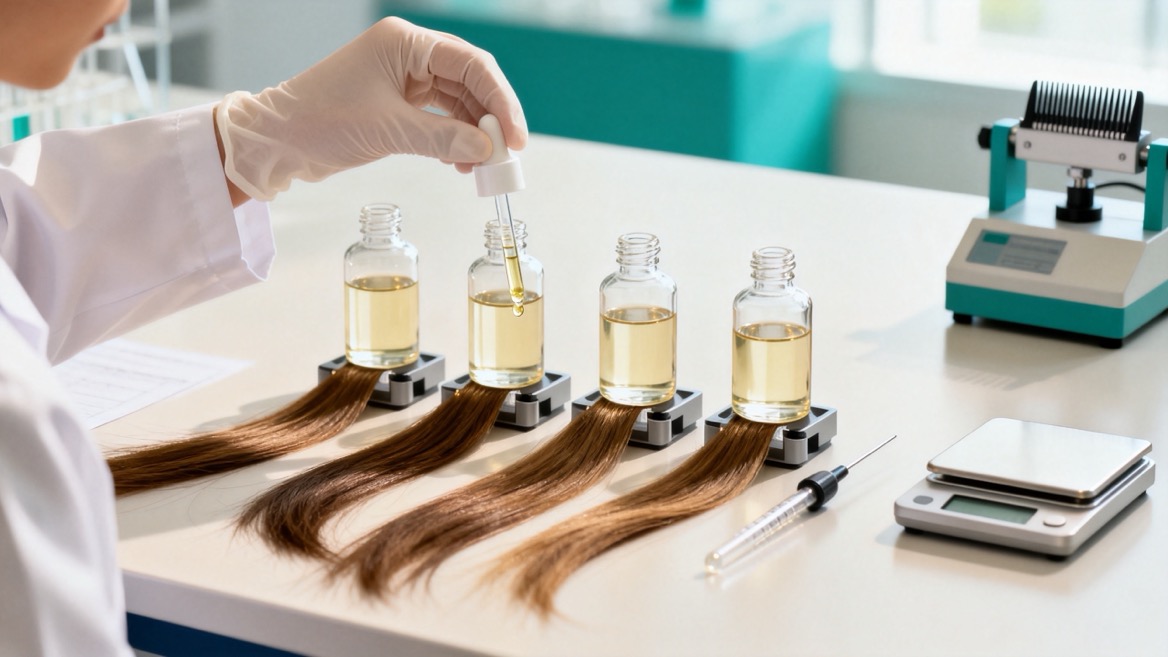
Use matched hair tresses, including virgin and bleached hair where relevant.
Control application amount, washing procedure, drying method, temperature, and humidity. Include multiple tresses and repeated measurements.
Assess combing resistance, smoothness, gloss, frizz, residue, and repeated-use feel.
For heat-protection claims, add a defined heat-damage protocol. For breakage claims, measure breakage rather than substituting a softness score.
"Improves manageability" and "reduces combing force by a measured percentage" require different levels of evidence.
Record the comparator, method, sample conditions, and limitations. This creates a stronger commercial dossier than broad ingredient claims.
A low raw-material price can conceal a low active concentration or additional processing requirements.
For silk peptide, request:
- Full ingredient declaration and carrier composition.
- Protein or active-solids content.
- Molecular-weight information.
- Certificate of analysis and microbiological specifications.
- Origin, traceability, and supporting efficacy information.
For dimethicone, request viscosity, purity, residual cyclic-siloxane information, and compatibility guidance.
Compare cost in the finished serum, not simply delivered price.
For ZHENYIBIO OEM and ODM discussions, define the target market, sensory benchmark, vegan requirements, acceptable ingredients, packaging, and substantiation plan before choosing the conditioning platform.
Choose silk peptide for a transparently sourced protein-conditioning concept. Choose dimethicone when surface lubrication and a polished finish are priorities. Consider a hybrid when both functions fit the brand.
Send ZHENYIBIO TECHNOLOGY INC your target-market requirements, reference serum, desired finish, and ingredient restrictions to discuss an OEM or ODM development brief. Make documented identity, measurable benefits, and repeatable product quality the foundation of your premium positioning.
Not universally. Silk peptide supports protein-based conditioning, while dimethicone supports lubrication. Compare the finished products on damaged hair using combing, breakage, and sensory tests.
It can be part of a silicone-free redesign, but it is not a universal one-for-one substitute. Matching silicone slip may require several supporting ingredients and a different formulation structure.
A serum containing conventional silkworm-derived silk is not vegan. Alternative protein routes require documented sourcing and verification of the complete manufacturing process.
No. Residue depends on formulation, application amount, repeated use, hair characteristics, and cleansing. Evaluate the intended routine instead of making an ingredient-wide assumption.
Yes, with an appropriate formulation system. Their different functions provide a reasonable development rationale, but compatibility and any claimed combined benefit need testing.
No. Ingredient presence does not establish protection at a specific temperature. Substantiate the finished serum under defined application and heat-exposure conditions.
1. Cosmetic Ingredient Review. *Safety Assessment of Silk Protein Ingredients as Used in Cosmetics*. Final report released February 8, 2016; subsequently published in the *International Journal of Toxicology*. Supports silk ingredient identity, manufacturing examples, molecular-weight distinctions, conditioning functions, and ingredient-specific safety conclusions. [cir-safety]
2. Cosmetic Ingredient Review Expert Panel. *Final Report on the Safety Assessment of Stearoxy Dimethicone, Dimethicone, Methicone, and Related Ingredients*. *International Journal of Toxicology*, 2003. Supports the discussion of dimethicone identity and cosmetic safety under the evaluated conditions of use. [pubmed.ncbi.nlm.nih]
3. Dias, Maria Fernanda Reis Gavazzoni. *Hair Cosmetics: An Overview*. *International Journal of Trichology*, 2015. Provides background on hair damage, conditioning, friction reduction, silicones, and the importance of complete formulations. [pmc.ncbi.nlm.nih]
4. *With or without Silicones? A Comprehensive Review of Their Role in Hair Care*. Published 2025; indexed in PubMed. Supports the discussion of silicone films, reduced friction, moisture-loss reduction, and shine. [pubmed.ncbi.nlm.nih]
5. European Commission. *Commission Regulation (EU) 2024/1328 of 16 May 2024*. Official legal text concerning restrictions on D4, D5, and D6, including the applicable cosmetic transition provisions. Supports the regulatory discussion; it does not establish a blanket dimethicone prohibition. [eur-lex.europa]
6. Belgium Federal Public Service Health, Food Chain Safety and Environment. *Siloxanes*. Updated April 22, 2026. Provides official explanatory context on cyclic siloxanes, environmental concerns, and transition periods. [health.belgium]


