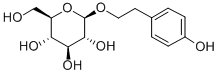
★Which cosmetic end products are suitable for adding Salidroside?
Salidroside has excellent water solubility and compatibility, making it suitable for a wide range of cosmetic formulations, including but not limited to:
- Serums and essences (anti-aging, brightening, antioxidant)
- Moisturizers and creams (hydrating, barrier-repairing)
- Face masks (sheet masks, cream masks, sleeping masks)
- Sunscreen products (enhancing UV protection and reducing post-sun damage)
- Eye care products (reducing fine lines and dark circles around the eyes)
- Sensitive skin care products (soothing and anti-irritating)
★What is the recommended addition level of Salidroside in cosmetic products?
The recommended addition level of Salidroside varies slightly according to product type and functional positioning, and it is generally recommended to use it within the range of 0.1% - 2.0%:
- Basic maintenance products (moisturizers, toners): 0.1% - 0.5%
- Functional products (anti-aging, brightening serums/essences): 0.5% - 1.5%
- High-concentration targeted products (anti-aging creams, repair masks): 1.0% - 2.0%
★Can Salidroside be used in products for sensitive skin ?
Salidroside is mild and has a soothing effect on the skin, making it suitable for sensitive skin products when used at the recommended addition level (0.1% - 0.5%)
★Does Salidroside have any restrictions on use in different regions (such as EU, US, China)?
Salidroside is not a prohibited ingredient in major regions such as the EU, US, and China, but there are slight differences in compliance requirements:
★Which cosmetic brands use Salidroside ?
Most brands use standardized Rhodiola root extract with marked salidroside ratio, rather than pure isolated salidroside monomer in finished cosmetics.
★Is your Salidroside 100% natural?
Yes,it is extracted from Rhodiola rosea root.
★What is the solubility of Salidroside for cosmetic formulation?
Highly soluble in water
Easily dissolved in purified water, aqueous phase formulas, hydrosols, serums, toners.
Soluble in propylene glycol, butanediol (BG), glycerin
Perfect for common cosmetic polyol moisturizers, very stable in water-glycol systems.