


Views: 294 Author: ZHENYIBIO Publish Time: 2026-10-03 Origin: Site
Content Menu
● Why Post-Laser Redness Requires a Different Formulation Strategy
● Asiaticoside vs. Bisabolol: Key Differences at a Glance
● What Is Asiaticoside, and Why Does It Interest Skincare Developers?
>> Asiaticoside and Skin-Recovery Research
>> Formulation Considerations for Asiaticoside
● What Is Bisabolol, and How Does It Support Soothing Formulas?
>> Bisabolol and Irritation-Related Research
>> Bisabolol Safety Requires Product-Level Evaluation
● What Does the Human Post-Laser Evidence Actually Show?
>> The Tested Ingredient Was a Standardized Extract
>> The Studied Concentration Was Not a Universal Dosage Recommendation
>> Statistical Significance Does Not Guarantee the Same Commercial Result
● Choosing Asiaticoside or Bisabolol for Different Product Briefs
>> For a Centella-Led Recovery-Support Concept
>> For an Oil-in-Water Soothing Moisturizer
>> For a Combined Asiaticoside and Bisabolol Formula
● A Five-Step Testing Plan for Post-Laser Skincare Development
>> 1. Define the Intended Recovery Stage
>> 2. Establish Comparable Prototype Groups
>> 3. Evaluate Stability and Microbiological Quality
>> 4. Design a Relevant Tolerability Study
>> 5. Measure Outcomes Separately
● Procurement Insight: Compare the Actual Active, Not the Ingredient Label
● Sustainability and Fermentation: Ask for Verifiable Details
● Build a Better-Documented Soothing Product
>> Is Asiaticoside Better Than Bisabolol for Post-Laser Redness?
>> Can Asiaticoside and Bisabolol Be Used Together?
>> Can Either Ingredient Be Applied Immediately After Ablative Laser Treatment?
>> Is Asiaticoside the Same as Centella Asiatica Extract?
>> Does Bisabolol Replace a Barrier-Supporting Moisturizer?
>> What Concentration Should a Brand Use?
Asiaticoside vs. bisabolol is more than a comparison between two botanical skincare ingredients. For brands developing products for post-laser redness, it is a question of evidence, formulation compatibility, and appropriate use. Asiaticoside belongs to the triterpenoid compounds associated with Centella asiatica, while bisabolol is a sesquiterpene alcohol widely used for skin conditioning.
The practical distinction is evidence: standardized Centella extracts have some human research directly involving laser-treated skin, but those findings cannot automatically be attributed to isolated asiaticoside. Bisabolol has a substantial soothing and safety literature, yet the sources reviewed here do not establish its superiority for post-laser redness.
From a formulation-development perspective, neither ingredient should be selected by reputation alone. The better choice depends on the finished product, the recovery stage, and the claims a brand can genuinely support.
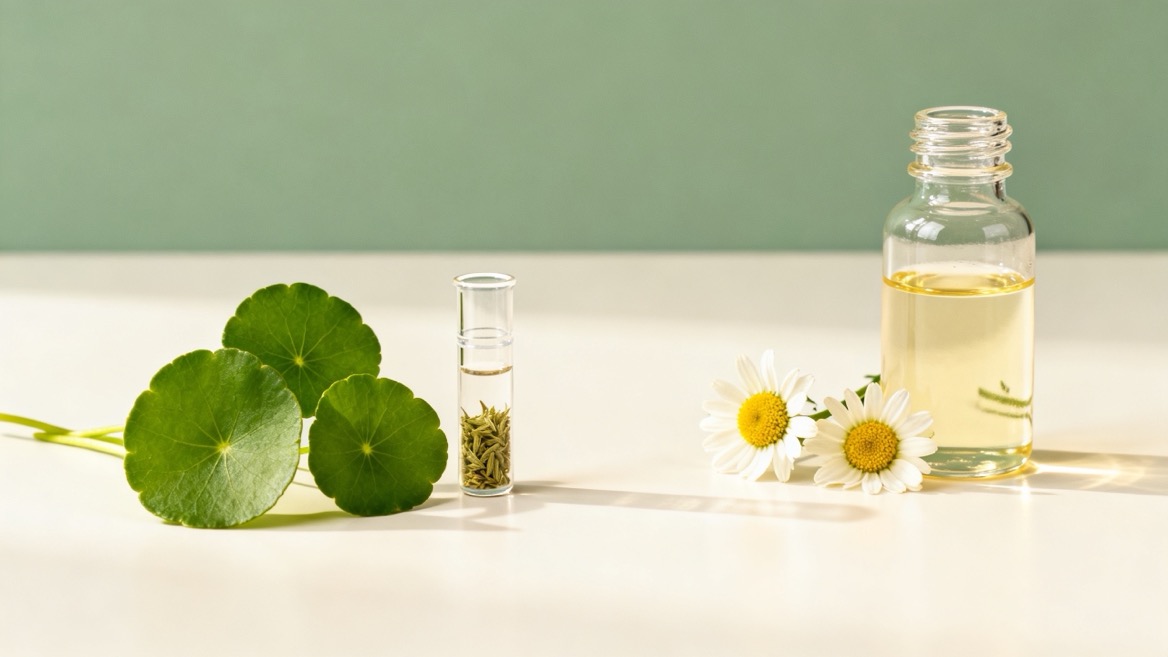
Laser treatments differ considerably. Ablative resurfacing disrupts the skin surface, while nonablative treatments generally leave it more intact. Treatment intensity, the anatomical site, and individual skin characteristics also influence recovery.
Consequently, "post-laser skincare" is not one uniform product category.
A cosmetic suitable for intact, sensitive skin may be inappropriate immediately after ablative resurfacing. During that early stage, patients should use only products approved by their treating clinician.
For product developers, this creates two distinct briefs:
- Clinician-directed care during the immediate recovery period.
- Cosmetic moisturization and comfort support after the skin has sufficiently recovered.
This distinction should guide ingredient selection, testing, instructions, and packaging. A soothing botanical does not make an ordinary cosmetic suitable for an open treatment site.
Increasing redness accompanied by worsening pain, swelling, fever, or unusual drainage requires clinical assessment rather than another skincare active.
| Comparison point | Asiaticoside | Bisabolol |
|---|---|---|
| Chemical family | Pentacyclic triterpenoid glycoside | Sesquiterpene alcohol |
| Botanical association | Centella asiatica | Chamomile and other botanical sources |
| Main development interest | Centella-associated recovery and skin-conditioning research | Soothing and anti-irritant formulation applications |
| Post-laser evidence | Relevant human evidence exists for standardized Centella extracts, not necessarily isolated asiaticoside | Direct post-laser comparative evidence remains limited in the reviewed sources |
| Formulation consideration | Grade-specific solubility, dispersion, and delivery must be established | Lipophilic character favors oil-phase incorporation |
| Main purchasing question | What is the actual asiaticoside content and broader triterpenoid profile? | What are the purity, source, and isomer specifications? |
| Important limitation | Extract results cannot be transferred automatically to a purified molecule | General soothing evidence does not prove laser-recovery efficacy |
Both ingredients are terpene-derived, but their chemistry differs substantially. Sharing a broad chemical origin does not make them interchangeable.
Asiaticoside is a triterpenoid glycoside found in Centella asiatica. Its structure includes a triterpenoid component linked to sugars.
Centella also contains madecassoside, asiatic acid, and madecassic acid. These names represent different compounds, not alternative labels for the same ingredient.
That distinction matters commercially. A Centella extract, a standardized triterpenoid mixture, and purified asiaticoside may have different compositions, processing requirements, and evidence packages.
Experimental research associates Centella constituents with processes relevant to wound repair, including inflammatory signaling, extracellular-matrix activity, and collagen-related responses.
However, laboratory findings do not establish that a cosmetic serum will accelerate recovery after laser treatment.
My starting point when evaluating this ingredient would be the identity of the tested material. Was the study conducted on purified asiaticoside, a mixture of triterpenoids, or a finished formulation?
Without that answer, even an impressive research summary can mislead a product-development team.
Do not assume that the presence of sugar groups makes every asiaticoside grade straightforward to dissolve in water.
Developers should verify:
- Solubility and dispersion in the actual formulation.
- Compatibility with the selected processing conditions.
- Appearance and crystallization during storage.
- Active-content stability over the proposed shelf life.
- Whether delivery-system excipients affect tolerability.
A clear prototype is not proof of long-term stability or adequate delivery.
Alpha-bisabolol is a lipophilic sesquiterpene alcohol associated with botanical sources including chamomile. It is used in cosmetics as a skin-conditioning ingredient.
Unlike purified asiaticoside, bisabolol generally fits naturally into the oil phase of an emulsion. This makes it an attractive candidate for creams and lotions designed to combine moisturization with a soothing ingredient story.
Reviews describe anti-inflammatory and antioxidant activity across experimental models. Human investigations also include formulations containing bisabolol for inflammatory skin conditions.
These findings support further formulation development, but they require careful interpretation.
A product containing bisabolol alongside other active ingredients does not demonstrate that bisabolol alone caused the observed benefit. Likewise, evidence from eczema, experimentally irritated skin, or other wound types is not equivalent to evidence from laser resurfacing.
Cosmetic safety assessments support bisabolol's use under evaluated conditions. That does not mean every concentration, formulation, or application site is equally appropriate.
The full formula still needs assessment. Relevant variables include emulsifiers, preservatives, fragrance, solvents, packaging, and the intended condition of the skin.
A botanical origin should never be treated as a guarantee of zero irritation or allergy.
A useful clinical example involved 30 participants with facial acne scars treated using a 2940 nm Er:YAG laser.
In this randomized, double-blind, split-face study, one side received a gel containing 0.05% standardized Centella extract, ECa 233. The other side received a placebo gel.
The extract-treated side showed a statistically significant reduction in erythema across follow-up. Physician assessments also favored the extract for redness at several early visits.
This is meaningful because the study examined an actual post-laser setting rather than an unrelated irritation model.
However, three limitations determine how brands should use these findings.
The study did not test isolated asiaticoside against bisabolol.
Its results therefore cannot justify the statement "asiaticoside is clinically proven to outperform bisabolol after laser treatment."
The 0.05% figure referred to the tested extract in a particular gel. It was not a recommended concentration for every asiaticoside grade or finished product.
Extract concentration and purified-active concentration are different quantities.
The study was small and involved a specific laser, application schedule, and formulation.
A different product, treatment procedure, or patient population may produce different outcomes. Claims should reflect that uncertainty.
Asiaticoside may fit brands seeking a clearly defined Centella-derived active. A standardized extract may be preferable when the intended evidence story relates specifically to extract research.
The decision should follow the material's documentation rather than a fashionable ingredient name.
Bisabolol may offer a convenient formulation route when the product already contains an oil phase.
Nevertheless, the moisturizer's overall architecture matters. Humectants, emollients, and tolerable sensory properties may contribute substantially to user comfort.
A sophisticated active cannot compensate for a base that stings or feels unpleasant.
Using both ingredients is a reasonable development hypothesis, not proof of synergy.
Their different properties may support a combined concept, but developers must demonstrate compatibility and performance.
Adding ingredients also increases complexity. Each addition should have a clear role and justify its testing burden.
Specify whether the product is intended for clinician-supervised early care or later cosmetic use on recovered skin.
Do not leave this distinction to marketing interpretation.
Develop a common base alongside versions containing asiaticoside, bisabolol, and both ingredients.
Keep other variables as consistent as practical. Otherwise, differences in moisturization or texture can obscure the contribution of the actives.
Assess appearance, viscosity, active content, packaging compatibility, and microbiological performance.
Testing should address the finished product, not simply the raw-material certificate.
Begin with an appropriate safety assessment. Any investigation involving recently laser-treated skin requires suitable clinical oversight and ethical review.
An ordinary patch test on intact skin does not establish suitability for immediate application after ablative resurfacing.
A useful study can distinguish:
- Instrument-measured redness.
- Clinician-assessed appearance.
- Participant-reported stinging or discomfort.
- Hydration.
- Transepidermal water loss.
- Adverse events.
Improved comfort does not necessarily mean faster wound closure. Reduced redness does not automatically demonstrate pigment prevention.

One overlooked sourcing problem is the difference between ingredient inclusion and delivered active content.
A formulation containing a certain percentage of Centella extract does not necessarily contain that percentage of asiaticoside.
A simplified purchasing calculation is:
Nominal asiaticoside content=extract inclusion level×asiaticoside assay fraction
Actual delivery and performance still depend on stability and the finished formulation.
For asiaticoside-related materials, request identity testing, assay results, the broader triterpenoid profile, and relevant contaminant documentation.
For bisabolol, request purity, source information, isomer specifications, and impurity limits.
For both, evaluate:
- Batch-to-batch consistency.
- Residual solvents and relevant contaminants.
- Microbiological specifications.
- Traceability and change-control procedures.
- Stability and storage documentation.
- Evidence supporting the intended application.
A recognizable ingredient name is not a complete technical specification.
Plant extraction, chemical synthesis, and biotechnology-derived production can involve different resource requirements.
A fermentation route is not automatically more sustainable, just as botanical extraction is not automatically environmentally preferable.
Meaningful evaluation considers feedstocks, energy, water, solvents, waste, processing yield, and traceability.
For ZHENYIBIO TECHNOLOGY INC, the stated combination of botanical expertise and modern biofermentation provides a relevant platform for these discussions. However, production-route and environmental claims should be documented for each offered material.
Buyers should ask which ingredient is produced through which route, what specifications apply, and what supporting information is available.
The most credible asiaticoside vs. bisabolol decision begins with the intended user and ends with a tested formulation.
Asiaticoside offers a connection to Centella-associated research. Bisabolol offers an established skin-conditioning profile and useful oil-phase compatibility. Neither removes the need for careful aftercare boundaries or substantiated claims.
For international brands, wholesalers, and manufacturers, contact ZHENYIBIO TECHNOLOGY INC with your target market, product format, intended recovery stage, and sourcing requirements. Request material specifications, available supporting documentation, and an OEM or ODM development discussion focused on measurable product quality.
There is no established universal winner. Standardized Centella extracts have relevant post-laser clinical evidence, but that does not prove isolated asiaticoside is superior to bisabolol.
Yes, they can be considered for the same formulation. Compatibility, stability, tolerability, and performance must be tested. Combining them does not automatically create a synergistic effect.
Patients should use only products approved by their treating clinician. The presence of a soothing ingredient does not make an ordinary cosmetic appropriate for freshly treated or open skin.
No. Asiaticoside is one defined compound. Centella extracts contain multiple constituents, with composition depending on the source, extraction process, and standardization.
No. Bisabolol is one ingredient within a formula. Hydration, emolliency, tolerability, and the overall product design remain important.
There is no universal post-laser concentration established by the evidence discussed here. Select levels using material-specific documentation, safety assessment, formulation testing, and relevant finished-product studies.
Primary clinical source for the 30-participant Er:YAG study, 0.05% ECa 233 gel, and erythema findings. The tested material was a standardized extract, not isolated asiaticoside. [pubmed.ncbi.nlm.nih]
2. ["Topical Application of Centella asiatica in Wound Healing." 2024. PubMed Central.]
Review supporting the discussion of Centella constituents, experimental repair mechanisms, and limitations when translating research into finished-product claims. [pmc.ncbi.nlm.nih]
3. ["Pentacyclic Triterpenoids from the Medicinal Herb, Centella asiatica." 2009. PubMed Central.]
Chemical background on Centella triterpenoids and the distinction between asiaticoside and related constituents. [pmc.ncbi.nlm.nih]
Supports discussion of bisabolol's pharmacological research, skin-conditioning applications, human formulation studies, and safety investigations. [pmc.ncbi.nlm.nih]
5. ["Safety Assessment of Bisabolol as Used in Cosmetics." Cosmetic Ingredient Review.]
Ingredient-level safety documentation. This assessment should not be interpreted as approval of every formulation for freshly laser-treated skin. [cir-safety]
Clinical aftercare guidance supporting provider-directed product use, sensitivity during recovery, and warning signs requiring medical contact. [mskcc]
Supports the importance of extraction conditions, quantitative analysis, and variable botanical active content in sourcing decisions. [nature]


