


Views: 288 Author: ZHENYIBIO Publish Time: 2026-10-15 Origin: Site
Content Menu
● Phytosterols vs. Squalane: The Essential Comparison
● What Does Lipid Replenishment Mean in Barrier-Repair Creams?
>> Surface Softening Is Not the Same as Structural Repair
>> Define Efficiency Before Comparing Ingredients
● How Phytosterols Support Barrier-Focused Formulation
>> A Sterol Family, Not One Standardized Active
>> Promising Mechanisms Need Careful Interpretation
>> Practical Limitations in Cream Development
● How Squalane Supports Barrier-Repair Creams
>> Squalane and Squalene Are Different Materials
>> Where Squalane Performs Well
>> What Squalane Does Not Establish by Itself
● Which Ingredient Is More Efficient for Lipid Replenishment?
>> For Immediate Skin Comfort: Squalane Has a Practical Advantage
>> For Sterol-Based Development: Phytosterols Offer a Different Opportunity
>> For Structural Barrier Recovery: Evaluate the Complete Lipid System
● Research Insight: Delivery Can Matter More Than Ingredient Reputation
● A Practical Testing Plan for OEM and ODM Development
>> Step 1: Create Controlled Prototype Comparisons
>> Step 2: Separate Sensory and Barrier Endpoints
>> Step 3: Set Claim Criteria Before Testing
● Sustainability and Supplier Qualification
● Choosing an OEM or ODM Direction
● Develop Your Next Barrier-Focused Cream with ZHENYIBIO
>> Are Phytosterols Better Than Squalane for Barrier Repair?
>> Can Squalane Replace Ceramides?
>> Can Phytosterols Replace Cholesterol?
>> Can Phytosterols and Squalane Be Used Together?
>> Are Both Ingredients Suitable for Sensitive-Skin Products?
>> What Concentration Should a Barrier Cream Use?
Phytosterols vs. squalane is not simply a contest between two plant-derived skincare ingredients. In barrier-repair creams, phytosterols offer sterol-based functionality and emerging biological benefits, while squalane provides stable, lightweight emolliency. Understanding their different roles helps brands develop formulas that balance lipid support, skin comfort, and commercial performance.
For formulators, "lipid replenishment efficiency" needs a clear definition. Does it mean immediate softness, reduced water loss, restoration of barrier lipid organization, or measurable recovery after irritation?
My formulation-focused assessment is straightforward: squalane is generally the more practical choice for lightweight emollient performance. Phytosterols deserve consideration when developing a broader sterol-containing lipid system. Neither ingredient alone should be presented as a proven replacement for the complete lipid architecture of healthy skin.

The most important distinction is complementarity. These ingredients can serve different functions within the same barrier-support formula.
| Comparison point | Phytosterols | Squalane |
|---|---|---|
| Ingredient identity | A family of plant sterols, including β-sitosterol, campesterol, and stigmasterol | A saturated hydrocarbon produced by hydrogenating squalene |
| Main formulation role | Skin conditioning and sterol-based lipid-system development | Emolliency, spreadability, and skin softness |
| Relationship to skin lipids | Structurally related to cholesterol, but not identical | Related to squalene found in sebum, but chemically distinct |
| Physical characteristics | Often crystalline; handling depends on composition and grade | Liquid oil with useful oxidative stability |
| Evidence limitation | Laboratory findings do not establish universal human barrier-repair superiority | Emollient performance does not prove physiological lipid replacement |
| Best development approach | Verify dispersion, compatibility, and finished-product performance | Optimize sensory performance and validate barrier-support claims |
No direct human head-to-head study identified in the sources reviewed establishes a universal winner for lipid replenishment efficiency.
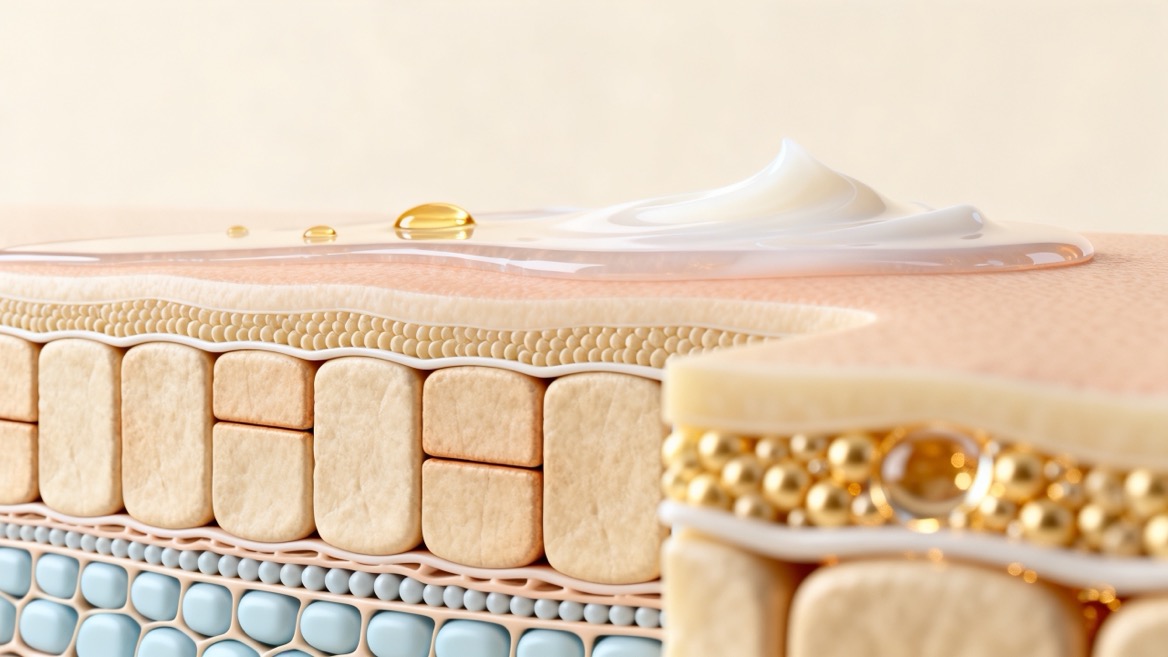
The stratum corneum, the outermost skin layer, contains cells surrounded by organized intercellular lipids. Ceramides, cholesterol, and free fatty acids are central components of this barrier.
Emollients improve the feel of rough, dry skin. A moisturizer can also reduce water loss through its overall formulation. However, these benefits do not automatically demonstrate restoration of the skin's native lipid composition or organization.
This distinction matters commercially. "Leaves skin feeling softer" and "restores depleted barrier lipids" require different supporting evidence.
A useful evaluation separates four outcomes:
- Sensory efficiency: softness, spreadability, and reduced greasy after-feel.
- Moisturizing efficiency: improved hydration and reduced transepidermal water loss.
- Recovery efficiency: faster improvement after a controlled barrier challenge.
- Formulation efficiency: stable incorporation, reproducible manufacturing, and acceptable cost.
Transepidermal water loss, or TEWL, measures water escaping through the skin. It is a valuable barrier-related endpoint, but lower TEWL alone does not identify which ingredient caused the change or prove lipid integration.
Phytosterols are plant-derived compounds with structures related to cholesterol. Commercial materials can contain different proportions of β-sitosterol, campesterol, stigmasterol, and other components.
Consequently, "phytosterols for skin barrier repair" should not be treated as a single, uniform specification.
For purchasing teams, composition matters. A supplier's botanical origin, total sterol assay, individual sterol profile, and impurity controls help define what is actually entering the formula.
Free phytosterols and phytosterol esters also require separate consideration. Their physical properties and formulation behavior should not be assumed identical.
Published research has investigated phytosterols for anti-inflammatory activity, skin delivery, and lipid-related biological effects.
A recent laboratory study identified β-sitosterol as a contributor to protection against UVB-related epidermal barrier injury. Its cell experiments reported approximately 52% lower reactive oxygen species and more than 50% greater lipid synthesis under the tested conditions.
These findings provide a research rationale, not a ready-made consumer claim. They do not establish that a commercial phytosterol cream will produce the same changes in human skin.
Likewise, structural similarity to cholesterol does not establish that every phytosterol blend can replace cholesterol at the same concentration or deliver equivalent barrier recovery.
Phytosterol incorporation can require more development work than adding a liquid emollient.
Depending on the grade and formulation, teams should investigate:
- Dissolution or dispersion in the selected oil phase.
- Crystal formation during cooling and storage.
- Compatibility with emulsifiers and other lipids.
- Changes in viscosity, appearance, and skin feel.
These are development checkpoints, not evidence that phytosterols are inherently unsuitable. The objective is a reproducible formula rather than a persuasive ingredient story alone.
Squalene is an unsaturated lipid found in human sebum and various biological sources. Squalane is its hydrogenated, saturated counterpart.
This chemical difference improves oxidative stability and makes squalane useful in cosmetic formulation. Ingredient documentation should distinguish the two clearly.
Squalane's association with skin surface lipids should not be stretched into a claim that it recreates the ceramide–cholesterol–fatty acid organization of the stratum corneum.
Squalane is particularly useful when the formulation brief calls for smooth application and lightweight emolliency.
It can help create a comfortable cream without relying exclusively on heavier oils. Its sensory properties may also support regular use, although consumer preference must be tested in the finished product.
For daily facial moisturizers, that usability can be commercially important. A formula that people enjoy applying has an advantage over one they avoid because of an unpleasant texture.
Squalane is not a humectant. A balanced moisturizer will commonly pair emollient functionality with water-binding ingredients such as glycerin and an appropriate overall lipid system.
Squalane's established cosmetic use does not prove that it:
- Replaces cholesterol in physiological lipid mixtures.
- Restores depleted ceramides.
- Repairs every type of compromised skin barrier.
- Outperforms phytosterols in controlled human testing.
Its strongest practical positioning is as a stable emollient supporting softness, moisturization, and formula aesthetics.
When efficiency means easy spreading, softness, and a lighter after-feel, squalane is usually the more straightforward development choice.
It is a liquid ingredient with useful oxidative stability. These characteristics simplify some formulation decisions, although final performance still depends on the whole cream.
This is a formulation assessment, not a claim of superior clinical barrier repair.
Phytosterols are relevant when a project specifically explores botanical sterols, skin-conditioning functionality, or mechanistic research around β-sitosterol.
However, a sterol-containing formula must still demonstrate compatibility and performance. Adding phytosterols does not automatically create an optimized physiological lipid mixture.
A defensible development brief would investigate whether the selected phytosterol grade adds measurable value beyond the base cream.
Clinical literature on barrier-focused moisturizers supports examining ceramides, cholesterol, and free fatty acids together.
One clinical practice study evaluated a ceramide-dominant emulsion containing these lipids in a 3:1:1 molar ratio. Other research has examined different physiological lipid systems.
The lesson is not that one ratio suits every product. Lipid identity, delivery, skin condition, and study design all influence interpretation. A molar ratio also cannot be copied directly as a weight-percentage ratio.
For brands, the complete formula is the appropriate unit of performance evaluation.
A 2026 ex vivo study compared phytosterol delivery from a topical film and a gel-cream using pig ear skin.
β-sitosterol deposition in the viable epidermis and dermis was approximately 2.5 times higher with the film than with the gel-cream under the study conditions.
This result is valuable because it highlights the influence of the delivery system. It does not prove that greater penetration produces better barrier repair, nor that a film is preferable for everyday facial care.
The practical takeaway is to test the ingredient inside the intended product format. Ingredient-level research cannot replace finished-formula evaluation.
A useful screening program can include:
1. A base cream without either comparison ingredient.
2. The base with squalane.
3. The base with a defined phytosterol grade.
4. A combined phytosterol–squalane prototype.
Keep other variables as consistent as technically feasible. Document any necessary adjustments to the oil phase or emulsification system.
Equal ingredient percentages do not necessarily represent equivalent functionality. Explain the rationale for each prototype rather than assuming a fair comparison from concentration alone.
Evaluate complementary outcomes:
| Evaluation area | Suggested measurements | Purpose |
|---|---|---|
| Skin feel | Structured user assessments | Compare spreadability, softness, and residue |
| Hydration | Corneometry | Assess changes in stratum corneum hydration |
| Barrier-related performance | TEWL under controlled conditions | Measure water-loss changes |
| Tolerance | Appropriate supervised assessments | Identify irritation or discomfort |
| Product stability | Physical and chemical testing | Confirm consistency through storage |
A controlled comparison is especially important when translating results into ingredient-specific claims.
Define the intended wording before selecting endpoints.
"Improves skin softness" requires different evidence from "supports barrier recovery after irritation."
Predefine assessment timing, application frequency, participant characteristics, environmental controls, and statistical analysis. Avoid choosing only the most favorable result after testing.
Where clinically meaningful claims are intended, qualified study design and relevant regulatory review should guide the program.
Neither "plant-derived" nor "biotechnology-produced" establishes sustainability by itself.
Squalane sourcing can involve plant feedstocks or fermentation-based routes. Phytosterol sustainability depends on the source material, processing, traceability, and wider supply chain.
For procurement, request documentation rather than relying on broad descriptors:
- Feedstock identity and origin.
- Manufacturing-route information.
- Batch specifications and certificates of analysis.
- Relevant impurity and residual-solvent controls.
- Traceability and substantiation for environmental claims.
A fermentation process should not be presented as improving barrier performance unless comparative evidence supports that specific benefit.
For a lightweight daily cream, prioritize sensory performance and evaluate squalane within a balanced moisturizing system.
For a botanical sterol concept, investigate a well-characterized phytosterol grade and establish its contribution through testing.
For a premium barrier-focused product, consider both ingredients alongside an appropriately developed lipid and humectant system. The combination is a development hypothesis, not an automatically proven synergy.
ZHENYIBIO TECHNOLOGY INC's stated focus on botanical actives and modern biofermentation provides a relevant platform for these projects. The strongest commercial narrative connects ingredient selection with documented quality, formulation feasibility, and measured product outcomes.
Bring ZHENYIBIO TECHNOLOGY INC your target market, preferred texture, ingredient requirements, and intended claims. Request an OEM or ODM consultation to explore botanical actives, phytosterol–squalane formulation options, and an evidence-led validation plan.
The objective is a commercially differentiated cream whose ingredient story matches its demonstrated performance.
Not universally. They offer different functionality, and the reviewed evidence does not establish direct human comparative superiority. Choose according to the formulation objective and validate the finished cream.
It should not be treated as an equivalent replacement. Squalane is an emollient hydrocarbon, whereas ceramides are key components of intercellular barrier lipids.
Not automatically. Structural similarity provides a research rationale, but equivalent performance requires evidence for the specific phytosterol material and formulation.
Yes, they can be investigated within the same formulation. Confirm compatibility, stability, tolerance, and performance rather than assuming the combination delivers superior repair.
Cosmetic safety assessments support their use under the reviewed conditions. However, suitability for a sensitive-skin product depends on concentration, impurities, other ingredients, and finished-product tolerance.
There is no universal concentration that guarantees effectiveness. Select levels using supplier guidance, safety information, formulation constraints, target-market requirements, and product testing.
- British Journal of Dermatology. "Topical supplementation with physiological lipids rebalances …" Human controlled research on a skin-identical lipid cream, water loss, resistance to physical damage, and irritation. [View journal article]. [academic.oup]
- "Evaluating Clinical Use of a Ceramide-dominant, Physiologic Lipid-Based Topical Emulsion for Atopic Dermatitis." Clinical evaluation of a ceramide, cholesterol, and fatty-acid formulation with a 3:1:1 molar ratio. [Read full text]. [pmc.ncbi.nlm.nih]
- Journal of Drugs in Dermatology. "The Effect of a Ceramide-Containing Product on Stratum Corneum Lipid Levels in Dry Legs." Study of hydration, skin discomfort, and lipid-level changes following moisturizer use. [View article]. [jddonline]
- "UPLC-Q-TOF/MS and network pharmacology identify β-sitosterol …" Laboratory research on UVB-related injury, oxidative stress, lipid synthesis, and proposed mechanisms. The reported percentages are experimental cell findings, not clinical cream outcomes. [Read research article]. [link.springer]
- "Development and Ex Vivo Assessment of Topical Formulations …" Research comparing phytosterol delivery from a gel-cream and topical film using pig ear skin. [Read full text]. [pmc.ncbi.nlm.nih]
- Cosmetic Ingredient Review. "Safety Assessment of Phytosterols as Used in Cosmetics." Ingredient functions, safety evidence, and impurity-control considerations. [Read assessment]. [cir-safety]
- Cosmetic Ingredient Review. "Squalane and Squalene." Safety reassessment summary reaffirming conclusions within reviewed cosmetic practices and concentrations. [Read reassessment]. [cir-safety]
- Formula Botanica. "The Formulator's Guide to Squalene and Squalane." Supporting formulation context for chemical differences, oxidative stability, and emollient use. [Read guide]. [formulabotanica]


