


Views: 215 Author: ZHENYIBIO Publish Time: 2026-10-20 Origin: Site
Content Menu
● What Is a Cosmetic Ingredient COA—and What Does It Actually Prove?
● 1. Verify Identity and Traceability Before Reading Test Results
>> Match the Certificate to the Material You Will Receive
>> Confirm Botanical and Fermentation Identity
● 2. Read Specifications, Results, and Methods Together
>> Check Units and Reporting Basis
>> Ask What "Not Detected" Means
● 3. Assess Botanical Potency Without Confusing Markers With Efficacy
>> Understand What the Assay Measures
>> Look Beyond a Single Marker
● 4. Evaluate Contaminants According to Ingredient Risk
>> Review Microbiological Quality
>> Review Chemical Contaminants
● 5. Check Physical Properties That Affect Formulation Performance
● 6. Use a Worked Example to Catch a Misleading Assay Comparison
● 7. Compare Multiple Batches Before Approving the Supplier
● 8. Turn COA Review Into a Supplier Approval Decision
>> Follow a Risk-Based Qualification Workflow
>> Recognize When Approval Should Pause
● Build Supplier Transparency Into Your Next Development Project
>> Is a COA the Same as a Cosmetic Ingredient Specification?
>> Can I Approve a Cosmetic Ingredient Supplier Using Only a COA?
>> Should Every COA Result Be Numerical?
>> Does a Passing Botanical Assay Prove Skin-Care Efficacy?
>> Does a Clean Microbial COA Eliminate the Need for Preservation Testing?
>> What Should I Do When Independent Results Differ From the Supplier's COA?
A cosmetic ingredient COA can help you distinguish a dependable manufacturing partner from a supplier with attractive paperwork. However, knowing how to read a cosmetic ingredient COA means looking beyond the word "Pass." You need to connect each result to the correct material, production batch, test method, and purchasing specification.
For botanical extracts and fermentation-derived actives, that review becomes particularly important. An ingredient's commercial name may conceal differences in plant origin, active concentration, carriers, or processing.
My starting question is simple: does this document provide enough evidence to approve this particular batch for its intended application?
This guide explains how to answer that question before committing to a cosmetic ingredient supplier.

A Certificate of Analysis, or COA, reports a material's test results against defined specifications. A useful certificate identifies the batch, lists relevant quality attributes, and records whether results meet acceptance criteria.
The essential distinction is batch-specific evidence.
A specification sheet describes what an ingredient should meet. A COA documents results for an identified batch. A safety data sheet addresses hazards and handling; a technical data sheet describes product characteristics and applications.
These documents support one another, but they are not interchangeable.
A COA also does not independently establish clinical efficacy, sustainability, suitability for every formulation, or comprehensive regulatory compliance. Supplier approval requires a broader assessment of manufacturing controls, traceability, technical support, and reliability.
Begin with the document header and compare it with the purchase order, sample label, and agreed specification.
| COA field | What to verify |
|---|---|
| Product name and code | Exact match to the ordered material and grade |
| INCI name | Consistency with the declared cosmetic ingredient identity |
| Batch or lot number | Match to the sample and shipment |
| Manufacturer | Clear identification of the manufacturing source |
| Manufacturing date | Plausible production timeline |
| Expiry or retest date | Consistency with the supplier's stability policy |
| Specification revision | Agreement with the approved purchasing specification |
| Quality authorization | Identifiable approval and document control |
A distributor-issued certificate is not automatically unacceptable. However, ask how its batch number connects to the original manufacturer's lot and whether repacking, blending, or additional processing occurred.
For botanical ingredients, request the scientific plant name, plant part, extraction solvent, and relevant standardization details. These may appear in supporting documentation rather than on the COA itself.
For fermentation-derived ingredients, clarify whether the material is a filtrate, lysate, purified metabolite, or another preparation. Request relevant information about the production organism, substrate, downstream processing, and carriers.
An INCI name alone may not describe these manufacturing differences.
A meaningful cosmetic raw material COA connects three elements:
- The acceptance criterion.
- The reported result.
- The analytical method or controlled method reference.
For example, "Assay: Pass" provides less decision-making information than a numerical assay result linked to a defined method.
Qualitative reporting remains appropriate for genuinely qualitative tests, such as a specified identification test. The issue is whether the reporting format matches the test's purpose.
Percentages, ppm, mg/kg, and CFU/g describe different measurements. For mass fractions, 1 ppm equals 1 mg/kg; converting to mg/L requires attention to density.
Also check whether an assay is reported:
- On an as-received basis.
- On a dry basis.
- As a percentage of total extract.
- As a percentage of the supplied commercial blend.
A "10% active" liquid and a "10% active" dry extract may deliver different amounts when their reporting bases differ.
"Not detected" does not mean absolute absence.
Ask for the detection limit, and where relevant, the quantification limit. A method that cannot detect below your acceptance threshold cannot demonstrate compliance with that threshold.
Likewise, "<10 CFU/g" reports a microbiological result below the stated reporting threshold—not a guarantee of sterility.
Botanical standardization may target an individual compound, a group of compounds, or a broader response expressed against a reference substance.
These approaches are not interchangeable.
For example, a total phenolics result does not establish the concentration of every individual phenolic compound. A marker assay also does not, by itself, prove a finished product's skin benefits.
Ask the supplier:
1. Which compound or compound group is measured?
2. Which reference standard is used?
3. Does the method distinguish the target from potential interference?
4. Is the result reported on the supplied material or dry solids?
A marker assay answers a concentration question. A chromatographic fingerprint can provide additional information about the ingredient's chemical profile and consistency.
For botanical extracts, combining appropriate identity testing with quantitative testing is generally more informative than relying on color, odor, or one assay alone.
No single method suits every botanical matrix. Highly processed extracts may require a different identity strategy from intact plant materials.
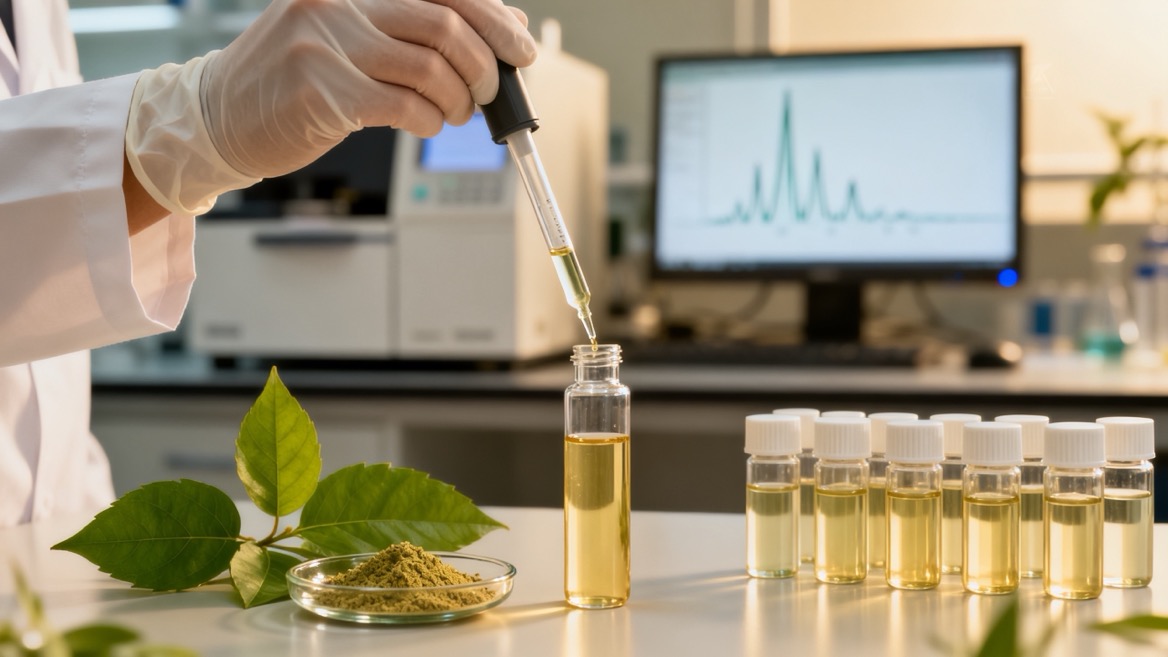
A supplier COA should reflect the material's origin, processing, and intended use—not merely repeat a generic test panel.
Depending on the ingredient, relevant testing may include total microbial counts, yeast and mold counts, and specified microorganisms.
Water-containing extracts and nutrient-rich fermentation preparations deserve careful attention because contaminated raw materials can introduce microorganisms into a formulation.
Do not automatically apply finished-cosmetic microbiological limits to every raw material. Establish ingredient specifications that account for its characteristics, use level, intended product, manufacturing process, and applicable requirements.
A raw material COA also cannot replace finished-formula preservation assessment.
Consider whether the risk assessment justifies testing for:
- Individual elemental impurities, such as lead, arsenic, cadmium, or mercury.
- Pesticide residues associated with agricultural sourcing.
- Residual solvents associated with extraction or processing.
- Mycotoxins where the botanical and storage conditions create a relevant risk.
- Other process-specific impurities.
An unspecified "heavy metals: pass" entry may be insufficient when individual elements have separate acceptance criteria.
There is no single universal contaminant limit covering every cosmetic ingredient and market. Agree on appropriate criteria before purchasing rather than interpreting a supplier's "Pass" as globally applicable.
Assay compliance does not guarantee manufacturing compatibility.
Review physical and chemical attributes relevant to the intended formula:
| Attribute | Why it matters |
|---|---|
| Appearance and odor | May reveal unexpected variation or deterioration |
| pH | Can affect compatibility with the formulation system |
| Moisture or loss on drying | Helps interpret concentration and handling characteristics |
| Solids content | Supports comparison of liquid extracts |
| Solubility or dispersibility | Influences incorporation and processing |
| Particle size | May affect texture, dispersion, and processing |
| Density or viscosity | Can affect pumping, dosing, and handling |
Methods matter here too. A powder's pH result needs a defined preparation, such as the concentration of an aqueous solution or dispersion.
Loss on drying is not always equivalent to water content because other volatile substances may contribute to the measurement.
For OEM and ODM projects, confirm that the reviewed grade matches the material used in development samples.
Consider two hypothetical botanical extracts. These figures illustrate interpretation; they are not supplier performance data.
| Parameter | Extract A | Extract B |
|---|---|---|
| Marker assay | 10% on dry basis | 9% as received |
| Moisture | 8% | 2% |
| Approximate marker content as received | 9.2% | 9.0% |
Extract A's headline assay looks higher. After accounting for moisture, the difference in supplied marker concentration is much smaller.
This comparison is valid only if both assays measure the same marker using sufficiently comparable methods and definitions.
The purchasing lesson is practical: compare usable active content, formulation suitability, and landed cost—not headline assay percentages alone. Also verify the concentration of any carrier-containing blend.
One acceptable certificate demonstrates one reported batch outcome. It does not establish long-term consistency.
As a practical qualification exercise, request several recent commercial-batch COAs and compare:
- Marker concentration.
- Moisture or solids.
- Relevant physical properties.
- Microbiological results.
- Relevant contaminant results.
Three batches can provide an initial comparison, but this is a suggested purchasing practice—not a universal cosmetic requirement or a statistically robust demonstration of process capability.
Investigate repeated results close to specification limits. Identical values across many certificates may also deserve clarification, although rounding, reporting limits, and stable processing can produce legitimate repetition.
Ask whether values represent batch testing, periodic testing, or another documented release approach. Never assume every listed parameter was measured on every lot.
1. Define the ingredient's intended use and target markets.
2. Agree on identity, composition, quality limits, and methods.
3. Review the supplier's quality questionnaire and traceability documentation.
4. Evaluate representative commercial-batch COAs.
5. Independently verify selected attributes according to risk.
6. Test the ingredient in the intended formulation.
7. Document approval conditions and ongoing monitoring.
Independent testing should answer specific uncertainties. A new supplier, complex botanical matrix, or unresolved method discrepancy may justify more verification than an established low-risk supply relationship.
Laboratory competence and method suitability matter more than a report's appearance.
Pause approval when:
- The batch number cannot be reconciled.
- Identity documentation conflicts.
- The assay basis is unclear.
- A reporting limit exceeds your acceptance criterion.
- Required contaminant evidence is missing.
- Manufacturing changes are not explained.
- Traceability or authorization cannot be verified.
Missing information does not always prove poor quality. It does mean the approval decision lacks sufficient support.
Keep "supplier approved" separate from "batch released." An approved supplier can still deliver a nonconforming lot.

At ZHENYIBIO TECHNOLOGY INC, our focus combines natural botanical actives with modern biofermentation for international beauty brands, wholesalers, and manufacturers.
For buyers, the strongest development conversation begins with clear requirements rather than a generic request for a certificate.
Contact ZHENYIBIO with your target ingredient, intended application, destination market, and OEM or ODM requirements. Request the relevant batch COA, specification, composition information, and available supporting technical documentation for review.
Agree on acceptance criteria before sampling or ordering. That gives procurement, formulation, and quality teams a shared basis for evaluating the material.
No. A specification defines acceptance criteria. A COA reports results for an identified batch against stated criteria. Always confirm that the certificate uses the specification revision you approved.
A COA alone is generally insufficient for a robust approval decision. Review traceability, manufacturing controls, documentation, supply reliability, and verification needs according to the ingredient's risk.
No. Qualitative identity tests may appropriately report conformity. Quantitative attributes are more informative when reported numerically, with units, methods, and relevant reporting limits.
No. An assay measures a defined chemical attribute. Skin-care benefit claims need appropriate supporting evidence; they cannot be established solely by a marker concentration.
No. The COA describes the tested raw material. Finished-formula microbial safety and preservation depend on the complete formulation, packaging, manufacturing, and intended use.
Hold the affected material while investigating sampling, storage, methods, reference standards, units, and reporting basis. Resolve the discrepancy through documented quality review before release.
1. [U.S. Food and Drug Administration — Good Manufacturing Practice Guidelines/Inspection Checklist for Cosmetics]. Covers raw-material identification, storage, sampling, testing, and compliance with specifications. [fda]
2. [U.S. Food and Drug Administration — Microbiological Safety and Cosmetics]. Explains contamination pathways, including raw materials, preservation, packaging, and storage. [fda]
3. [World Health Organization — Quality Control Methods for Herbal Materials, 2011]. Provides analytical approaches for herbal identity, quality, and contaminants. Its scope is herbal materials used in herbal medicines, not a universal cosmetic specification. [who]
4. [International Council for Harmonisation — Q7: Good Manufacturing Practice Guide for Active Pharmaceutical Ingredients]. Provides a useful reference for certificate content and supplier evaluation. It concerns pharmaceutical ingredients and is not presented here as a cosmetic legal requirement. [database.ich]
5. [ISO — ISO 17516:2014, Cosmetics—Microbiology—Microbiological Limits]. Addresses assessment of cosmetic product microbiological quality; it should not be treated as a universal raw-material specification. [iso]
6. [ISO — Cosmetics—Microbiology—Evaluation of the Antimicrobial Protection of a Cosmetic Product]. Describes preservation-efficacy evaluation and assessment of a cosmetic formulation's antimicrobial protection. [iso]
7. [U.S. Food and Drug Administration — Testing of Cosmetics for Arsenic, Cadmium, Chromium, Cobalt, Lead, Mercury, and Nickel]. Provides context on elemental impurities and manufacturing controls. [fda]


