


Views: 230 Author: ZHENYIBIO Publish Time: 2026-09-03 Origin: Site
Content Menu
● Why Pigmentation Requires a Multi-Pathway Strategy
● 4-Hexylresorcinol vs. Hydroquinone at a Glance
● How 4-Hexylresorcinol Works in Brightening Formulas
>> Anti-Aging Positioning Opportunity
● How Hydroquinone Works—and Why It Needs Careful Control
>> Regulatory and Commercial Limitations
● Clinical Efficacy: What the Comparison Really Means
● Safety Profile: Which Ingredient Better Fits Modern Cosmetic Systems?
>> When 4-Hexylresorcinol May Be the Better Choice
>> When Hydroquinone May Still Be Considered
● Formulation Blueprint for a Professional Brightening Serum
>> Step 1: Define the Pigmentation Need
>> Step 2: Build a Complementary Active System
>> Step 3: Validate the Finished Product
>> Step 4: Protect the Formula and the User Experience
● Expert Perspective: Efficacy Without Routine Failure
● Choosing the Right Active for Your Brand
>> Is 4-Hexylresorcinol as effective as hydroquinone?
>> Is 4-Hexylresorcinol safe for daily skincare products?
>> Why is hydroquinone restricted in some markets?
>> Can 4-Hexylresorcinol be combined with niacinamide?
>> How long does a brightening serum take to show visible results?
>> Can brightening products be used without sunscreen?
>> Is Hydroquinone suitable for an international private-label skincare brand?
For professional-grade brightening systems, 4-Hexylresorcinol vs. Hydroquinone is no longer a simple question of which ingredient lightens the skin faster. For global beauty brands, formulators, clinics, and private-label buyers, the decision also involves safety margins, product positioning, regulatory suitability, formulation flexibility, consumer tolerance, and long-term commercial viability.
Hydroquinone has a long history as a dermatology-led pigment-correcting ingredient, particularly for visible melasma, post-inflammatory hyperpigmentation, freckles, and solar lentigines. However, its restrictions in cosmetic markets and its association with irritation and misuse-related complications have increased demand for alternatives. 4-Hexylresorcinol, also known as hexylresorcinol or 4-HR, is one of the most commercially relevant options for brands seeking a high-performance brightening active that can support a more modern, non-hydroquinone product strategy.
From a formulation and product-development perspective, the best choice depends on the intended market, claim framework, user profile, concentration, delivery system, supporting ingredients, and whether the final product will be positioned as a cosmetic or a medically supervised treatment.
At ZHENYIBIO TECHNOLOGY INC, we approach pigment-care development through the intersection of botanical expertise, advanced fermentation technology, active-ingredient science, and sustainable formulation design. A successful brightening system should not merely reduce the appearance of dark spots. It should also support skin comfort, repeat use, barrier-conscious routines, and responsible product commercialization.

Uneven skin tone is not caused by one biological event. Melanin production and distribution involve a sequence of processes, including inflammatory signaling, oxidative stress, tyrosinase activity, melanosome transfer, ultraviolet exposure, hormonal influence, and skin-barrier disruption.
This is why a strong professional brightening formula must address more than surface discoloration.
Common pigmentation concerns include:
- Melasma and hormonally influenced uneven tone.
- Post-inflammatory hyperpigmentation following acne, irritation, injury, or procedures.
- Sun-related dark spots and solar lentigines.
- Uneven tone associated with repeated UV exposure.
- Persistent visible discoloration in mature skin.
- Dark marks intensified by over-exfoliation or poorly tolerated actives.
In practice, the most commercially successful brightening products combine an evidence-based active with a complete system that may include antioxidants, skin-soothing agents, barrier-support ingredients, moisturizers, chelators, encapsulation technology, and broad-spectrum daily sun protection.
No topical brightening active can deliver consistent long-term results without photoprotection. New UV exposure can reactivate pigment pathways and reduce the visible benefit of even a well-designed corrective serum.
| Comparison Factor | 4-Hexylresorcinol | Hydroquinone |
|---|---|---|
| Primary role | Cosmetic brightening active for uneven tone and dark-spot appearance | Dermatology-associated depigmenting active |
| Main mechanism | Multi-pathway pigment modulation, including tyrosinase inhibition and antioxidant-related activity | Primarily inhibits tyrosinase and affects melanocyte metabolic activity |
| Typical product positioning | Premium cosmetic serums, creams, spot correctors, professional homecare | Prescription-led or medically supervised hyperpigmentation treatment in many markets |
| Clinical comparison | In a 12-week split-body study, 1% hexylresorcinol performed comparably to 2% hydroquinone for facial and hand pigmentation appearance | Established benchmark active with extensive clinical history |
| Tolerability approach | Often selected for long-term cosmetic routines and multi-active systems | Requires careful attention to concentration, duration, skin response, and local rules |
| Regulatory fit | May be more practical for globally oriented cosmetic portfolios, subject to local review | Cosmetic use is restricted or prohibited in important markets, including the European Union |
| Formulation opportunity | Suitable for non-hydroquinone, science-led brightening platforms | More limited by regional compliance and higher risk-management needs |
| Brand communication | "Radiance," "dark-spot care," "tone-evening," and "pigment-correcting" concepts | Often requires medical or drug-category positioning rather than conventional cosmetic messaging |
A randomized, double-blind, split-body clinical study involving 32 healthy female participants aged 35 to 65 compared 1% hexylresorcinol with 2% hydroquinone over 12 weeks. Both groups showed significant reductions in measured and clinically graded pigmentation at weeks 4 and 12, with no statistically significant difference between the two ingredients in that study. No adverse effects were reported for either intervention.
This does not mean that every hexylresorcinol formula will automatically match every hydroquinone product. Formula architecture matters. Concentration, vehicle design, pH, active stability, packaging, skin type, compliance, and routine compatibility all influence real-world results.
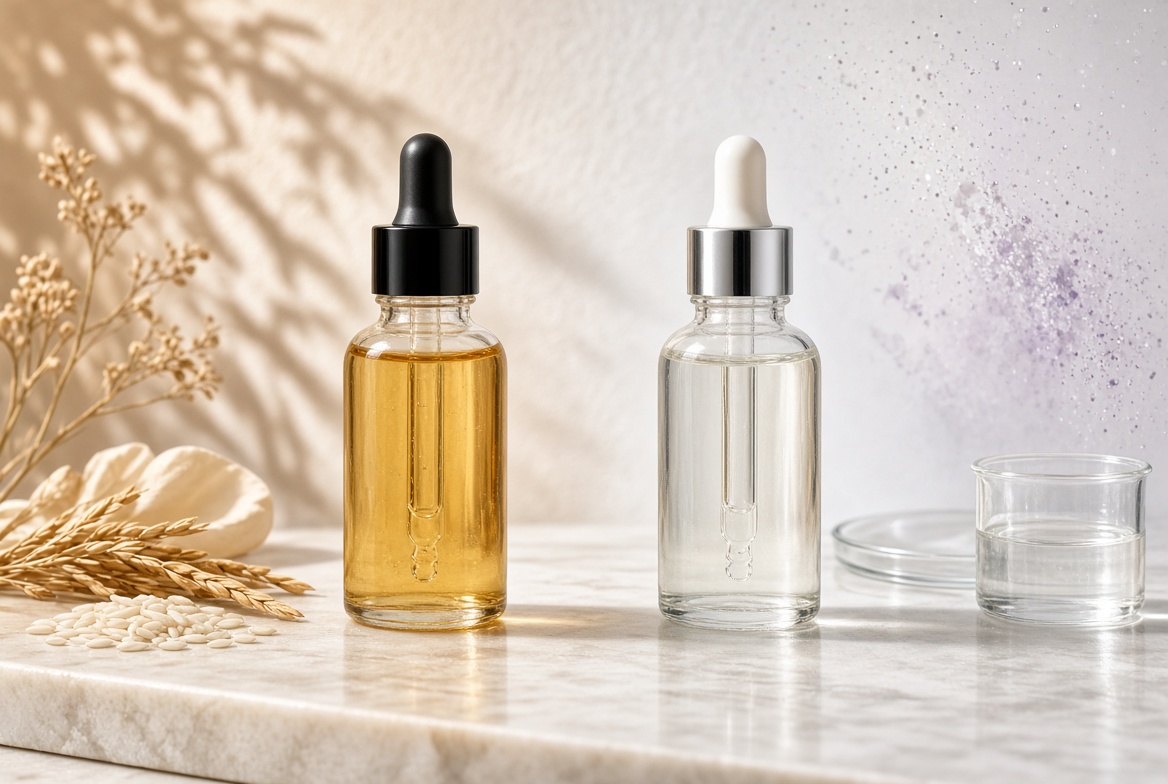
4-Hexylresorcinol is a substituted resorcinol compound used in skin-brightening systems for its ability to help reduce the appearance of uneven pigmentation. Its value lies in its potential to support multiple pigment-related pathways rather than relying on a single mechanism.
Tyrosinase is a key enzyme in melanin synthesis. When tyrosinase activity increases, the skin can produce more melanin, contributing to visible dark spots and uneven tone.
Like hydroquinone, 4-Hexylresorcinol is associated with tyrosinase-inhibiting activity. However, it is generally positioned in cosmetic formulations as part of a broader pigment-management system rather than as a standalone medical depigmenting intervention.
Oxidative stress can contribute to visible skin aging and pigment irregularities. A formula containing 4-Hexylresorcinol may be paired with antioxidant ingredients to create a more complete daily-care approach.
Useful complementary ingredients can include:
- Fermented botanical antioxidants.
- Niacinamide.
- Ectoin.
- Stable vitamin C derivatives.
- Tocopherol.
- Licorice-root derivatives.
- Tranexamic-acid alternatives where permitted and appropriate.
- Barrier-support lipids and humectants.
One commercial advantage of 4-Hexylresorcinol is that it fits naturally into broader "brightening plus age-support" formulas. Rather than focusing only on spot correction, a brand can develop a more sophisticated consumer proposition around radiance, tone uniformity, antioxidant care, skin smoothness, and visible luminosity.
A previous open-label study evaluated a formula containing retinol, niacinamide, resveratrol, and 1.1% hexylresorcinol in a moisturizing base. The study described the system as efficacious and tolerable for skin brightening and anti-aging when used together with SPF 30 sun protection.
For OEM and ODM development, this creates room for differentiated products such as:
- Dark-spot correcting serums.
- Barrier-conscious brightening emulsions.
- Post-acne mark care products.
- Mature-skin radiance creams.
- Professional homecare kits.
- Multi-phase ampoules.
- Brightening eye-area products.
- Tone-evening body lotions.
- Overnight pigment-support masks.
Hydroquinone has historically been considered a reference ingredient in hyperpigmentation management. It reduces pigmentation mainly by reversibly inhibiting the conversion steps involved in melanin production and by influencing melanocyte activity.
Its clinical relevance is clear. Hydroquinone has been used for conditions such as melasma, chloasma, freckles, solar lentigines, and post-inflammatory discoloration. However, strong efficacy does not eliminate the need for responsible use.
Hydroquinone can cause skin irritation, burning, redness, dryness, allergic contact dermatitis, or post-inflammatory pigment changes in susceptible users. One of the most discussed long-term complications is exogenous ochronosis, a blue-gray discoloration that can be difficult or impossible to reverse.
Risk may increase when consumers:
- Use high concentrations without supervision.
- Apply products for excessive periods.
- Combine hydroquinone with irritating acids or retinoids without a tolerance plan.
- Use unregulated or counterfeit lightening products.
- Fail to use daily sun protection.
- Continue treatment despite persistent irritation.
- Apply products to compromised or inflamed skin.
The U.S. Food and Drug Administration has warned consumers about over-the-counter skin-lightening products containing hydroquinone, noting reports of rashes, facial swelling, and ochronosis. The agency states that over-the-counter hydroquinone skin-lightening products are not generally recognized as safe and effective and may be unapproved drugs.
For product developers, this distinction is essential: a historically effective ingredient may still create substantial market-access, customer-service, compliance, and reputation-management challenges.
Hydroquinone is not a universal cosmetic ingredient. Its status differs by market, product category, claim language, concentration, and route to market.
In the European Union, hydroquinone is listed as prohibited for cosmetic use, with a narrow exception relating to certain professional artificial nail systems. This does not provide a route for hydroquinone facial serums, creams, masks, or skin-lightening cosmetics.
For international brands, this can create several operational challenges:
- Separate formulas may be required for different regions.
- Product registrations may be more complex.
- Claims need legal and regulatory review.
- Retailers may reject hydroquinone-containing cosmetic products.
- Consumers may associate the ingredient with unsafe or illegal skin-lightening products.
- Marketplace compliance and import clearance can become more difficult.
The most useful direct comparison currently available is the 12-week randomized, double-blind split-body study of 1% hexylresorcinol and 2% hydroquinone. The study found that both sides improved from baseline, with no significant difference between the two treatments for pigmentation appearance.
This result is important, but it should be interpreted responsibly.
The study supports the view that 1% 4-Hexylresorcinol can be a credible non-hydroquinone brightening option for visible facial and hand pigmentation in a controlled 12-week setting.
It also gives formulators a practical benchmark when designing professional cosmetic systems for customers who want a hydroquinone-free alternative.
The study does not prove that all 4-Hexylresorcinol formulas outperform hydroquinone. It also does not establish universal equivalence across:
- All pigmentation conditions.
- Every skin phototype.
- Every climate and UV exposure level.
- Longer treatment periods.
- More severe melasma.
- Post-procedure pigmentation.
- Different concentrations or delivery technologies.
- Combination formulas containing multiple actives.
A credible brand should not overstate the finding. Strong product communication should focus on visible tone-evening, dark-spot appearance, formula tolerability, and substantiated finished-product testing.
For a globally positioned cosmetic brand, 4-Hexylresorcinol usually offers a more adaptable starting point than hydroquinone. This is particularly true for leave-on products designed for routine use, international retail, clean-label-adjacent positioning, and sensitive-skin-conscious product development.
Hydroquinone may remain relevant within physician-directed pigment protocols where it is legally available and clinically appropriate. But it is not automatically the best choice for a scalable consumer cosmetic portfolio.
Consider a 4-Hexylresorcinol-based system when the brand needs:
- A hydroquinone-free brightening product.
- A cosmetic positioning suitable for multiple international markets.
- A high-value active for premium serum or cream development.
- A formula that can be paired with fermented botanical ingredients.
- A comprehensive radiance and age-support story.
- A product designed for repeat use with barrier-support ingredients.
- A more flexible path for OEM and ODM customization.
Hydroquinone may remain relevant when:
- The product is developed for a legally permitted, medically supervised channel.
- The target concern is clinically significant hyperpigmentation.
- The brand has region-specific regulatory support.
- User instructions, duration limits, warnings, and sun-protection guidance can be carefully managed.
- Dermatology oversight is part of the intended product experience.
Professional judgment matters. A visibly darker spot does not always require the most aggressive active. In many consumer routines, a well-tolerated formula that users can apply consistently may produce better long-term adherence than a stronger formula that triggers irritation or fear of side effects.
A high-quality 4-Hexylresorcinol serum should be designed as a system, not just an ingredient list. At ZHENYIBIO TECHNOLOGY INC, our development philosophy begins with active selection but extends to delivery, stability, sensory profile, ingredient compatibility, and the end user's full routine.
Start with a clear product brief:
- Is the serum designed for post-acne marks?
- Is it intended for dullness and uneven tone?
- Is it for mature skin with sun-related spots?
- Is it for a professional aesthetic aftercare range?
- Does the target customer prioritize gentle daily use?
- Will it be sold in humid, dry, high-UV, or cold climates?
A product for post-acne marks may need more soothing and barrier support. A mature-skin dark-spot serum may benefit from antioxidant and anti-aging companions. A professional-use concept may require clinical testing and carefully controlled claims.
A well-balanced formula could combine 4-Hexylresorcinol with:
- Niacinamide for visible tone evenness and barrier support.
- Fermented botanical extracts for antioxidant storytelling and ingredient differentiation.
- Panthenol, beta-glucan, or ectoin for comfort-focused positioning.
- Stable vitamin C derivatives for antioxidant support.
- Hyaluronic acid or multi-molecular humectants for hydration.
- Ceramide-support systems for barrier-conscious use.
- A suitable chelating system to support formula robustness.
Avoid creating an unnecessarily aggressive formula. A formula with too many exfoliating acids, retinoids, and high-intensity actives may increase irritation, which can worsen the appearance of post-inflammatory discoloration in some users.
Raw-material information is not enough. The finished formula should be evaluated through a practical testing roadmap:
1. Conduct stability testing under relevant temperature and light conditions.
2. Confirm active compatibility with the selected base and packaging.
3. Perform microbiological and preservative-efficacy testing.
4. Run irritation and compatibility assessments appropriate to the intended market.
5. Conduct consumer-use or instrumental testing for visible tone-evening claims.
6. Evaluate product performance with daily sunscreen use included in the study routine.
7. Ensure artwork, warnings, and claims match local legal requirements.
Packaging can influence performance. Airless pumps, opaque containers, and low-oxygen packaging approaches can help protect sensitive formula components. The sensory experience also matters: a brightening serum should layer well, avoid excessive pilling, and fit into morning and evening routines.
A practical use direction may be: apply a small amount to clean, dry skin, follow with moisturizer as needed, and use a broad-spectrum sunscreen during the day. If the product contains multiple active ingredients, introduce it gradually and avoid pairing it immediately with several other potentially irritating products.
In product development, the strongest active is not always the most successful ingredient. The best-performing commercial formula is often the one that consumers can understand, tolerate, repurchase, and use consistently.
This is especially important in pigmentation care. Consumers frequently combine dark-spot products with exfoliants, retinoids, cleansing devices, masks, and sun exposure. If a formula causes persistent redness or barrier disruption, the resulting inflammation can undermine the brightening objective.
A premium brightening system should therefore deliver four forms of value:
- Visible results: improvement in the look of uneven tone and dark spots.
- Skin comfort: low-friction integration into real-world routines.
- Commercial adaptability: a claim and ingredient platform suitable for the intended regions.
- Brand credibility: clear instructions, responsible claims, and finished-product substantiation.
4-Hexylresorcinol is particularly relevant because it allows brands to create a sophisticated alternative to conventional hydroquinone-centered brightening. It can be paired with plant-derived, fermented, and biomimetic ingredients without compromising the need for scientific rationale.
The 4-Hexylresorcinol vs. Hydroquinone decision should be made with regulatory planning and finished-product performance in mind—not solely with an ingredient comparison chart.
Choose 4-Hexylresorcinol when your objective is to build a modern, hydroquinone-free, high-performance brightening formula for global cosmetic markets. It is especially suitable for tone-evening serums, dark-spot correctors, premium moisturizers, and professional homecare products that need a balance of efficacy, tolerability, and formulation versatility.
Consider Hydroquinone only where its use is lawful, professionally appropriate, and supported by robust risk-management procedures. Its clinical history is significant, but it carries more regulatory and reputation-related complexity for conventional consumer cosmetics.
ZHENYIBIO TECHNOLOGY INC supports beauty brands, wholesalers, and manufacturers with customized OEM and ODM solutions for advanced brightening systems. From fermented botanical actives and ingredient-selection strategy to serum development, texture customization, stability planning, and premium product positioning, we help partners translate pigment-care science into commercially distinctive formulations.
Contact ZHENYIBIO TECHNOLOGY INC to develop a customized 4-Hexylresorcinol brightening serum, dark-spot cream, or professional pigment-care collection tailored to your target market and brand strategy.
A 12-week randomized, double-blind split-body study found that 1% hexylresorcinol and 2% hydroquinone both significantly improved the appearance of facial and hand pigmentation, with no significant difference between the two treatment groups in that study. Results can still vary depending on formula design, skin condition, concentration, product use, and sun exposure.
4-Hexylresorcinol is used in cosmetic brightening formulations, but safety should always be assessed in the context of the complete formula, concentration, intended use, target market, and user population. Brands should conduct stability, compatibility, and appropriate finished-product safety testing before launch.
Hydroquinone has been associated with irritation, allergic reactions, and rare but serious complications such as ochronosis when misused or used for prolonged periods. Regulatory authorities also distinguish between drug-style treatment use and conventional cosmetic use. In the European Union, hydroquinone is prohibited in cosmetic products except for a limited professional nail-system exception.
Yes. 4-Hexylresorcinol can be formulated with niacinamide in a tone-evening system. Niacinamide may help support the skin barrier and complements a routine designed for visible dullness, uneven tone, and dark-spot appearance. Formula compatibility, pH, preservative design, and stability should be verified during development.
Visible improvements often require several weeks of consistent use. In the direct 4-Hexylresorcinol and hydroquinone comparison, pigmentation improvements were observed at week 4 and week 12. A realistic consumer trial should generally assess tone-evening performance over at least 8 to 12 weeks, while maintaining daily sun protection.
No. Daily sun protection is a core part of pigmentation care. UV exposure can trigger melanogenesis, worsen existing discoloration, and contribute to the recurrence of dark spots. Brightening products should be presented as part of a complete routine that includes broad-spectrum sunscreen.
Often, it is not the most practical starting point for an international cosmetic portfolio because its legal status and permitted use vary substantially by market. Brands planning distribution across multiple regions should conduct market-specific regulatory review and may find a 4-Hexylresorcinol-based system easier to position as a cosmetic product.
1. U.S. Food and Drug Administration. [FDA Works to Protect Consumers from Potentially Harmful OTC Skin Lightening Products].
2. U.S. Food and Drug Administration. [Skin Product Safety: Skin Lightening Products].
3. Wu H, Gabriel TA, Burney WA, Chambers CJ, Pan A, Sivamani RK. [Prospective, Randomized, Double-Blind Clinical Study of Split-Body Comparison of Topical Hydroquinone and Hexylresorcinol for Skin Pigment Appearance]. *Archives of Dermatological Research*. 2023;315(5):1207–1214.
4. European Commission. [Commission Regulation (EU) 2021/1099].
5. Schwartz C, Jan A, Zito PM. [Hydroquinone]. *StatPearls*. National Library of Medicine.
6. Draelos ZD, et al. [Efficacy and Tolerability of a Skin Brightening/Anti-Aging Cosmeceutical]. *Journal of Drugs in Dermatology*. 2016;15(7):863–868.
7. DailyMed. [Hydroquinone 4% Cream Drug Label].


