


Views: 299 Author: ZHENYIBIO Publish Time: 2026-11-17 Origin: Site
Content Menu
● What Is the Difference Between Salicylic Acid Powder and Liquid Salicylic Acid?
>> Salicylic acid powder: More control over the formula
>> Liquid salicylic acid: A concentrate with a carrier
● Salicylic Acid Powder vs. Liquid Salicylic Acid: Side-by-Side Comparison
● Why Salicylic Acid Solubility and pH Matter More Than Raw Material Format
>> A clear premix does not guarantee a clear finished product
>> The same percentage can behave differently at a different pH
● Worked Example: Compare Both Formats at 1% Salicylic Acid
● How to Test Both Formats Before Scaling Up
● Which Format Fits Your Skincare Product?
● Regulatory and Supplier Checks for Global Skincare Brands
● Develop Your Salicylic Acid Product With ZHENYIBIO
>> Is liquid salicylic acid stronger than salicylic acid powder?
>> Can I dissolve salicylic acid powder directly in water?
>> Can I replace salicylic acid powder with a liquid concentrate one-for-one?
>> Why did my salicylic acid serum crystallize after cooling?
>> Is willow bark extract equivalent to salicylic acid powder?
>> Which format is better for an OEM or ODM launch?
Salicylic acid powder is the better starting point when you need full control over the solvent system, ingredient list, and cost per kilogram of active. Liquid salicylic acid is often the better choice when you want to simplify manufacturing and the supplier's carrier already fits your formula. Neither is inherently more effective. What matters is how much salicylic acid reaches the finished product, whether it stays dissolved or otherwise remains in its intended physical state, and whether the formula meets its safety and performance requirements.
For a brand developing a clear exfoliating serum, the deciding question may be whether the product stays clear after cold storage. For a contract manufacturer, it may be whether a shorter mixing process offsets the higher cost of a concentrate. The right choice comes from comparing both formats at the same active level in the actual product base.

Salicylic acid powder is the solid raw material. The supplier's certificate of analysis establishes its assay, or measured salicylic acid content, for the lot you receive. Your formulation team chooses how to incorporate it, which solvents to use, and how to manage pH and mixing.
Powder suits projects with a tightly controlled ingredient list, a custom solvent system, or an established manufacturing process. The trade-off is that your team owns the dissolution step. You need a process that works not only in a lab beaker but also in a production vessel, where mixing and cooling conditions can differ.
Liquid salicylic acid is a purchasing description, not a single standardized ingredient. It may refer to salicylic acid already dissolved in a carrier or to a formulated dispersion or delivery system. Ask for the full composition and the salicylic acid assay as supplied. A related ingredient such as sodium salicylate is not automatically interchangeable with salicylic acid.
A compatible concentrate can remove a separate dissolution step and simplify dosing. It also brings other ingredients into the formula. If the carrier changes the serum's skin feel, disrupts a gel, or conflicts with a brand's ingredient requirements, the easier manufacturing step may not be worth the compromise.
| Decision factor | Salicylic acid powder | Liquid salicylic acid |
|---|---|---|
| Active content | Calculate from the lot-specific powder assay | Calculate from the concentration as supplied |
| Solvent and carrier | Formulator selects the solvent system | Supplier's carrier becomes part of the formula |
| Manufacturing | Requires a validated incorporation process | Can simplify dosing if compatible with the base |
| Clear serums and toners | Suitable if the acid stays dissolved after dilution and storage | Suitable if the concentrate stays compatible after dilution and pH adjustment |
| Procurement | Compare assay, lot consistency, storage, and handling | Compare assay, carrier disclosure, shelf life, and storage |
| Cost | Include solvents, labor, and processing losses | Include freight on the carrier and any savings in processing or rework |
Salicylic acid has a reported water solubility of about 2.24 g/L at 25 °C. That figure is not a universal limit for finished products: changing the pH, solvent composition, or temperature changes the conditions that govern solubility. It does explain why stirring powder directly into plain water is not a reliable route to a clear 1% serum.
The same principle applies to liquid concentrates. A concentrate can be clear in its original container but turn cloudy or form crystals when diluted into a water-rich base. The carrier that keeps the acid dissolved in the drum may be present at too low a level in the finished serum. Judge clarity after incorporation, cooling, and storage—not just when the concentrate arrives or when the batch is still warm.
Salicylic acid has a reported pKa near 2.97. The pKa is the point at which the un-ionized acid and its ionized form are present in roughly equal proportions in a simple aqueous system. Raising pH increases the ionized proportion and can improve apparent water solubility. But it also changes the balance between those forms, so adjusting pH to clear a batch is not a neutral change.
Use the finished-product pH alongside the measured total salicylic acid content when comparing prototypes. Neither number alone establishes exfoliating performance or skin tolerability. Set a pH range that fits the complete formula, then check whether the product stays within that range during stability testing.
Consider a hypothetical 100 kg pilot batch with a target of 1.00% salicylic acid by weight. This example illustrates the purchasing and formulation math; it is not a recommended concentration for every product.
| Raw material | Assumed assay as supplied | Amount for a 100 kg batch | What else enters the batch? |
|---|---|---|---|
| Salicylic acid powder | 99.5% | About 1.005 kg | Any separate solvent required by the formula |
| Liquid salicylic acid concentrate | 20.0% | 5.000 kg | 4.000 kg of carrier or other components |
Divide the target mass of active by the assay expressed as a decimal: 1.000 kg ÷ 0.995 for the powder, or 1.000 kg ÷ 0.20 for the liquid. Confirm that the supplier's assay applies to the material as supplied, rather than to a dry or corrected basis.
The practical difference is the 4.000 kg of non-active material in the liquid route. If the carrier is a glycol already budgeted into the serum, the concentrate may replace part of that glycol. If the base was developed without it, the carrier takes up 4% of the finished formula and may change tack, viscosity, or drying feel. Rebalance the formula to 100 kg before comparing the prototypes.
Use the same calculation to compare quotes. Divide price per kilogram of raw material by its active fraction to estimate price per kilogram of salicylic acid. Then add the costs that differ between routes: solvent, freight, weighing and mixing time, and expected losses. A cheaper raw material is not always the cheaper production process.
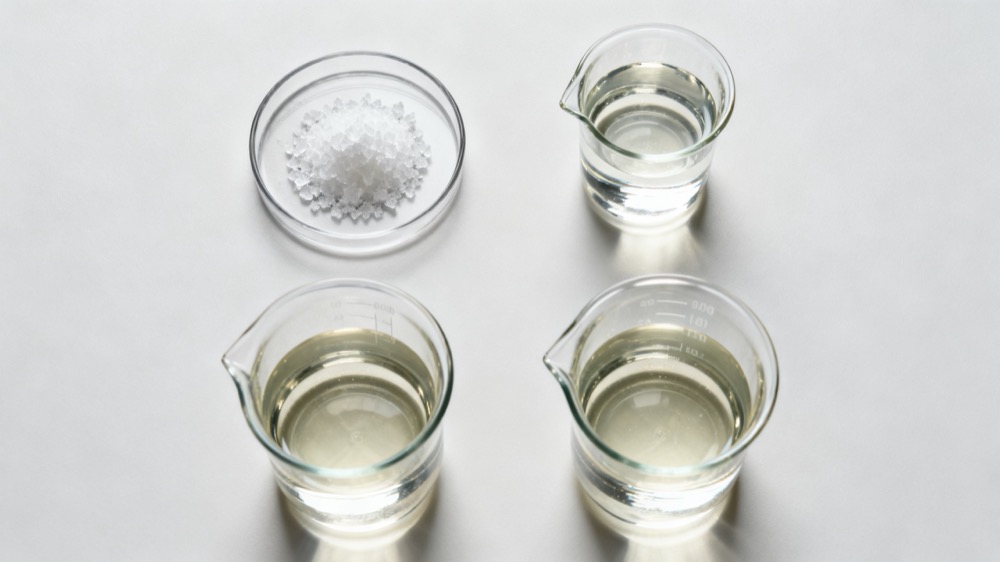
1. Define the product brief. Record the target active level, acceptable pH range, desired appearance and skin feel, packaging, and launch markets. Confirm whether the product will be marketed as a cosmetic exfoliant or with acne-treatment claims.
2. Make two comparable pilots. Match total salicylic acid and aim for the same finished pH range. Document every carrier and solvent adjustment. Record the addition order, mixing conditions, and temperature so you can repeat the process.
3. Check the batch after it cools. Record appearance, pH, viscosity where relevant, and any particles or sediment. A clear sample taken during mixing is not sufficient evidence of stability.
4. Test in the intended packaging. Use a stability plan appropriate to the product and distribution conditions. Include cool storage if crystallization is a concern. Check for haze, crystals, separation, pH drift, and dispensing changes. Confirm active content with a suitable assay where required; visual inspection cannot tell you how much salicylic acid is present.
5. Repeat the preferred route at pilot scale. Confirm that production equipment can reproduce the bench result. Compare batch time, process complexity, and release results before committing to a commercial order.
If a sample turns hazy or gritty, identify the cause before changing the formula. Crystals, an incompatible carrier, and emulsion instability can all produce visible defects, but they call for different corrections.
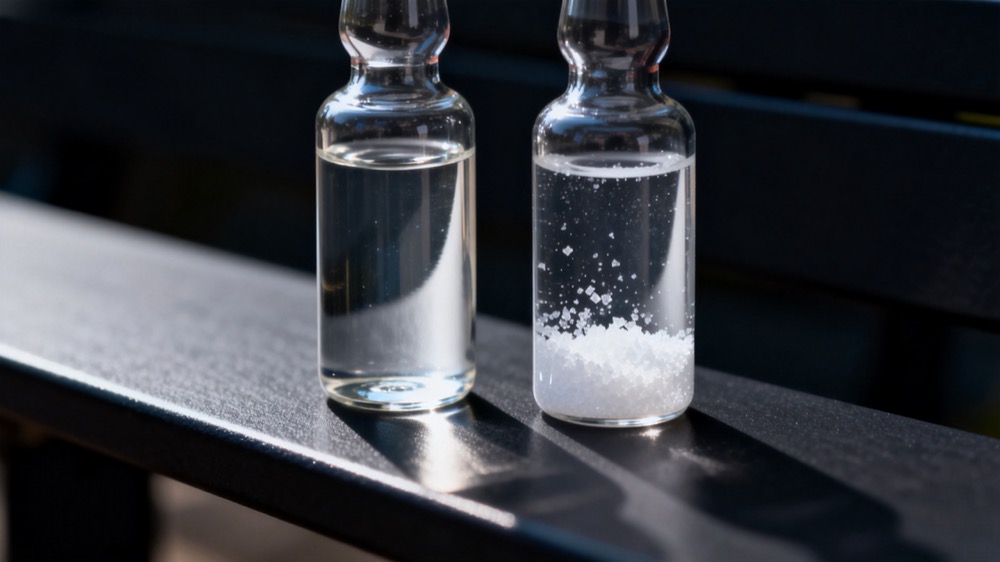
- Clear toners and exfoliating serums: Trial a liquid concentrate first if its carrier suits your sensory brief and ingredient list. Keep a powder-based prototype as a benchmark if clarity or skin feel is a deciding factor.
- Rinse-off cleansers and scalp products: Test the acid in the complete surfactant base. Check whether addition changes viscosity or clarity, and confirm the rules for the specific product category. A facial cleanser and a rinse-off hair product are not necessarily treated alike.
- Gels and emulsions: Test the acid, carrier, and pH against the thickener or emulsifier. A concentrate that disperses readily may still thin a gel or change an emulsion's texture.
- Products with a restricted ingredient list: Start with powder if the supplier's liquid carrier conflicts with the brief and you have a viable incorporation process. Verify feedstock origin and manufacturing claims separately; neither format proves botanical sourcing, fermentation origin, or lower environmental impact.
In the United States, salicylic acid at 0.5% to 2% is listed as an active ingredient for over-the-counter topical acne drugs under the applicable acne provisions. That range is not a general cosmetic allowance. Intended use and claims matter, and concentration alone does not establish drug compliance.
In the European Union, Annex III, entry 98 distinguishes between product categories for non-preservative use. It sets a maximum of 3.0% for rinse-off hair products, 2.0% for other eligible products outside the specified exceptions, and 0.5% for body lotion, eye shadow, mascara, eyeliner, lipstick, and roll-on deodorant. Additional restrictions cover young children, oral use, and applications that may expose the lungs by inhalation. Check Annex V separately if the intended function is preservation, and verify the current requirements for each destination before approving claims and labels.
Before qualifying either raw material, request a lot-specific certificate of analysis, technical data sheet, safety data sheet, complete composition, and storage guidance. For a liquid grade, ask whether the stated use rate assumes a particular pH, addition sequence, or formula type. For powder, ask which specifications control lot consistency and confirm the recommended handling conditions.
Choose powder if control over the solvent system and ingredient list is the priority. Choose liquid if its carrier fits the brief and it demonstrably simplifies manufacturing. If both pass bench testing, let pilot-scale stability and total production cost decide.
ZHENYIBIO TECHNOLOGY INC develops botanical cosmetic ingredients and combines traditional plant knowledge with modern biofermentation technology. For an OEM or ODM skincare project, send our team your product type, launch markets, target active level, carrier restrictions, and packaging requirements. Request a formulation review and a sample plan so you can compare the two routes before committing to a production batch.
No. Liquid formats differ in concentration, and powders differ in assay. Compare them at the same finished-product salicylic acid level, then evaluate pH, stability, and performance in the actual formula.
Not reliably at concentrations that exceed its solubility under the conditions of your formula. If a clear product is required, develop a compatible solvent and pH strategy and verify it after cooling and storage.
No. Recalculate the input using the concentrate's assay and account for its carrier. For example, 5 kg of a 20% concentrate supplies 1 kg of salicylic acid, not 5 kg.
The solvent system may hold more salicylic acid while warm than it can at lower temperatures. Dilution or pH drift can also contribute. Check the temperature history, pH, and solvent balance before changing the process.
No. Willow bark extract is a botanical mixture, not a direct substitute for a defined salicylic acid assay. Use the extract's specification to assess its composition and substantiate any claims separately.
Liquid can be a good first trial when the carrier fits an existing base and the priority is simpler processing. Powder is often a better starting point when the brief requires a custom carrier system. Confirm the decision with comparable pilot batches.
- [National Library of Medicine, PubChem: Salicylic Acid, Compound CID 338] — Chemical identity, reported water solubility at 25 °C, and dissociation constants. [pubchem.ncbi.nlm.nih]
- [Electronic Code of Federal Regulations: 21 CFR § 333.310, Acne Active Ingredients] — U.S. salicylic acid concentration range for topical over-the-counter acne drug products. [ecfr]
- [EUR-Lex: Consolidated Regulation (EC) No 1223/2009 on Cosmetic Products] — Annex III, entry 98, and Annex V, entry 3, for category-specific restrictions and preservative use. [eur-lex.europa]


