


Views: 298 Author: ZHENYIBIO Publish Time: 2026-11-16 Origin: Site
Content Menu
● Alpha-Ketoglutarate vs. Calcium AKG: Establish the Dose Before Comparing Stability
>> Equivalent AKG doses do not require equal powder weights
● AKG Capsule Stability: Separate Shell Damage From Fill Changes
>> HPMC vs. gelatin capsules for moisture-sensitive blends
● AKG Tablet Stability: Balance Mechanical Strength With Release
>> Screen direct compression before adding process complexity
● A Practical Stability Plan for AKG Capsules and Tablets
>> 1. Define what counts as failure before putting samples on stability
>> 2. Compare prototypes on a consistent basis
>> 3. Test the commercial pack, not just the prototype
● Troubleshooting Example: When the Tablet Passes Assay but Slows Down
● What to Include in an OEM or ODM Development Brief
>> 1. Are alpha-ketoglutarate and calcium AKG interchangeable?
>> 2. Is calcium AKG automatically more stable than free-acid AKG?
>> 3. Are HPMC capsules better than gelatin capsules for AKG?
>> 4. Can a tablet deliver more AKG per unit than a capsule?
>> 5. Does passing accelerated testing establish the expiration date?
>> 6. Can we reuse stability data after changing the AKG supplier?
Alpha-ketoglutarate vs. calcium AKG is not a choice between a capsule ingredient and a tablet ingredient. It is a choice between chemical forms, followed by a separate choice about how to manufacture and package the finished product. An HPMC capsule can be a useful first prototype when you want to avoid tablet compression. A tablet can be a better fit when the target serving does not fit a practical capsule size and the blend compresses reliably. Neither approach solves stability issues without testing the exact ingredient grade, formulation, and package.

Strictly speaking, alpha-ketoglutarate is the negatively charged form of alpha-ketoglutaric acid. In a supplier quotation or product brief, however, "AKG" may not tell you whether the material is the free acid or a salt. For this comparison, *free-acid AKG* means alpha-ketoglutaric acid, while *calcium AKG* means its calcium salt. Ask the supplier to identify the form and state whether the material is anhydrous or hydrated. A hydrate contains water as part of its solid structure; that is not the same as moisture picked up during storage.
A theoretical comparison shows why the distinction matters. Assuming pure materials and a 1:1 calcium-to-AKG salt, 500 mg of alpha-ketoglutaric acid provides the same number of AKG units as approximately 630 mg of anhydrous calcium AKG or 692 mg of calcium AKG monohydrate. These figures illustrate the mass difference; they are not finished-product label values or manufacturing targets. Calculate your actual input using the supplier's assay basis and verified material composition, and confirm how any elemental calcium should be declared in the destination market.
That difference can change the format decision. The calcium salt may require more fill mass at an equivalent AKG dose, but capsule fit also depends on powder density and the space required for excipients. Before quoting a one-capsule serving, measure how much of the actual blend the production equipment can fill consistently.
| Development question | Free-acid AKG | Calcium AKG |
|---|---|---|
| What must purchasing confirm? | Free-acid identity, assay basis, and grade | Salt identity, hydration state, assay basis, and calcium content |
| What drives unit size? | Target dose, blend density, and excipient volume | The same factors, plus the extra mass associated with the salt form |
| What establishes stability? | Finished-product data for the selected formula and pack | Finished-product data for the selected formula and pack |
Dry-filled capsules are useful for early screening because they avoid tablet compression. They also introduce a variable tablets do not have: moisture can move between the powder and the shell. A capsule that cracks may have a shell problem even if the AKG assay remains within specification. Conversely, an intact capsule may conceal a caked fill or a change in release performance. Inspect the shell and its contents separately instead of judging both by appearance alone.
HPMC, or hypromellose, generally has lower inherent shell moisture than gelatin. That makes it a reasonable candidate when the fill is sensitive to moisture or tends to draw moisture from its surroundings. It does not make the shell a moisture barrier. Gelatin may still be suitable if the filled capsule holds up under expected storage and handling conditions. Compare the actual shell grades you intend to buy, rather than assuming all HPMC or all gelatin shells behave alike.
For a useful first comparison, divide one representative blend between the two shell types and test both in the same candidate package. Record shell cracks, softening, fill clumping, fill weight, and disintegration at baseline and during storage. If only one shell type fails while the fills behave similarly, investigate shell compatibility first. If both fills cake, prioritize the blend and packaging before spending more time on shell selection.
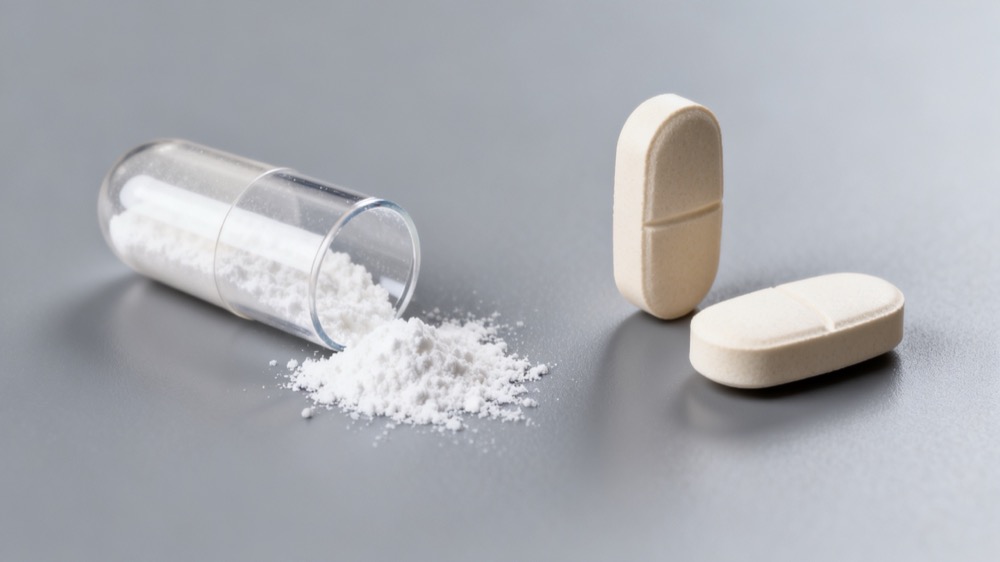
A tablet has to withstand ejection, handling, and transport without losing its ability to break up and release its contents. A freshly pressed core can look acceptable yet chip in a bottle or disintegrate more slowly after storage. When assessing an AKG tablet, look at mechanical and release results together. Do not select the hardest tablet automatically.
Direct compression means blending the powders and pressing them without a separate granulation step. Start there if the blend flows consistently and forms durable tablets. At pilot scale, check unit-weight variation, breaking force, and friability—the tendency to lose material through abrasion. Watch for sticking to the tooling and *capping*, when the top or bottom separates from the tablet. Repeat disintegration testing after storage and include dissolution where it is needed to evaluate release.
If the blend does not press reliably, change one factor at a time: ingredient grade, excipient system, or process route. Consider dry granulation when flow or compression is inadequate and you want to avoid adding liquid. If wet granulation or aqueous film coating is proposed, include a process comparison to see whether the added moisture and drying steps affect the core. A coated tablet still needs a package that protects it under the intended storage conditions.
Set baseline measurements and acceptance criteria for the attributes that matter to the product. An *assay* measures how much AKG is present. *Disintegration* measures how the unit breaks apart under defined test conditions. *Dissolution* measures how much of the ingredient enters solution over time. These tests answer different questions: a passing assay does not show that a tablet releases its contents as intended, and normal disintegration does not establish chemical stability.
Ask the laboratory to confirm that the assay is suitable for the finished blend, not just the raw material. If the method is intended to detect degradation, it should distinguish AKG from relevant degradation products and formulation interference. Set format-specific checks as well: shell integrity for capsules and mechanical strength for tablets.
Match prototypes on the intended amount of AKG rather than equal powder weight. Keep the initial packaging consistent where possible. Then compare the leading candidates in the packages you could actually commercialize. This sequence helps separate a formulation problem from a package problem without changing the AKG form, excipients, process, and package all at once. Record the raw-material lot and process settings so a promising result can be reproduced at scale.
| What you observe | What to test next |
|---|---|
| Capsule shells crack, but the fill remains free-flowing | Repeat the comparison with an alternative shell and check whether the fill is drawing moisture from the shell |
| Both capsule fills cake during storage | Compare moisture uptake in the loose blend and in the candidate packs |
| Tablets look normal, but disintegration slows | Compare compression settings and stored versus initial results; use dissolution testing if release remains in question |
| Assay falls in both formats | Verify the analytical result, then compare retained raw material, finished blends, and packaged units to narrow down the cause |
A bottle and a unit-dose blister expose the product differently during use. For a bottle, assess the container, closure, seal, and any desiccant as a system. If repeated opening is part of normal use, consider an in-use study that reflects it. For a blister, evaluate the specific material and seal configuration. A passing result in a sealed laboratory container does not establish stability in a different commercial package.
The pharmaceutical stability framework uses 40°C/75% RH as a common accelerated condition, where RH means relative humidity. It can inform a stress-screening plan, but it is not a blanket requirement for supplements or a shortcut to a shelf-life claim. Use accelerated testing to help identify weaknesses, and build real-time evidence for the proposed shelf life in the intended pack. Verify the requirements for the product category and destination market separately.
Consider a hypothetical pilot in which a calcium AKG tablet meets its initial specifications, but disintegration slows after humid storage. Its assay is unchanged. An HPMC capsule containing the same AKG grade shows no comparable change in disintegration. That result does not prove the ingredient is more stable in capsules. It points to a difference in how the finished formats perform under the test conditions.
The next experiment should keep the AKG lot fixed and compare two tablet compression settings in the same package. Separately, compare the best-performing setting in two candidate packages. If disintegration changes with compression, investigate the tablet core. If it changes mainly with packaging, focus on moisture protection. If neither comparison explains the result, review the excipient system and manufacturing process before switching ingredient forms. The objective is to identify which variable to change, rather than reformulate on the strength of one failed result.
Ask prospective partners for the exact material identity, a representative certificate of analysis, and the assay basis before comparing prices. A quote per kilogram is difficult to interpret when one option is the free acid and another is a hydrated calcium salt. Compare the cost per verified serving, including excipients, shell or coating, packaging, and stability work. Also establish who owns the test methods, retains samples, and approves changes in ingredient grade, manufacturing site, or packaging.
Send ZHENYIBIO TECHNOLOGY INC your target market, intended AKG amount per serving, maximum unit size, preferred capsule or tablet format, and proposed packaging. Ask for a feasibility discussion covering material documentation, pilot options, and stability responsibilities. ZHENYIBIO's stated manufacturing focus is plant-derived cosmetic actives and fermentation-enabled ingredients; confirm oral-product sourcing or OEM/ODM scope separately before commissioning a pilot.
Not by weight. Calcium and any water of hydration contribute to the salt's mass. Define whether the target is expressed as calcium AKG, the AKG portion, or free-acid equivalent, then calculate the input from the verified grade and assay basis.
No universal ranking should be assumed. Compare the selected grades and finished formulations under the same conditions. A difference in powder handling, shell condition, or tablet breakup is not necessarily a difference in chemical stability.
They are a sensible candidate when shell moisture or brittleness is a concern. They are not automatically better for every fill, and neither shell replaces protective packaging. Test the filled capsules in the proposed pack.
It can if the blend compresses well and the resulting tablet remains practical to swallow. Compare the actual capsule fill volume with pilot tablet dimensions at the same AKG-equivalent dose. Do not choose by powder weight alone.
Not on its own. Accelerated data can inform the stability assessment, but the shelf-life decision should account for real-time results, the commercial pack, and the requirements of the destination market.
Do not assume the data transfer. Even if the ingredient name is unchanged, compare hydration state, assay basis, and physical properties. Assess whether the change affects filling, compression, or finished-product performance before deciding what testing to repeat.
- [National Library of Medicine, PubChem — Alpha-Ketoglutarate]. Chemical identity, molecular formula, and molecular weight of the alpha-ketoglutarate ion. [pubchem.ncbi.nlm.nih]
- [Fisher Scientific — CAS 328-50-7: Alpha-Ketoglutaric Acid]. Free-acid identity, formula, and molecular weight used for the theoretical dose comparison. [fishersci]
- [National Library of Medicine, MeSH — Ketoglutaric Acids]. Terminology for ketoglutaric acids and calcium alpha-ketoglutarate. [meshb.nlm.nih]
- [Vlad et al. — Hydroxypropyl Methylcellulose—A Key Excipient in Pharmaceutical Drug Delivery Systems]. Review of HPMC in capsules, tablets, and coatings, including shell moisture considerations. [pmc.ncbi.nlm.nih]
- [Tablets & Capsules — HPMC Capsules and Hygroscopic Fills: Some Clarification]. Technical discussion of moisture transfer and why shell selection does not replace protective packaging. [tabletscapsules]
- [FDA / ICH — Q1A(R2): Stability Testing of New Drug Substances and Products]. Pharmaceutical reference for accelerated and long-term testing, stability attributes, and container-closure evaluation. [fda]
- [ICH — Q6A: Specifications, Test Procedures and Acceptance Criteria for New Drug Substances and New Drug Products]. Pharmaceutical reference for specifications and the distinction between disintegration and dissolution testing. [database.ich]
- [European Medicines Agency — ICH Q1 Guideline on Stability Testing of Drug Substances and Drug Products]. Regulatory context for stability studies and environmental factors. [ema.europa]


