


Views: 264 Author: ZHENYIBIO Publish Time: 2026-11-14 Origin: Site
Content Menu
● Why Salicylic Acid Solubility in Water Limits Your Options
● Ethanol vs. Propylene Glycol vs. Propanediol
>> When Ethanol Makes Sense for Salicylic Acid
>> When to Choose Propylene Glycol or 1,3-Propanediol
● How pH Changes Salicylic Acid Solubility
● A Bench Screen That Tests More Than Premix Clarity
>> Step 1: Define What a Passing Formula Looks Like
>> Step 2: Hold the Base Constant and Change the Solvent System
>> Step 3: Challenge the Finished Formula After Cooling
● Worked Example: A Clear, Ethanol-Free Serum
● Check Market Classification Before Locking the Formula
● Develop Your Salicylic Acid Formula With ZHENYIBIO
>> Can I dissolve salicylic acid in water alone?
>> Is propanediol a direct replacement for propylene glycol?
>> Why does salicylic acid crystallize after the batch cools?
>> Does a higher pH make salicylic acid less effective?
>> Can I replace powdered salicylic acid with a supplier's water-dispersible grade?
>> Is a clear sample proof that the formula is stable?
The right solvent for salicylic acid is the one that keeps the active dissolved in the finished acne skincare formulation—not just in the premix. Ethanol is a useful starting point when fast dry-down matters. Propylene glycol and 1,3-propanediol are candidates when the brief calls for an ethanol-free formula. In every case, the decision comes down to what happens after you add water, adjust pH, cool the batch, and fill it into the intended package.
For a brand developing a clear serum, a targeted gel, or a rinse-off cleanser, that distinction can prevent an expensive reformulation. A premix that looks clear on the bench tells you how the active behaves in that premix. It does not tell you whether the finished product will still be clear after cold storage or whether it will feel right on the skin.

At 25 °C, a commonly reported water solubility for salicylic acid is about 2.24 g/L. That corresponds to roughly 0.22% weight per volume, not 0.22% by weight. The distinction matters when comparing published data with a commercial formula expressed in weight percent. Either way, plain water is a weak starting solvent for many formulas targeting a higher dissolved active level.
A co-solvent is a second solvent added to change what the liquid mixture can dissolve. It can help you make a clear salicylic acid concentrate, but adding that concentrate to an aqueous base changes the solvent composition. A warm batch may stay clear as you mix it, then develop haze or crystals once it cools. A clear concentrate is therefore a useful first checkpoint, not a stability result.
Before choosing a solvent, define three things: the intended active concentration, the finished product format, and the maximum solvent level the product can accommodate without sacrificing skin feel, packaging compatibility, or the brief.
Compare solvents at the finished-product level. A candidate that dissolves more salicylic acid on its own does not necessarily make the better serum or cleanser once dilution, pH, and sensory targets enter the picture.
| Solvent or system | When to screen it | What to check in the finished formula |
|---|---|---|
| Ethanol | Clear liquids or targeted products where fast dry-down matters | Stinging or dryness in use, alcohol loss through the package, and residue at the dispensing tip |
| Propylene glycol | Ethanol-free gels or aqueous blends where some humectancy is welcome | Tack at the level needed for solubility, gel viscosity, and clarity after cooling |
| 1,3-Propanediol | Ethanol-free serums or briefs that call for a documented bio-based solvent grade | Supplier-specific solubility data, water-dilution tolerance, and afterfeel |
| Blended co-solvents | Products where one solvent meets the clarity target but misses the sensory brief | Whether the blend improves the finished product without narrowing the manufacturing window |
| Water with pH adjustment | Formulas where a higher proportion of ionized salicylate is acceptable | Final pH, active form, claim suitability, and stability if pH drifts |
Salicylic acid is much more soluble in ethanol than in water, making ethanol a useful benchmark for early development. In a targeted liquid, it may also help deliver the quick dry-down the brief calls for. But fast evaporation is not always an advantage. If ethanol escapes from the pack, the remaining liquid has a different composition from the formula you originally tested.
Evaluate the product in the actual closure, not just in a sealed laboratory vial. Compare the first and last doses during simulated use. If crystals appear around the nozzle but not in the bulk, investigate local evaporation before assuming the entire formula lacks solvent capacity.
Propylene glycol is a practical candidate when ethanol is excluded and the product can accommodate the afterfeel of a glycol-rich system. Screen 1,3-propanediol alongside it when skin feel or documented renewable sourcing is important. They are different ingredients; replacing one with the other at the same percentage is a test condition, not a validated substitution.
Ask suppliers whether their solubility data come from the neat solvent or a water-containing blend, and at what temperature. A useful comparison reports the exact grade, solvent-to-water ratio, and whether the reading was taken after the sample cooled. For bio-based sourcing claims, request documentation for the specific grade rather than inferring its origin from the ingredient name.
Salicylic acid has an aqueous pKa near 2.97. The pKa is the point at which the dissolved acid and its ionized form, salicylate, are present in roughly equal proportions under ideal dilute aqueous conditions. Raising pH favors salicylate and can increase the total amount that appears dissolved. Lowering pH shifts the balance toward the un-ionized acid and can expose a solubility problem that was hidden at the higher pH.
For example, in a simplified aqueous calculation, about 48% of the dissolved salicylic acid species are un-ionized at pH 3.0, versus about 9% at pH 4.0. These figures illustrate the chemistry, not a recommended pH range. Mixed solvents and other formulation ingredients can shift the result, and the calculated fraction does not establish skin delivery, tolerability, or acne efficacy.
Set the pH window around the finished product, not around one calculation. Check whether the thickener, preservative system, botanical ingredients, and packaging are compatible with that window. Then track pH during stability testing alongside appearance and active content. If pH falls as crystals appear, test whether the change explains the precipitation rather than immediately adding more solvent.
Write down the proposed active level, pH window, viscosity range, appearance, packaging, and skin-feel targets. If the product is a clear toner, haze may be a failure. If it is an opaque cleanser, appearance alone will not tell you whether the active has crystallized. Decide how you will detect particles and how you will verify active content before screening.
Compare an ethanol benchmark where the brief permits it, a propylene glycol version, a 1,3-propanediol version, and a blend if the first results justify one. Hold the active level and other ingredients constant where practical, accounting for each solvent change in the water balance. Record the solvent grade, addition order, batch temperature, and pH. Otherwise, a change in process can be mistaken for a difference between solvents.
Inspect the complete formula after it cools and equilibrates, then put the strongest candidates into the intended packaging. Use storage conditions that reflect realistic cold, ambient, and warm exposures. Compare clarity, crystals, pH, viscosity, and dispensing behavior. For a volatile system, track package weight where appropriate. If active content is critical, use a fit-for-purpose assay. A total-active result can still look acceptable when some active has precipitated, so interpret it alongside physical inspection.
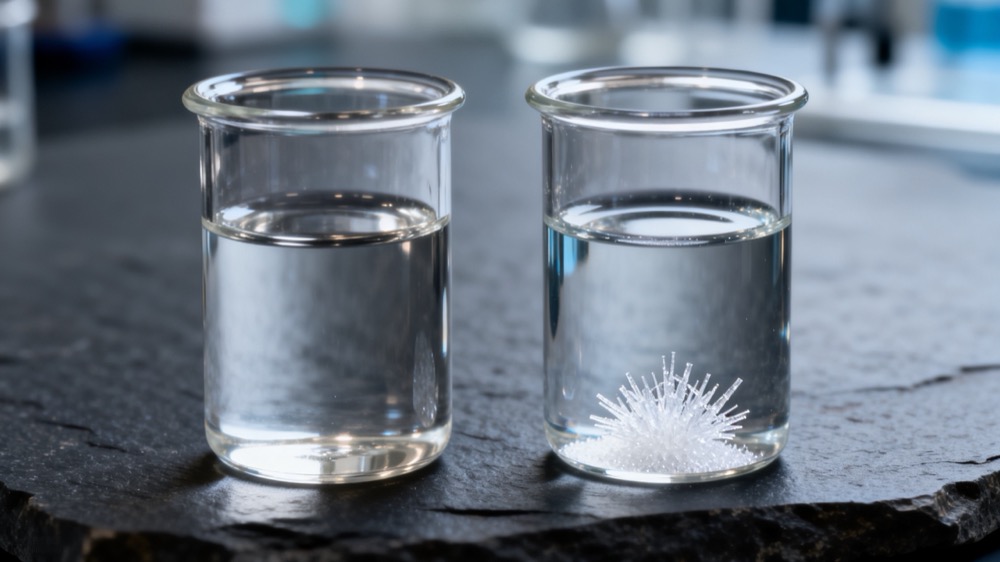
Suppose a brand requests a clear serum containing 1.0% salicylic acid by weight, without ethanol. A 10% premix used at 10% of the finished batch delivers 1.0% active. If that premix contains only salicylic acid and one solvent, it also contributes 9.0% solvent. The calculation confirms the formula balance; it does not confirm that 9.0% solvent can keep the active dissolved in the water-rich serum.
Here is how a formulation team could interpret three different outcomes:
- The premix is clear, but the serum clouds as soon as water is added. Screen a different solvent blend or a revised water-to-solvent ratio at the same target pH.
- The serum stays clear overnight but forms crystals during cold storage. Compare controlled-temperature samples and look for a formulation that remains clear beyond the initial bench conditions.
- The base passes, but haze appears after a botanical extract is added. Compare the base and finished serum side by side, and check the extract carrier and any change in pH before attributing the haze to salicylic acid.
This is a hypothetical development example, not a production formula. It shows why the fastest route to a solution is often to identify when the failure starts rather than simply increasing solvent.
In the United States, the topical OTC acne drug monograph lists salicylic acid at 0.5% to 2% as an active ingredient. The concentration alone does not establish compliance: the product must also meet applicable monograph conditions, including labeling requirements. In the European Union, cosmetic restrictions depend on the product category and the ingredient's function. A U.S. acne drug concentration is not a blanket allowance for an EU cosmetic.
For an export brief, confirm the destination, intended claims, product format, application site, and target users before committing to the active level or package artwork. Resolve those choices early enough that a classification change does not force a new solvent screen.
For an OEM or ODM project, send ZHENYIBIO TECHNOLOGY INC your target market, active level, product format, excluded ingredients, botanical or fermentation-derived actives, and proposed packaging. If an existing prototype has failed, include when it turned cloudy, the temperature, and the last recorded pH. Ask for a comparison of candidate solvent systems against agreed clarity, skin-feel, and stability criteria before approving a pilot batch.
Only to a limited extent under ordinary room-temperature conditions. If your target exceeds that range, screen a co-solvent or a pH-adjusted system. Confirm the result in the finished base rather than relying on the clarity of a warm water premix.
No. Screen the two at comparable levels, then check finished-product clarity, viscosity, and afterfeel. A substitution that works in one toner may fail in another because the water content, pH, or other ingredients differ.
The warm batch may have dissolved more salicylic acid than the cooler liquid can hold. Check cooling, dilution, and pH together: a crystal appearing after cooling does not, by itself, identify which variable caused the failure.
Not necessarily. Higher pH changes the balance between un-ionized salicylic acid and salicylate. That shift alone does not predict the finished product's performance. The vehicle, contact time, tolerability, and supporting evidence also matter.
Not gram for gram without checking the active content. For example, a grade containing 40% salicylic acid by weight requires 2.5% of that grade to supply 1.0% active. Verify the grade's composition, processing instructions, regulatory suitability, and performance in your base.
No. It shows only that no visible particles or haze were observed at that point. Recheck after storage and in-use exposure, and assess active content and dispensing performance separately.
- National Library of Medicine, PubChem. *Salicylic Acid, Compound Summary, CID 338.* Aggregated physical-property data for water and ethanol solubility and acid dissociation constants. [pubchem.ncbi.nlm.nih]
- Dabagh et al. (2024). *Investigation of the Solubility and Thermodynamics of Salicylic Acid in Binary Solvent Mixtures.* Experimental data on the effects of solvent composition and temperature, including measurements in neat propylene glycol. [pmc.ncbi.nlm.nih]
- Zemea® Propanediol technical literature. *Personal Care Formulation Examples.* Supplier data illustrating the use of 1,3-propanediol in a salicylic acid formulation; not a universal solubility specification. [digital.h5mag]
- U.S. Food and Drug Administration. *OTC Monograph M006: Topical Acne Drug Products for Over-the-Counter Human Use.* Final administrative order covering permitted active ingredients and applicable monograph conditions. [accessdata.fda]
- European Commission, Scientific Committee on Consumer Safety. *Opinion on Salicylic Acid (CAS No. 69-72-7, EC No. 200-712-3).* Scientific assessment and discussion of EU cosmetic categories and restrictions; consult the applicable consolidated regulation for a market release decision. [health.ec.europa]


