


Views: 257 Author: ZHENYIBIO Publish Time: 2026-11-11 Origin: Site
Content Menu
● HMB-Ca vs. L-Arginine AKG: Key Differences
● What Is HMB-Ca, and Why Is It Studied for Muscle Maintenance?
>> How HMB-Ca Relates to Muscle Protein Turnover
>> Does HMB-Ca Prevent Sarcopenia?
● What Is L-Arginine AKG, and Why Is It Used in Pump Formulas?
>> Does AAKG Reliably Increase Blood Flow?
>> Does AAKG Improve Strength?
● HMB-Ca vs. AAKG for Nutricosmetics: Where Does Beauty Fit?
>> Muscle Maintenance Is Not a Skin Benefit
>> Separate Brand Narrative From Demonstrated Outcomes
● What Recent HMB Research Means for Ingredient Buyers
● Dosage, Safety, and Formulation Considerations
>> HMB-Ca: Confirm the Delivered HMB Amount
>> AAKG: Verify Composition Before Comparing Doses
>> Safety Requires Population-Specific Review
● A Practical OEM and ODM Development Framework
>> Step 1: Write a Benefit Brief
>> Step 2: Build a Claim-to-Evidence Matrix
>> Step 3: Test the Finished Formula
>> Step 4: Verify Sustainability Separately
● Develop a Formula With a Clear Purpose
>> Is HMB-Ca Better Than L-Arginine AKG for Older Adults?
>> Can HMB-Ca Prevent Sarcopenia?
>> Does AAKG Guarantee a Stronger Workout Pump?
>> Can HMB-Ca and AAKG Be Combined?
>> Do These Ingredients Improve Skin Appearance?
>> Which Ingredient Is Better for a Beauty-From-Within Brand?
HMB-Ca vs. L-Arginine AKG is a comparison between two different product-development strategies: supporting muscle maintenance during aging and targeting exercise-related blood flow. For brands exploring active-aging supplements, sports nutrition, or beauty-from-within products, these ingredients are not interchangeable.
HMB-Ca has a more relevant evidence base for muscle preservation, particularly in older adults. L-Arginine AKG is associated with nitric oxide and workout-pump positioning, but its clinical results are inconsistent. Neither ingredient should automatically be presented as a proven skin-rejuvenation active.
From a formulation perspective, my starting question is simple: what measurable benefit should the finished product deliver? For ZHENYIBIO TECHNOLOGY INC and its international OEM and ODM customers, answering that question first creates a stronger foundation for ingredient selection, testing, and responsible communication.

| Comparison | HMB-Ca | L-Arginine AKG |
|---|---|---|
| Full name | Calcium beta-hydroxy-beta-methylbutyrate | L-arginine alpha-ketoglutarate, commonly AAKG |
| Ingredient identity | Calcium salt of a leucine metabolite | Combination of L-arginine and alpha-ketoglutarate |
| Main research focus | Muscle protein turnover, strength, and recovery | Arginine availability, nitric oxide, and exercise performance |
| Most relevant positioning | Muscle maintenance and active aging | Pre-workout and active-lifestyle products |
| Evidence limitation | Benefits vary by population and outcome | More circulating arginine does not consistently improve blood flow |
| Direct beauty evidence | Insufficient for established skin claims | Insufficient for established skin claims |
| Development priority | Match the studied form, dose, and population | Verify composition and substantiate the intended benefit |
The practical distinction is between preserving muscle function over time and attempting to influence an exercise response. A temporary pump is not evidence of lasting muscle growth, and muscle maintenance is not evidence of improved skin appearance.
HMB is a metabolite of leucine, an essential amino acid involved in muscle metabolism. HMB-Ca is its calcium-salt form. Another studied form is free-acid HMB; findings should not be transferred between forms without checking the original research.
Muscle tissue continually undergoes protein synthesis and breakdown. HMB research focuses on its potential to support synthesis and reduce breakdown, particularly when maintaining muscle becomes difficult.
This explains its relevance to aging, inactivity, and recovery-oriented nutrition. However, a plausible biological mechanism is only the beginning. A commercially useful claim requires human evidence showing a meaningful benefit in the intended consumer group.
Sarcopenia involves age-associated deterioration in muscle strength, muscle quantity or quality, and physical performance. "Sarcopenia prevention" is therefore a substantially stronger claim than "supports muscle maintenance."
A 2025 systematic review included five randomized controlled trials in patients diagnosed with sarcopenia. It reported improvements in skeletal muscle mass index and handgrip strength, but no significant improvement in gait speed.
The analysis included 154 participants for muscle-mass outcomes and 359 for strength and physical-performance outcomes. These are outcome-specific sample totals, not separate populations that should be added together.
The important limitation is that improving selected measurements in people who already have sarcopenia does not establish prevention in healthy consumers. The review also evaluated HMB interventions generally; product developers must check which formulations support their specific HMB-Ca proposition.
L-Arginine AKG combines L-arginine with alpha-ketoglutarate. Arginine serves as a substrate for nitric oxide production, while alpha-ketoglutarate participates in cellular metabolism.
Nitric oxide helps regulate blood-vessel dilation. That relationship explains why AAKG appears in pre-workout products marketed around circulation and muscular fullness.
Not necessarily.
In a randomized study involving 24 physically active men, seven days of supplementation with an AAKG-containing product increased circulating arginine. However, it did not produce greater exercise-related brachial-artery blood flow or nitric oxide metabolite responses than placebo.
That distinction matters: biomarker changes do not automatically establish consumer benefits.
A higher blood concentration of an ingredient can confirm exposure without proving better circulation, greater performance, or a stronger pump.
A separate randomized crossover study tested a single 3,000 mg AAKG dose in 16 trained and untrained men. It found no improvement in bench-press or leg-press maximum strength or total exercise volume.
These trials do not resolve every possible dose or formulation question. Nevertheless, they do challenge blanket statements that AAKG reliably increases strength or pump.
Research on ordinary L-arginine also cannot automatically substantiate claims for every AAKG product. Ingredient form, composition, dose, and study conditions remain important.
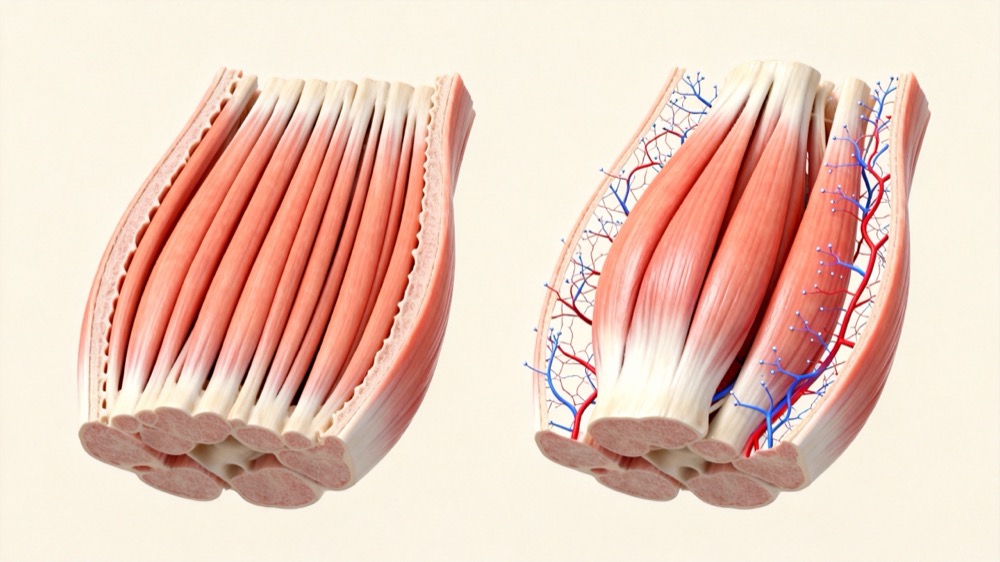
The comparison becomes more complicated when either ingredient is positioned as a nutricosmetic rather than a sports or healthy-aging supplement.
A product can support an active-aging concept without demonstrating effects on wrinkles, elasticity, pigmentation, or hydration.
HMB's muscle research does not establish collagen regeneration or facial firming. Likewise, arginine's involvement in nitric oxide pathways does not establish that oral AAKG improves complexion.
The studies discussed here primarily address muscle and exercise outcomes, not validated cosmetic endpoints.
An active-lifestyle or healthy-aging narrative may fit a broader beauty-from-within range. But the narrative must not substitute for evidence.
For a skin-focused product, I would first define a measurable endpoint, such as hydration or elasticity. I would then require research relevant to that endpoint rather than borrowing credibility from muscle studies.
For ZHENYIBIO, this distinction supports a more disciplined development approach: connect botanical expertise and modern biotechnology with clearly defined benefits, while evaluating each additional ingredient on its own evidence.
Recent reviews offer useful guidance, but they do not support an unrestricted endorsement.
A 2024 meta-analysis reported benefits for handgrip strength while finding insufficient evidence of improvements across several other muscle and performance measurements. The 2025 review reported improvements in strength and skeletal muscle mass index, but not gait speed.
The difference reinforces three practical lessons:
1. Define the outcome precisely. Strength, muscle mass, and walking performance are related but different.
2. Examine the intervention. An HMB-containing nutritional supplement may include other relevant nutrients.
3. Match the population. Results in diagnosed patients may not predict outcomes in healthy younger adults.
My interpretation is that HMB presents a more credible starting point for muscle-maintenance development than AAKG. That is not the same as saying every HMB-Ca formula prevents age-related decline.
Many adult HMB studies use approximately 3 g daily. This is a research reference point, not a universal recommendation.
The specification and label should distinguish the weight of the calcium salt from the delivered HMB amount. Calcium contribution also needs consideration in the complete formula.
Gram-level daily delivery makes serving size important. Developers should compare capsules, powders, sachets, and beverages rather than assuming a compact beauty format will accommodate the target amount.
AAKG raw materials may differ in their arginine-to-alpha-ketoglutarate composition. Equal total weights therefore do not necessarily deliver equal quantities of arginine.
Before approving a specification, request:
- Ingredient identity and composition.
- Assay method and acceptance limits.
- Relevant contaminant and microbiological testing.
- Stability information.
- Evidence connecting the proposed serving to the intended claim.
The 3,000 mg acute trial is not a validated effective dose; it is a dose that produced no measurable performance benefit under those study conditions.
Short-term adult HMB studies generally report good tolerability at commonly studied amounts. However, authoritative sources differ in how confidently they interpret longer-term evidence.
Arginine can cause gastrointestinal discomfort and may lower blood pressure. General arginine safety information should not be treated as a complete safety dossier for every AAKG formulation.
Consumers using medication, managing chronic illness, or requiring clinical nutrition should obtain professional guidance. Finished-product assessment must also consider the other ingredients and total daily intake.
Start with the user, not the ingredient.
An older consumer seeking muscle-maintenance support has different needs from a gym user seeking a pre-workout experience. A beauty consumer expecting visible skin changes requires a different evidence package again.
Specify the audience, measurable outcome, serving format, and intended market.
| Proposed message | Evidence requirement | Main concern |
|---|---|---|
| Supports muscle maintenance | Relevant human muscle outcomes | Generalizing across populations |
| Improves workout pump | Direct blood-flow or relevant pump measurements | Relying only on arginine levels |
| Improves skin elasticity | Validated skin measurements | Extrapolating from muscle studies |
| Prevents sarcopenia | Appropriate prevention evidence and regulatory assessment | Confusing treatment research with prevention |
This matrix helps commercial and technical teams identify unsupported wording before packaging development begins.
A formula should not be approved solely because its individual ingredients have published research.
Evaluate serving feasibility, sensory acceptance, content uniformity, packaging compatibility, and stability. When making product-specific benefit claims, consider whether finished-product human testing is needed.
Combining HMB-Ca and AAKG does not itself establish synergy.
Neither ingredient should automatically be described as botanical, fermentation-derived, or sustainable.
Those descriptions require supplier documentation covering manufacturing routes, feedstocks, traceability, and the basis of environmental claims.
ZHENYIBIO's botanical and biofermentation positioning can guide sourcing priorities. It should not be used to imply an unverified production origin for these particular ingredients.
For muscle-maintenance products, HMB-Ca offers the more relevant research foundation. For pump-oriented products, AAKG requires particularly careful benefit substantiation. Neither should receive unsupported beauty or disease-prevention claims.
Contact ZHENYIBIO TECHNOLOGY INC with your target audience, destination market, preferred format, and intended benefit. Request an OEM or ODM consultation focused on ingredient documentation, formulation feasibility, and an evidence-aligned product brief.
HMB-Ca is more relevant to a muscle-maintenance concept because HMB has direct research in older and sarcopenic populations. Individual suitability still depends on health, nutrition, activity, and the proposed formulation.
Current evidence does not justify a universal prevention promise. Trials suggest possible improvements in selected muscle outcomes, but this does not establish that supplementation prevents sarcopenia in healthy people.
No. A controlled study increased circulating arginine without improving measured exercise-related blood flow compared with placebo. AAKG's mechanism is plausible, but its practical benefits are not consistently demonstrated.
They can be considered within one development brief, but complementary mechanisms do not prove additive benefits. Dose feasibility, tolerability, stability, and claim support require separate assessment.
The muscle and exercise studies reviewed here do not establish improvements in wrinkles, hydration, or elasticity. Skin claims require relevant human cosmetic outcomes.
Neither is automatically the better beauty ingredient. HMB-Ca better fits a muscle-maintenance proposition; AAKG fits an exercise-oriented concept with greater efficacy uncertainty. A skin-focused brand should prioritize skin-specific evidence.
1. "The effects of β-hydroxy-β-methylbutyrate supplementation in patients with sarcopenia: a systematic review and meta-analysis." 2025. Human clinical evidence on muscle mass, strength, and physical performance. [View PubMed record]. [pubmed.ncbi.nlm.nih]
2. Su H., et al. "The effects of β-hydroxy-β-methylbutyrate or HMB-rich nutritional supplements on sarcopenia patients: a systematic review and meta-analysis." *Frontiers in Medicine*, 2024;11:1348212. [Read the full article]. [frontiersin]
3. "International society of sports nutrition position stand: β-hydroxy-β-methylbutyrate (HMB)." 2024. Position statement discussing mechanisms, studied forms, efficacy, and safety. [View PubMed record]. [pubmed.ncbi.nlm.nih]
4. "Effects of 7 days of arginine-alpha-ketoglutarate supplementation on blood flow, plasma L-arginine, nitric oxide metabolites, and asymmetric dimethyl arginine after resistance exercise." 2011. [View PubMed record]. [pubmed.ncbi.nlm.nih]
5. "Acute L-arginine alpha ketoglutarate supplementation fails to improve muscular performance in resistance trained and untrained men." 2012. Randomized crossover exercise study. [Read the full article]. [pmc.ncbi.nlm.nih]
6. National Institutes of Health, Office of Dietary Supplements. "Dietary Supplements for Exercise and Athletic Performance: Fact Sheet for Health Professionals." Evidence and safety summaries for arginine and HMB. [Read the fact sheet]. [ods.od.nih]


