


Views: 264 Author: ZHENYIBIO Publish Time: 2026-11-07 Origin: Site
Content Menu
● 1. Start Your Cosmetic Ingredient Formulation Guide With a Product Brief
● 2. Document Ingredient Identity, Function, and Quality
>> Botanical Ingredient Documentation
● 3. Specify Ingredient Concentrations and the Complete Formula
>> Set Evidence-Based Use Levels
● 4. Explain Ingredient Compatibility and Processing Conditions
>> Write a Reproducible Manufacturing Procedure
● 5. Give Fermented Botanical Ingredients Their Own Evaluation
● 6. Build Safety and Microbiological Protection Into Development
>> Separate Microbial Quality From Preservation Performance
● 7. Establish a Stability and Packaging Compatibility Plan
● 8. Connect Cosmetic Claims to the Right Evidence
>> Create a Claim-to-Evidence Matrix
● 9. Include Market-Specific Compliance and Sustainability Records
>> Make Sustainability Claims Specific
● 10. Add an OEM/ODM Development and Scale-Up Roadmap
>> An Illustrative Botanical Serum Decision
● Turn Your Formulation Brief Into a Development Plan
>> What is the difference between an ingredient list and a formulation guide?
>> Can botanical extracts replace cosmetic preservatives?
>> Are fermented cosmetic ingredients always more effective?
>> How do I choose the correct botanical active concentration?
>> How long does cosmetic stability testing take?
>> What should I send an OEM or ODM development partner?
A complete cosmetic ingredient formulation guide should explain ingredient selection, effective use levels, compatibility, manufacturing procedures, safety assessment, stability testing, regulatory requirements, and scale-up. It should connect every ingredient decision to a measurable product objective—not simply provide a recipe.
For brands, wholesalers, and manufacturers developing botanical skincare, the challenge is especially important. Plant-derived ingredients bring distinctive sourcing, composition, preservation, and consistency considerations. Fermentation adds further questions about material identity and processing.
At ZHENYIBIO TECHNOLOGY INC, our focus combines natural botanical actives with modern biofermentation. Our perspective is straightforward: traditional plant knowledge can inspire development, but specifications, testing, and traceable documentation must support commercialization.
This guide outlines what your formulation documentation should contain—and how to make it useful throughout an OEM or ODM project.

Before choosing ingredients, define the product's purpose, intended users, and commercial requirements.
A useful brief answers:
- What cosmetic benefit should the product deliver?
- Is it leave-on or rinse-off?
- Where will it be applied?
- Which markets will it enter?
- What texture, fragrance, and appearance are acceptable?
- What packaging, price, and launch schedule are required?
Translate broad ambitions into testable objectives. "Premium botanical serum" is a positioning statement. "Lightweight serum with acceptable tack, defined viscosity, and hydration measured under a specified protocol" is a development brief.
My preferred starting question is: "What evidence will convince us that this formula works as intended?" Answering early helps prevent expensive reformulation later.
A professional cosmetic formulation guide needs more than trade names and supplier brochures.
Each raw material should have a documented identity, purpose, specification, and approval status.
| Documentation item | What the guide should capture |
|---|---|
| Ingredient identity | INCI name, supplier code, and composition |
| Functional role | Humectant, emollient, emulsifier, preservative, or active |
| Quality specifications | Relevant chemical, physical, and microbial limits |
| Processing requirements | Solubility, addition phase, and temperature restrictions |
| Supporting documents | Technical data, safety information, and batch certificate |
| Traceability | Supplier, manufacturing location, and lot identification |
A certificate of analysis describes specified batch results. It does not, by itself, establish finished-product safety or efficacy.
For plant-derived materials, request the botanical species, plant part, extraction method, carrier system, and relevant marker specifications.
Also consider risk-based testing for contaminants, including pesticide residues, heavy metals, residual solvents, and microorganisms.
Two extracts from the same plant are not automatically interchangeable. Different processing methods and specifications can produce materially different ingredients.
Record every raw material as a percentage by weight, with the total reaching 100%.
Include carriers and preservatives supplied within commercial blends. Otherwise, the development team may misunderstand the finished product's composition.
Distinguish between:
- The percentage of a commercial ingredient added.
- Its dry-solids content.
- Its standardized marker concentration.
- The concentration used in supporting studies.
For example, adding a hypothetical extract at 2%, when that extract contains 5% of a specified marker, delivers 0.1% marker in the finished formula by weight. That calculation establishes composition—not proven efficacy.
Do not treat a supplier's recommended range as universal proof of performance.
Review whether the evidence concerns the same ingredient grade, concentration, vehicle, application conditions, and endpoint.
Increasing concentration may also change sensory properties, color, preservation requirements, or tolerability. The appropriate level balances performance, safety, stability, and cost.
An ingredient can perform well independently yet behave differently inside a complete formula.
Your cosmetic ingredient compatibility guide should identify potential interactions involving:
- pH and electrolyte concentration.
- Solvents and solubilizers.
- Emulsifiers and rheology modifiers.
- Preservatives and botanical materials.
- Oxidation-sensitive components.
- Packaging-contact materials.
Define the intended pH range using the requirements of the whole system. Avoid selecting pH solely because one featured active prefers it.
Include order of addition, mixing equipment, temperature ranges, hold times, cooling conditions, and adjustment procedures.
"Mix until uniform" is insufficient when reproducibility depends on controlled processing.
Record when pH is measured, how viscosity is tested, and whether samples require equilibration. Define acceptance limits before comparing prototypes.
For production transfer, document equipment geometry and mixing conditions rather than assuming laboratory mixer speed can be copied directly.
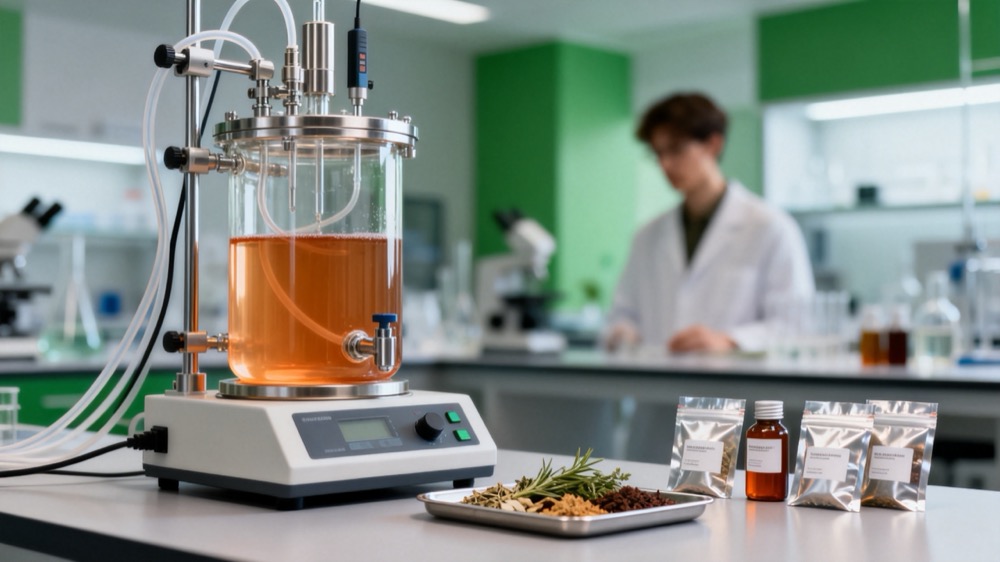
Biofermentation deserves a dedicated section rather than a marketing footnote.
For each material, ask:
1. What substrate is fermented?
2. Which microorganism or strain is used?
3. What downstream processing follows?
4. What exactly is present in the supplied ingredient?
5. Which specifications demonstrate batch consistency?
6. What evidence supports its proposed cosmetic function?
Clarify whether the material is a filtrate, lysate, extract, or another preparation. Do not imply that every fermented ingredient contains living microorganisms.
Likewise, fermentation alone does not prove better absorption, superior efficacy, reduced irritation, or lower environmental impact.
For ZHENYIBIO's botanical and fermentation-focused development approach, the useful distinction is between an appealing process story and a demonstrable ingredient advantage. Both can matter, but they require different evidence.
Natural origin is not a substitute for safety assessment.
A complete skincare formulation guide should address intended exposure, ingredient toxicology, impurities, foreseeable use, and relevant interactions. Testing should follow the product's risk profile and destination-market requirements.
For water-containing products, preservation cannot be an afterthought. Contamination may originate from raw materials, water, manufacturing, packaging, storage, or consumer use.
Routine microbial testing evaluates the tested sample's microbiological quality. Preservative efficacy testing evaluates the formulation's ability to withstand an intentional microbial challenge under a defined method.
These tests answer different questions.
Document:
- Water-quality controls.
- Raw-material microbial specifications.
- Manufacturing hygiene.
- Preservative selection and compatibility.
- Applicable challenge-test methods and acceptance criteria.
- Any justified low-risk assessment.
Antioxidants help address oxidation; they should not be mistaken for antimicrobial preservatives. Similarly, airless packaging does not automatically eliminate preservation requirements.
A formula is not commercially ready because a fresh sample looks attractive.
Your cosmetic formulation stability testing plan should define storage conditions, sampling intervals, methods, and acceptance criteria.
Typical observations include:
| Parameter | What it helps evaluate |
|---|---|
| Appearance and odor | Visible deterioration or unacceptable change |
| pH | Drift affecting compatibility or product quality |
| Viscosity | Texture consistency and dispensing performance |
| Separation or precipitation | Physical instability |
| Relevant marker content | Chemical stability, where justified |
| Package integrity | Leakage, deformation, or component failure |
Choose conditions according to the formulation, packaging, intended distribution, and technical justification.
Accelerated studies support development decisions, but a short elevated-temperature study should not automatically become a multi-year shelf-life claim.
Test the intended commercial package. Pumps, liners, seals, and container materials can influence product performance. Packaging compatibility belongs in the development program, not just the purchasing checklist.
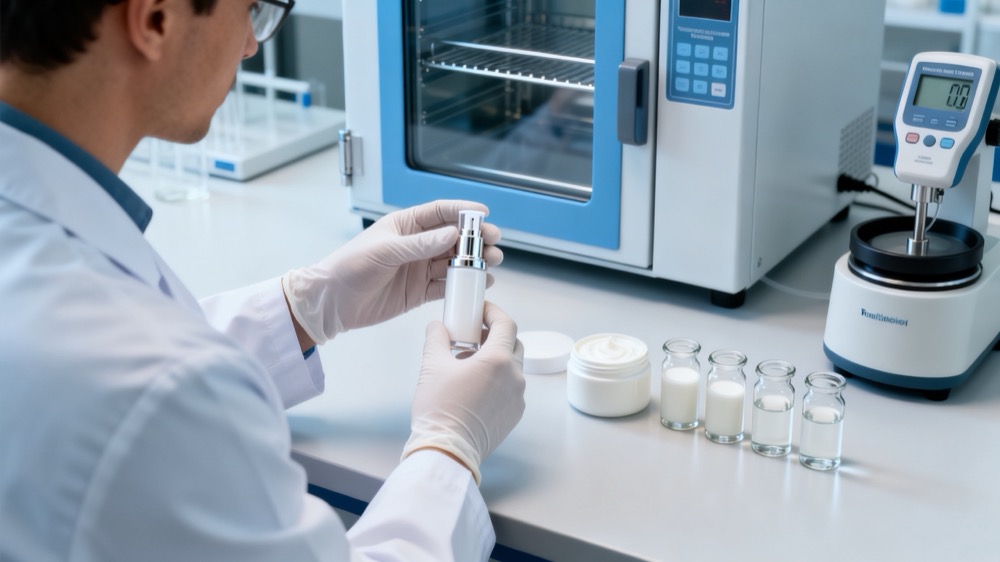
A convincing ingredient narrative is not equivalent to proof that the finished product delivers the advertised benefit.
Organize evidence according to what it actually supports:
- Ingredient characterization establishes identity and composition.
- Laboratory studies can support mechanisms or screening decisions.
- Finished-product instrumental studies measure defined outcomes.
- Consumer studies assess perceptions under stated conditions.
These evidence types are complementary, not interchangeable.
| Proposed claim | Evidence planning question |
|---|---|
| "Improves hydration" | Was hydration measured on the finished product? |
| "Suitable for sensitive skin" | Were the population and assessment appropriate? |
| "Clinically tested" | What was tested, by whom, and with what results? |
| "Fermented botanical formula" | Do composition and processing records support the description? |
Match wording to study design and results. Avoid converting an ingredient's laboratory result into an unqualified finished-product claim.
Keep cosmetic positioning distinct from disease-treatment claims, which may change the product's regulatory classification.
A global cosmetic ingredient formulation guide needs separate market checklists.
For the European Union, planning should address the responsible person, safety assessment, Cosmetic Product Safety Report, Product Information File, notification, labeling, and applicable ingredient restrictions.
In the United States, assess applicable MoCRA obligations, including safety substantiation, facility registration, product listing, and adverse-event responsibilities. Exemptions and applicability require product-specific review.
Registration or listing should never be presented as product approval. Check current requirements before launch rather than relying on an old formulation template.
Ask what "sustainable" means for the particular ingredient or process.
Relevant documentation may concern sourcing traceability, extraction solvents, manufacturing inputs, waste handling, or comparative environmental assessment.
Botanical origin and fermentation do not independently establish a lower environmental footprint. Comparative claims need a defined baseline, scope, and method.
For international buyers, the guide should explain how a concept becomes a repeatable commercial product.
Define responsibilities for formulation ownership, testing, packaging approval, regulatory documents, procurement, and batch release. OEM and ODM arrangements vary, so contractual responsibilities should be explicit.
A practical approval sequence is:
1. Approve the brief and target specifications.
2. Review ingredient documentation and feasibility.
3. Select and evaluate laboratory prototypes.
4. Approve the testing and claims plan.
5. Manufacture and assess a pilot batch.
6. Confirm packaging compatibility and production controls.
7. Authorize commercial release after required reviews.
Include minimum order quantities, lead times, change-control procedures, and substitution rules. A supplier change should trigger a documented impact assessment—not an assumption of equivalence.
Suppose a prototype serum develops sediment after adding a botanical extract.
Do not immediately increase the solubilizer. First examine extract solubility, carrier composition, pH, electrolyte loading, processing order, and changes over storage.
Compare controlled prototypes while changing one relevant variable at a time. Record observations and retain samples.
This is an illustrative troubleshooting workflow, not a reported ZHENYIBIO project or validated commercial formula.
A complete guide creates a traceable path from ingredient selection to commercial release.
Share your project brief with ZHENYIBIO TECHNOLOGY INC to discuss botanical active selection, fermentation-derived ingredient options, and OEM/ODM requirements. Request the technical documentation and project-specific testing plan needed to evaluate your concept before committing to production.
An ingredient list identifies components. A formulation guide also documents quantities, functions, processing, specifications, testing, evidence, and commercialization requirements.
Not without appropriate evidence. A botanical material's antimicrobial activity in a laboratory assay does not establish adequate preservation of the finished formulation.
No. Effectiveness depends on the specific material, composition, concentration, formulation, and supporting studies. Fermentation describes processing, not guaranteed performance.
Review supplier specifications, relevant efficacy evidence, safety information, compatibility, and finished-product testing. Distinguish commercial-blend dosage from active or marker concentration.
There is no universal duration. The program depends on the product, packaging, intended shelf life, storage conditions, and technical justification.
Provide target markets, product format, desired benefits, ingredient preferences, packaging concept, budget, expected volume, and launch schedule. Identify mandatory exclusions and required supporting documents.
1. U.S. Food and Drug Administration. *Modernization of Cosmetics Regulation Act of 2022 (MoCRA).* Official overview of safety substantiation, registration, listing, and other statutory requirements. [fda]
2. U.S. Food and Drug Administration. *Microbiological Safety and Cosmetics.* Guidance on contamination sources and manufacturers' microbiological safety responsibilities. [fda]
3. U.S. Food and Drug Administration. *Good Manufacturing Practice (GMP) Guidelines/Inspection Checklist for Cosmetics.* Guidance covering raw materials, production controls, laboratory controls, and preservation assessment. [fda]
4. European Parliament and Council. *Regulation (EC) No 1223/2009 on Cosmetic Products.* Framework covering safety assessment, product documentation, composition, stability, exposure, and packaging considerations. Consult the current consolidated text and amendments for launch decisions. [eur-lex.europa]
5. European Commission. *Commission Implementing Decision 2013/674/EU: Guidelines on Annex I to Regulation (EC) No 1223/2009.* Detailed guidance on Cosmetic Product Safety Report content, stability evidence, and documentation. [eur-lex.europa]
6. European Commission. *Commission Regulation (EU) No 655/2013: Common Criteria for the Justification of Claims Used in Relation to Cosmetic Products.* Requirements addressing truthfulness, evidential support, honesty, fairness, and informed decision-making. [eur-lex.europa]
7. U.S. Food and Drug Administration. *Is It a Cosmetic, a Drug, or Both? (Or Is It Soap?)* Explanation of how intended use and claims influence classification. [fda]


