


Views: 298 Author: ZHENYIBIO Publish Time: 2026-11-05 Origin: Site
Content Menu
● 1. Define What Cosmetic Ingredient Technical Support Should Include
● 2. Request a Grade-Specific Technical Documentation Package
>> Check Whether Documents Describe the Exact Material
>> Understand What Each Document Actually Proves
● 3. Test Cosmetic Ingredient Formulation Support With a Real Question
>> Send a Small but Representative Development Brief
● 4. Examine Botanical and Biofermentation Expertise
>> Ask How Natural Ingredient Variability Is Controlled
>> Challenge Broad Claims About Fermented Cosmetic Ingredients
● 5. Check Regulatory Support Without Confusing Responsibilities
● 6. Run a Five-Day Technical Support Trial
● 7. Turn Customer Service Concerns Into Measurable Commitments
>> Separate Acknowledgment From Technical Resolution
>> Establish Ownership and Escalation
● 8. Evaluate Troubleshooting With a Controlled Scenario
● 9. Use a Weighted Cosmetic Ingredient Supplier Scorecard
● 10. Clarify OEM and ODM Responsibilities Before Development
● Start With a Technical Conversation, Not Just a Quotation
>> Should every cosmetic ingredient supplier provide a sample formula?
>> How can I evaluate support without disclosing my full formula?
>> Does a natural or fermented ingredient automatically require fewer safety checks?
>> What should I do if responses become slower after placing an order?
>> Can strong technical support replace finished-product testing?
Before choosing a cosmetic ingredients manufacturer, assess technical support with the same care you apply to ingredient quality and pricing. Request a technical dossier, submit a real formulation question, and observe how the supplier handles missing information, testing limitations, and follow-up commitments.
For international brands, wholesalers, and manufacturers, weak support can leave development teams waiting for documents, repeating unsuccessful trials, or struggling to investigate inconsistent batches. Friendly communication helps, but dependable technical service requires accountability.
At ZHENYIBIO TECHNOLOGY INC, our focus combines natural plant-active cosmetic ingredients, traditional botanical knowledge, and modern biofermentation technology for international OEM and ODM projects. The evaluation framework below explains what buyers should verify before committing to any supplier—including us.

A useful starting point is to separate customer service from technical support.
Customer service coordinates quotations, samples, shipping, and order updates. Technical support explains how an ingredient should be evaluated, incorporated, documented, and investigated when results differ from expectations.
A capable cosmetic raw material supplier should provide access to the right specialists rather than expecting one salesperson to answer everything.
| Support area | What buyers should expect |
|---|---|
| Application support | Grade-specific guidance on dosage, incorporation, and compatibility |
| Quality support | Specifications, batch results, traceability, and deviation investigations |
| Regulatory support | Available ingredient documentation for the intended market |
| Development support | Trial planning, evidence review, and scale-up discussions |
| Service coordination | Named ownership, agreed timelines, and clear escalation routes |
My recommended buying principle is simple: evaluate the quality of the supplier's next action, not the confidence of its first answer.
Before ordering commercial quantities, request documentation for the precise ingredient grade being sampled.
A generic botanical brochure cannot establish the composition or performance of a particular commercial blend. Carriers, extraction methods, preservatives, and active concentrations may differ between grades.
Ask for:
- Technical data sheet and approved specification.
- Representative certificate of analysis, followed by a batch-specific version.
- Safety data sheet, where applicable.
- INCI composition, including relevant carriers and preservatives.
- Storage conditions, shelf life, and available stability information.
- Relevant microbiological and contaminant specifications.
- Available safety and efficacy summaries.
Compare the product name, grade code, revision date, and manufacturer details across documents. Ask the supplier to explain discrepancies before approval.
A certificate of analysis reports batch results against listed specifications. It does not automatically establish finished-product efficacy.
A safety data sheet addresses relevant hazard communication and handling information. It is not a substitute for a cosmetic product safety assessment.
For botanical actives, ask which analytical markers are controlled, how they are measured, and whether those markers relate to the proposed benefit. A tightly controlled marker can support consistency without proving every marketing claim.
Instead of asking, "Can this ingredient be used in a serum?", provide enough context for a meaningful answer:
- Product format and intended function.
- Target ingredient concentration.
- Formula pH and processing temperatures.
- Main emulsifiers, surfactants, or thickeners.
- Preservative system.
- Packaging and destination market.
Then ask the supplier to identify likely compatibility risks, missing information, and recommended preliminary tests.
Strong technical support does not promise universal compatibility. It distinguishes established application data from assumptions that still need testing.
Compare these responses:
"Add during cooling. It should be fine."
"Please confirm the exact grade and maximum processing exposure. We recommend evaluating incorporation under the documented conditions, then monitoring appearance, pH, viscosity, and precipitation against a control."
The second response creates a workable investigation.
Avoid adopting a universal temperature or pH rule for all botanical or fermentation-derived ingredients. Processing suitability depends on the actual material, its composition, and supporting data.
Plant-derived cosmetic ingredients can vary with species, plant part, growing conditions, extraction, and subsequent processing.
Ask the manufacturer:
1. How is botanical identity verified?
2. Which compositional attributes are standardized?
3. What colour and odour variation is acceptable?
4. How are relevant contaminants controlled?
5. What changes require customer notification?
Request representative results from multiple lots when available. One successful laboratory sample cannot establish long-term supply consistency.
Fermentation can modify botanical composition, but its effects depend on the substrate, microorganisms, and process conditions.
Ask whether the commercial material is a filtrate, lysate, purified metabolite, or another preparation. Clarify its composition and whether any viable microorganisms are intentionally present.
Then examine the evidence:
- Was the exact commercial grade tested?
- At what concentration?
- In which test system?
- Against what comparator?
- With what limitations?
"Fermented" should describe a documented process—not function as automatic proof of superior skin benefits, safety, or sustainability.
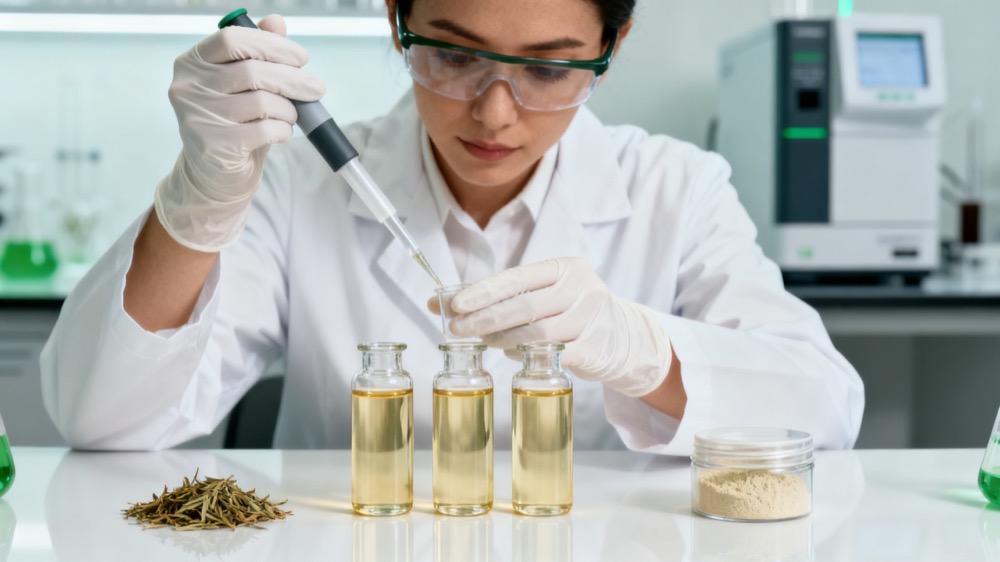
A cosmetic ingredients manufacturer should explain what documentation it can supply for your target market. It should also recognize where specialist assessment is required.
For the United States, MoCRA requires the responsible person to ensure and maintain records supporting adequate cosmetic product safety substantiation. An ingredient supplier may contribute relevant evidence, but cannot replace the finished-product company's obligations.
In the European Union, finished cosmetics require a responsible person and a cosmetic product safety report before market placement. Ingredient documentation supports this assessment; it does not independently establish finished-product compliance.
Ask suppliers to identify:
- Available composition and impurity information.
- Relevant toxicological data and known restrictions.
- Documentation gaps requiring additional assessment.
- Who will answer the safety assessor's follow-up questions.
Similarly, natural-origin calculations under ISO 16128 do not establish human safety, environmental safety, or finished-product regulatory compliance.
Before signing a long-term agreement, test the working relationship.
The following is a proposed buyer-designed exercise, not an industry requirement. Agree on its scope and timing with shortlisted suppliers.
| Stage | Buyer's request | What to evaluate |
|---|---|---|
| Day 1 | Send one identical technical brief | Does someone confirm ownership? |
| Day 2 | Request the grade-specific dossier | Are documents complete and consistent? |
| Day 3 | Submit a compatibility question | Does the answer address your formula? |
| Day 4 | Present a hypothetical deviation | Is there a structured investigation plan? |
| Day 5 | Request unresolved items and next steps | Are responsibilities and dates explicit? |
Evaluate accuracy and follow-through rather than speed alone. Some questions require laboratory work or confidential-document review.
A supplier that explains a limitation and provides a realistic delivery date may be more dependable than one that gives an immediate, unsupported assurance.
When customer feedback indicates that service needs improvement, "we will communicate better" is not a sufficient corrective action.
Translate the concern into a written service arrangement.
Agree on three different milestones:
- Acknowledgment: confirmation that the request was received.
- Initial assessment: the information needed and proposed investigation.
- Resolution or progress update: findings, remaining work, and next reporting date.
These should reflect issue severity, working hours, laboratory requirements, and time zones. Do not treat suggested timelines as universal industry benchmarks.
Ask for one primary contact, a backup, and a technical escalation route.
For OEM and ODM projects, define who approves formula revisions, manages testing, releases documents, and communicates specification changes.
A shared issue log should record the batch number, question, owner, due date, and closure evidence. This prevents international buyers from repeating the same explanation across disconnected email threads.
Consider this hypothetical situation: a botanical active causes haze in a clear serum after storage.
An unhelpful response is, "Our ingredient meets specification, so the formula must be wrong."
A stronger supplier first requests the ingredient lot, complete processing history, pH, storage conditions, and comparison samples.
A useful investigation might then:
1. Check retained ingredient samples and batch documentation.
2. Compare the base formula with and without the active.
3. Evaluate concentration and incorporation conditions.
4. Examine plausible ingredient interactions.
5. Repeat the trial with another representative lot where appropriate.
6. Document findings and proposed corrective actions.
The supplier should avoid declaring a root cause before evidence supports it.
Also distinguish preliminary screening from validation. A short compatibility trial can identify concerns, but cannot alone establish commercial shelf life, preservation adequacy, or finished-product safety.
A scorecard helps procurement and formulation teams evaluate the same evidence.
The following weights are a proposed purchasing tool, not a validated industry standard.
| Criterion | Suggested weight |
|---|---|
| Documentation accuracy and completeness | 25% |
| Formulation and troubleshooting capability | 25% |
| Quality consistency and change control | 20% |
| Regulatory support and evidence transparency | 15% |
| Communication ownership and follow-through | 15% |
Score each category from one to five, then calculate its weighted contribution. Keep a short justification and supporting evidence beside every score.
Set non-negotiable approval conditions separately. A strong total should not compensate for unresolved ingredient identity, missing critical safety information, or a serious unexplained specification discrepancy.
Compare technical support costs as well. Clarify whether application trials, custom testing, translations, or development work require additional fees.
Ingredient supply, OEM manufacturing, and ODM development involve different deliverables. Do not assume that purchasing an active includes complete formulation development.
Before work begins, agree on:
- Development scope and sample revisions.
- Formula ownership and confidentiality.
- Testing responsibilities and acceptance criteria.
- Pilot production and scale-up support.
- Documentation deliverables.
- Change notification and complaint handling.
- Any post-launch support.
For wholesalers, also clarify which technical documents can be shared with downstream customers and how confidential information will be handled.
For brands, confirm whether the supplier's evidence supports an ingredient-level statement or a finished-product claim. These are not interchangeable.
The right cosmetic ingredients manufacturer should make uncertainty easier to investigate—not hide it behind confident sales language.
For your next botanical or biofermentation project, send ZHENYIBIO TECHNOLOGY INC your product format, target market, intended benefit, processing conditions, and development timeline. Request a grade-specific documentation package and a discussion of available formulation or OEM/ODM support.
Before approving a sample, agree on the evidence required, the person responsible, and the next review date. That is how a promising ingredient becomes a more manageable development partnership.
Submit a real development brief, request grade-specific documents, and run a small support trial. Evaluate whether answers are accurate, limitations are disclosed, and agreed follow-up actions are completed.
Not necessarily. A supplier may provide incorporation guidance without offering full formulation development. Clarify the service scope beforehand, and treat sample formulas as development starting points rather than validated commercial products.
Begin with the ingredient classes, processing conditions, pH, and problem description needed for initial assessment. Use a confidentiality agreement before sharing sensitive details. Recognize that incomplete information can limit the reliability of troubleshooting.
No. Natural origin and fermentation do not remove the need to evaluate composition, impurities, exposure, and intended use. The required evidence depends on the specific material and finished product.
Refer to the agreed service milestones, document missed commitments, and escalate through the named contact structure. Review recurring delays during supplier performance meetings rather than handling each incident as an isolated email.
No. Ingredient expertise can help design development trials and interpret results, but the finished formula still needs appropriate safety, stability, microbiological, and packaging evaluations for its intended use.
1. U.S. Food and Drug Administration. "Modernization of Cosmetics Regulation Act of 2022 (MoCRA)." Basis for the discussion of safety substantiation and responsible-person obligations. [fda]
2. European Commission. "Legislation—Cosmetics." Overview of Regulation (EC) No 1223/2009, responsible persons, and finished-product safety requirements. [single-market-economy.ec.europa]
3. European Parliament and Council. "Regulation (EC) No 1223/2009 on Cosmetic Products." Articles 4 and 10 and Annex I provide the regulatory basis for responsibilities and cosmetic product safety reports. [health.ec.europa]
4. International Organization for Standardization. "ISO 16128-1:2016—Guidelines on Technical Definitions and Criteria for Natural and Organic Cosmetic Ingredients and Products—Part 1: Definitions for Ingredients." Basis for distinguishing natural-origin definitions from safety, environmental, and regulatory assessment. [iso]
5. International Organization for Standardization. "ISO 16128-2:2017—Cosmetics—Guidelines on Technical Definitions and Criteria for Natural and Organic Cosmetic Ingredients—Part 2: Criteria for Ingredients and Products." Scope and limitations of natural and organic ingredient criteria. [iso]
6. Bandyopadhyay, A., et al. "Plant-Based Ingredients in Cosmetic Science: Current …" *International Journal of Cosmetic Science*, 2026. DOI: 10.1111/ics.70034. Supports the discussion of botanical variability, standardization, stability, and safety evaluation. [onlinelibrary.wiley]
7. Suhaera, S., et al. "Fermented Plant-Derived Phytoconstituents in Biocosmetics." 2026. Supports the discussion of fermentation-related compositional changes and limitations in comparing evidence across different processes. [pmc.ncbi.nlm.nih]


