


Views: 299 Author: ZHENYIBIO Publish Time: 2026-11-03 Origin: Site
Content Menu
● 1. Confirm the Identity and Form of Glutathione Powder
>> What Should the Identity Documentation Include?
● 2. Examine Glutathione Assay, Not Just "Purity"
>> Distinguish Assay from Chromatographic Area Percentage
● 3. Measure Oxidized Glutathione and Related Impurities
>> Check Whether the Method Separates Relevant Impurities
● 4. Check Moisture and Physical Characteristics
>> Water Content Versus Loss on Drying
● 5. Review Heavy Metals and Process-Related Contaminants
>> Request Results with Meaningful Detection Limits
● 6. Establish Appropriate Microbiological Specifications
● 7. Verify Stability in the Intended Cosmetic Formula
>> Request Evidence for Both Powder and Finished Product
● 8. Use a Glutathione Powder Purchasing Checklist
● 9. Audit the Certificate of Analysis and Supplier Controls
>> Look Beyond a Single Approved Sample
● 10. Qualify a Supplier in Four Practical Steps
● 11. Compare Cost per Usable Active, Not Price per Kilogram
● Build Your Next Glutathione Project on a Clear Specification
>> What Is the Most Important Quality Parameter for Glutathione Powder?
>> Is 99% Glutathione Purity Enough to Approve a Supplier?
>> Should Buyers Test Every Incoming Batch?
>> Can a COA Replace Independent Testing?
>> Does High-Purity Powder Guarantee an Effective Cosmetic?
When purchasing glutathione powder, buyers should check identity, reduced-glutathione content, oxidation-related impurities, moisture, contaminants, microbiological quality, stability, and batch traceability. A high purity percentage alone cannot establish whether an ingredient will perform consistently in a cosmetic formulation.
For international brands, wholesalers, and manufacturers, the essential purchasing principle is verification: every important specification should connect to a suitable test method, a batch-specific result, and the intended application.
At ZHENYIBIO TECHNOLOGY INC, our focus on natural plant actives and modern biofermentation provides the background for a science-led sourcing approach. This guide explains how to evaluate glutathione powder beyond the quotation sheet—and build a more reliable foundation for cosmetic ingredient purchasing and OEM/ODM development.

Before comparing prices, establish exactly what each supplier is offering.
Reduced glutathione, commonly abbreviated as GSH, and oxidized glutathione, known as GSSG, are related but distinct substances. They should not be treated as interchangeable purchasing categories.
Likewise, a carrier-based blend, encapsulated ingredient, or glutathione derivative requires a different specification from unblended reduced glutathione powder.
Request:
- The precise ingredient name and applicable identification details.
- Confirmation of reduced or oxidized form.
- Declared carriers, processing aids, or other added ingredients.
- An identity test against an appropriate reference standard.
- Manufacturing-route and origin information.
Suitable identity testing may combine chromatographic comparison with another appropriate technique. A matching chromatographic retention time is useful, but stronger identification considers the possibility of interference.
Fermentation-derived also does not automatically mean plant-extracted. Buyers making natural-origin, vegan, or sustainability claims should verify the production route and supporting documentation separately.
A statement such as "99% purity" is incomplete without its measurement basis.
Does the figure represent reduced glutathione by mass, chromatographic peak area, total glutathione, or a result corrected for moisture? These measurements answer different questions.
An assay quantifies the target substance using a defined analytical procedure and suitable calibration.
Chromatographic area percentage describes the relative detector response of integrated peaks under specified conditions. It does not automatically account for water, inorganic residues, or substances the method does not detect effectively.
Ask suppliers:
1. Is the reported result specific to reduced glutathione?
2. Is it calculated on an as-is or dried basis?
3. Which reference standard supports quantification?
4. What method and specification version were used?
5. Can the laboratory provide representative chromatograms?
From a procurement perspective, comparable methods matter as much as comparable numbers. A slightly lower, well-supported assay may be more useful than an impressive percentage with an unclear definition.
Reduced glutathione can convert to GSSG through oxidation. Other degradation products or process-related impurities may also require control.
Consequently, total glutathione content cannot replace a reduced-glutathione assay when GSH is the purchased active.
Ask whether the analytical method can distinguish:
- GSH from GSSG.
- Relevant process-related impurities.
- Relevant degradation products.
- Interferences from carriers or other ingredients.
A published analytical development project demonstrated quantification of four associated glutathione impurities at concentrations as low as 0.03% by weight. That finding illustrates the importance of method sensitivity; it is not a universal commercial impurity limit.
Request individual and total impurity criteria, where appropriate, together with reporting thresholds. If GSH and GSSG results are combined or converted, confirm the calculation basis rather than assuming their percentages are directly interchangeable.
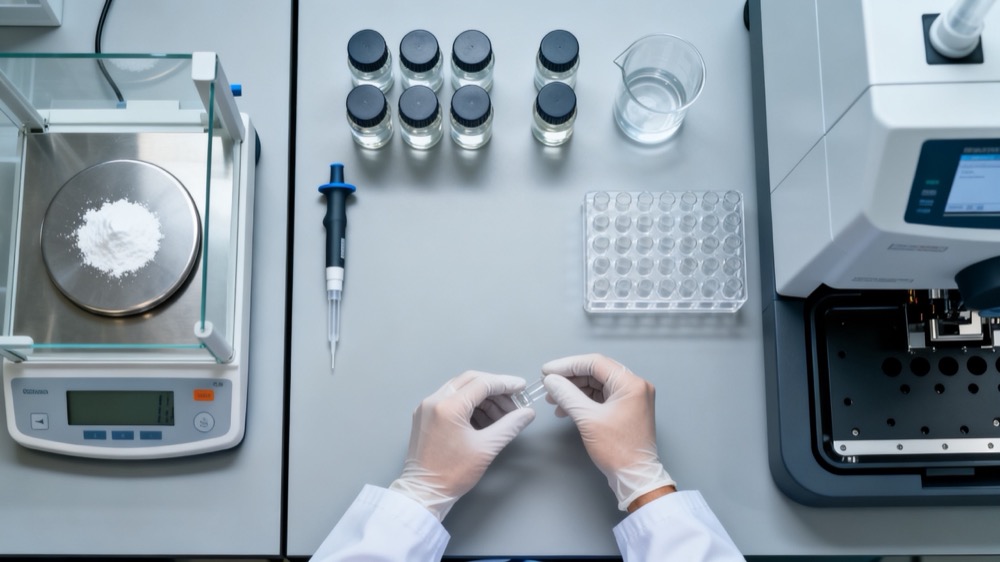
Moisture influences the interpretation of assay results and may affect powder handling. However, different moisture-related methods do not necessarily measure the same thing.
Karl Fischer testing measures water. Loss on drying measures mass lost under defined conditions and may include water plus other volatile substances.
Ask which method applies, how the sample is prepared, and whether moisture correction is used in assay calculations.
Physical specifications should also address:
- Appearance and color.
- Odor profile.
- Visible foreign matter.
- Caking or agglomeration.
- Particle size, when relevant to processing.
Appearance is a screening tool, not proof of identity or purity. Unexpected discoloration or caking should trigger investigation, but normal-looking powder still requires analytical release testing.
Contaminant specifications should reflect the manufacturing route, intended use, exposure, and destination market.
For elemental impurities, request individual results for relevant elements, commonly including lead, arsenic, cadmium, and mercury. A combined "heavy metals" statement may provide insufficient detail.
A useful report identifies:
- Each element tested.
- The analytical technique.
- Units and numerical results.
- Detection or quantification limits.
- Applicable acceptance criteria.
"Not detected" does not mean zero. It means the substance was not detected above the method's stated capability.
Residual-solvent requirements should follow the process history. For fermentation-derived material, buyers should also understand downstream purification and relevant residual risks rather than assuming fermentation removes every contamination concern.
Avoid copying one supplier's limits into every market specification. The finished product's safety assessment and applicable local requirements remain essential.
Chemical purity and microbiological quality are separate purchasing considerations.
A cosmetic ingredient assessment should consider total aerobic microbial counts, yeast and mold counts where appropriate, and specified objectionable microorganisms based on the application.
Ask for test methods, sample quantities, acceptance criteria, and actual batch results.
ISO 17516 addresses microbiological quality in finished cosmetics. Its product categories should not be copied automatically into a universal raw-material specification. Ingredient limits should support the finished formulation's microbiological control strategy.
Another important boundary concerns intended use: cosmetic or dietary-supplement material must not be assumed suitable for injection. Regulatory safety communications have documented serious problems associated with inappropriate glutathione ingredients used in sterile preparations.
An acceptable release assay does not guarantee acceptable performance throughout storage or after formulation.
Published topical-formulation research shows that glutathione in aqueous solution can oxidize and that temperature and formulation design affect its stability. Results from one experimental system cannot establish another product's shelf life.
For the powder, examine:
- Tested storage conditions.
- Packaging configuration.
- Assay and impurity trends over time.
- Retest period or expiry justification.
- Handling instructions after opening.
For a serum, cream, or other cosmetic, test the actual formula and intended packaging.
Monitor reduced-glutathione content, relevant degradation products, appearance, odor, pH, and physical stability. Assess microbiological protection separately where applicable.
There is no universally correct processing temperature, pH, or addition sequence for every glutathione formulation. Establish these conditions through development studies rather than relying on a generic supplier recommendation.
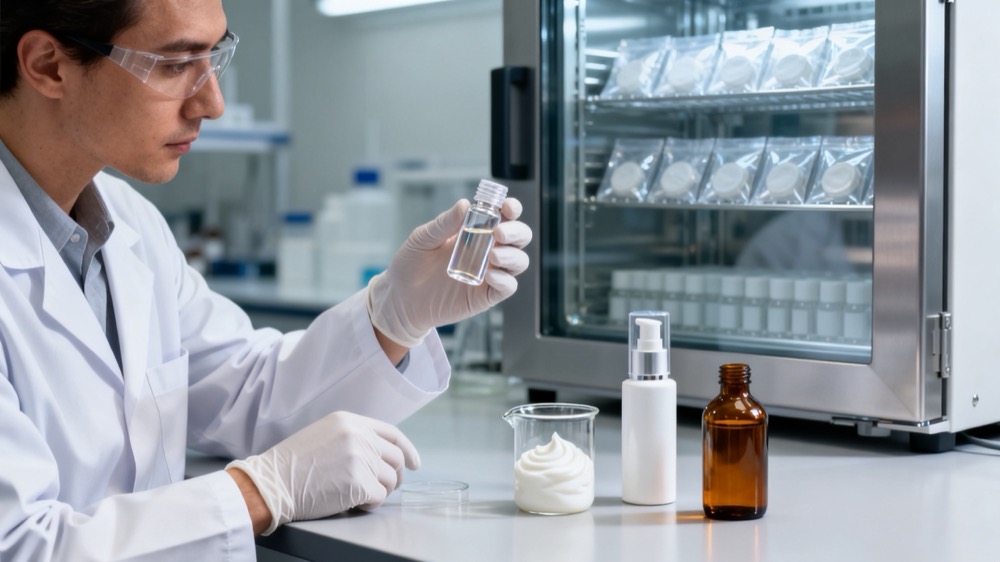
A written comparison sheet prevents sales descriptions from replacing technical evaluation.
| Quality parameter | Evidence to request | Purchasing question |
|---|---|---|
| Identity and form | Identity results and composition declaration | Is this the exact ingredient specified? |
| Reduced-glutathione assay | Quantitative result, method, and calculation basis | How much GSH is present? |
| GSSG and related impurities | Impurity profile and reporting thresholds | What oxidation or process-related material is present? |
| Moisture | Water or loss-on-drying result | Are assay and handling comparisons valid? |
| Elemental impurities | Individual results and method limits | Are contamination risks adequately controlled? |
| Microbiological quality | Counts and specified-organism results | Does the material support the intended application? |
| Physical properties | Appearance and relevant handling tests | Will the powder process consistently? |
| Stability | Studies in the supplied packaging | Is the proposed storage period supported? |
| Traceability | Lot records and change-control information | Can problems be investigated effectively? |
These categories form a purchasing framework, not a universal numerical specification. Acceptance limits require application-specific justification.
A certificate of analysis, or COA, should connect the delivered lot to the agreed specification.
Check the product name, batch number, manufacturing date, relevant retest or expiry date, specification version, methods, results, and release authorization.
"Pass" may be suitable for certain qualitative tests. For quantitative purchasing decisions, numerical results usually provide greater insight.
Where feasible, review several recent production batches. Compare assay, moisture, impurities, and other critical parameters.
Ask how the supplier manages:
- Out-of-specification results.
- Deviations and corrective actions.
- Reference standards and instrument calibration.
- Retained samples.
- Manufacturing or raw-material changes.
- Complaints and traceability.
ISO 22716 provides guidance for cosmetic production, control, storage, and shipment. Any certification claim should be checked for its scope, site, and validity; it does not replace ingredient-specific evidence.
A staged qualification process can reduce the risk of approving attractive paperwork that does not represent commercial supply.
1. Define the application. Specify ingredient form, target markets, formulation type, critical tests, and required documentation.
2. Review the technical package. Resolve differences between the specification, COA, safety information, and quotation.
3. Test representative samples. Use an independent laboratory for critical parameters when warranted. Confirm method comparability before interpreting disagreements.
4. Run a formulation pilot. Evaluate dissolution, processing behavior, active retention, packaging compatibility, and product stability.
Keep initial commercial lots under enhanced review until consistency is demonstrated. Sampling should represent the purchased supply, not merely a specially prepared demonstration sample.
The lowest quotation may not deliver the lowest formulation cost.
A useful first comparison is the purchase price divided by the independently supported as-is active fraction. Keep freight, testing, rejected material, processing losses, and storage requirements visible as additional costs.
For example, two powders with identical dried-basis assays may contain different amounts of active per delivered kilogram if their moisture levels differ.
This comparison does not establish cosmetic efficacy. It simply makes procurement economics more transparent.
Sustainability deserves the same evidence-based approach. Ask for clearly defined information on feedstocks, resource use, waste management, and assessment boundaries instead of treating "biofermented" as proof of lower environmental impact.
Reliable glutathione purchasing connects identity, assay, impurities, contamination control, stability, and traceability. No single test replaces that system.
Contact ZHENYIBIO TECHNOLOGY INC with your target market, formulation type, expected order volume, and OEM/ODM requirements. Request an application-specific specification review and confirm the documentation, samples, and testing support available for your project before placing a commercial order.
Identity and intended-use suitability come first. For reduced glutathione, the next priorities are a reliable GSH assay, relevant impurity controls, and contaminant specifications supported by appropriate methods.
No. Buyers must understand the measurement basis and review oxidation products, moisture, contamination, traceability, and stability. One percentage cannot describe the complete quality profile.
Every batch needs a defined acceptance process. Testing frequency should follow supplier qualification, ingredient risk, applicable requirements, and quality agreements. Reduced testing requires documented justification, not convenience alone.
A COA is essential evidence, but it does not eliminate supplier qualification or verification. Independent testing is particularly valuable during initial approval, after significant changes, or when results appear inconsistent.
No. Finished-product performance also depends on concentration, formulation, processing, stability, packaging, and delivery. Product claims need evidence relevant to the finished cosmetic.
1. U.S. Food and Drug Administration. "Validation of an HPLC-UV Method for the Analysis of Glutathione and Its Impurities." Analytical research supporting the discussion of glutathione impurity separation and quantification capability. [fda]
2. International Council for Harmonisation. "Validation of Analytical Procedures Q2(R2)." Final guideline, adopted November 2023. Supports analytical principles including specificity, accuracy, precision, and reportable range. This pharmaceutical guideline is used here for methodological context, not presented as a cosmetic certification requirement. [database.ich]_Guideline_2023_1130.pdf)
3. Boonme and Wuttikul. "Stability Enhancement of L-Glutathione by Incorporation in Microemulsion." Experimental comparison of aqueous and formulated glutathione, including temperature-dependent oxidation. Supports the need for formulation-specific stability studies rather than universal shelf-life assumptions. [li05.tci-thaijo]
4. International Organization for Standardization. "ISO 17516:2014—Cosmetics—Microbiology—Microbiological Limits." Standard information describing finished-cosmetic microbiological quality assessment and product-category distinctions. [standards.iteh]
5. International Organization for Standardization. "ISO 22716:2007—Cosmetics—Good Manufacturing Practices (GMP)—Guidelines on Good Manufacturing Practices." Guidance covering cosmetic production, control, storage, and shipment. [iso]
6. Halla, N., et al. "Cosmetics Preservation: A Review on Present Strategies." *Molecules*, 2018. Reviews raw-material control, manufacturing hygiene, preservation systems, and challenge testing. [pmc.ncbi.nlm.nih]
7. U.S. Food and Drug Administration. "FDA Highlights Concerns with Using Dietary Ingredient Glutathione to Compound Sterile Injectables." Safety communication explaining intended-use differences and endotoxin risks from inappropriate ingredient sourcing. [fda]
8. Shodex. "Analysis of Glutathiones (By Post-column Reaction Method)." Technical application demonstrating chromatographic separation of reduced glutathione and glutathione disulfide. [shodex]


