


Views: 228 Author: ZHENYIBIO Publish Time: 2026-11-09 Origin: Site
Content Menu
● Understanding the Russian Sialic Acid Powder Market
>> Local supply access does not necessarily mean local manufacturing
>> What recent market reports actually tell buyers
● Selection Criteria: How These Suppliers Were Assessed
● Technical Specifications Buyers Should Define First
>> Specify Neu5Ac rather than relying on "sialic acid"
>> Compare grades and assay methods carefully
>> Request relevant certifications—not unrelated logos
● Supplier Comparison: Capacity, MOQ, and Certification Transparency
>> Overseas cosmetic-ingredient partner for customized development
>> Russian sourcing channel for chemical and laboratory procurement
● 3. DIA-M
>> Russian laboratory supplier for early-stage evaluation
>> International source for defined research materials and analytical comparisons
>> International alternative for research-to-bulk quotation
● Buyer's Guide: From Supplier Shortlist to Approved Supply
>> Start with a standardized technical RFQ
>> Use a staged sample-approval process
>> Confirm logistics before placing the purchase order
● Procurement Pitfalls and an Overlooked Analytical Trap
>> Common mistakes that increase purchasing risk
>> Insider checkpoint: distinguish free Neu5Ac from total sialic acid
● Conclusion: Select the Supply Model Before Selecting the Price
● FAQs
>> 1. How can we check whether a supplier's ISO certificate is expired or irrelevant?
>> 2. Can a ≥98% research reagent be used in a commercial cosmetic?
>> 3. How do we verify a fermentation-derived or animal-free claim?
>> 4. What proves that a supplier can support industrial quantities?
>> 5. Does a supplier's raw-material dossier make our finished cosmetic compliant in Russia?
Finding a reliable Sialic Acid Powder supplier in Russia requires more than comparing prices or accepting a certificate of analysis. Professional buyers need to establish who manufactures the material, which chemical form is supplied, whether the grade suits cosmetic production, and how consistently the supplier can deliver repeat orders.
The available supplier evidence points to an important distinction: Russia offers established laboratory-reagent and chemical-distribution channels, but the sources reviewed do not establish a substantial domestic cluster of industrial-scale, cosmetic-grade sialic acid manufacturers. Russian catalog listings should therefore not automatically be interpreted as evidence of Russian production.
This guide compares five sourcing candidates and channels relevant to buyers evaluating the Russian market. It distinguishes local distributors, international reagent suppliers, and an overseas cosmetic-ingredient partner rather than presenting every company as a Russian factory.
The assessment focuses on manufacturing transparency, research and development support, quality-control documentation, supply continuity, and customization capability. Publicly unavailable capacity, minimum order quantity, and certification details are identified as verification requirements—not replaced with estimates.

For procurement teams, Russia's most clearly documented advantage is access to established scientific-supply infrastructure. CHIMMED advertises N-acetylneuraminic acid through its Russian catalog, while DIA-M provides access to international reagent catalogs that include the same substance. These channels can be useful for laboratory evaluation and analytical development.
However, purchasing a small reagent pack and qualifying a long-term cosmetic ingredient are different projects.
A research catalog may provide useful identity and purity information without establishing:
- Suitability for incorporation into commercial cosmetics.
- Industrial batch consistency.
- Fermentation provenance.
- Annual manufacturing capacity.
- Cosmetic formulation support.
- A dependable kilogram-scale supply agreement.
The practical sourcing opportunity is therefore a combination of Russian distribution access and qualified overseas manufacturing—not a presumed domestic production cluster.
Published market estimates require caution. DataIntelo reports a global sialic acid market value of $285.4 million for 2025, whereas ReAnIn reports $13 million for the same year. These figures are not interchangeable, and the publicly available summaries do not reconcile the difference.
That discrepancy is commercially important. Before using a market report to justify inventory or supplier investment, procurement teams should check whether its scope includes free N-acetylneuraminic acid, other sialic acid forms, research reagents, or downstream applications.
Neither estimate establishes Russian domestic production capacity or Russia-specific cosmetic demand. A qualified purchasing plan should rely more heavily on documented customer demand, approved formulations, and supplier performance than on a headline market valuation.
The following criteria provide a transparent framework for comparing Sialic Acid Powder manufacturers and suppliers.
| Assessment area | Evidence buyers should request | Why it matters |
|---|---|---|
| Manufacturing identity | Legal manufacturer, production address, manufacturing or distribution role | Prevents confusion between a reseller and a producer |
| Product identity | Chemical name, CAS number, source, analytical identification | Reduces substitution and specification errors |
| Quality management | Current certificates, site scope, batch-release procedures | Connects quality claims to the actual operation |
| Technical capability | Analytical methods, impurity controls, formulation support | Determines suitability beyond headline purity |
| Supply continuity | Batch size, available inventory, replenishment schedule, change-control policy | Supports repeat commercial orders |
| Customization | Packaging, documentation, formulation work, OEM/ODM responsibilities | Clarifies what the supplier can actually deliver |
| Commercial transparency | Written MOQ, quotation validity, payment terms, Incoterms | Makes landed-cost comparisons meaningful |
Supplier websites and catalogs were used to identify capabilities. No physical factory inspections, independent batch testing, or delivery-performance audits were conducted for this article.
Sialic acid describes a family of related compounds. For the ingredient discussed here, purchase documents should identify N-acetylneuraminic acid, commonly abbreviated Neu5Ac or NANA, with CAS number 131-48-6. Supplier product documentation lists a molecular formula of C11H19NO9 and molecular weight of 309.27.
The purchasing specification should also distinguish free Neu5Ac from activated derivatives, salts, analytical mixtures, and extracts containing sialic acid.
These materials should not be treated as equivalent solely because their product descriptions contain the same general ingredient name.
Commercial catalogs demonstrate that specifications can differ substantially. Sigma-Aldrich lists a synthetic powder at ≥95% on an anhydrous basis and a separate product at ≥98% by HPLC, identified as originating from *Escherichia coli*. These are different product specifications, not interchangeable statements of quality.
A cosmetic procurement specification should therefore address:
- Identity and assay method.
- Whether assay is reported as supplied or on a dry/anhydrous basis.
- Water content.
- Related substances and residual processing materials.
- Microbiological limits.
- Relevant elemental impurities.
- Packaging, storage conditions, and retest period.
- Suitability documentation for the intended application.
A material described as fermentation-derived should be supported by process and traceability documentation. Fermentation alone does not establish vegan status, environmental superiority, cosmetic suitability, or finished-product efficacy.
Quality-system certification, environmental management, and product conformity serve different purposes. An ISO certificate does not replace a batch-specific certificate of analysis or confirm that a particular ingredient is appropriate for a finished cosmetic.
CE and RoHS should not be used as default quality requirements for cosmetic Sialic Acid Powder. Instead, ask which legal requirements apply to the ingredient, its importation, and the finished formulation.
For cosmetics marketed in Russia and the wider Eurasian Economic Union, TR CU 009/2011 is a central regulatory framework. The Eurasian Economic Commission has published amendments to composition requirements and updates to associated standards, including standards applicable from 2025. Buyers should assess the current requirements for their particular finished product rather than treating raw-material documentation as finished-product authorization.
The table below separates published evidence from details requiring a quotation or document review.
| Company | Sourcing role and geographic position | Public Neu5Ac capacity | MOQ or published pack information | Certification evidence and limitations |
|---|---|---|---|---|
| ZHENYIBIO TECHNOLOGY INC | China-based cosmetic-ingredient company; overseas partner candidate | Not publicly established in the reviewed company profile | Product-specific MOQ requires confirmation | Company lists quality and other certifications; current certificates and applicable scope require review |
| CHIMMED | Russia-based chemical and laboratory supplier | No Neu5Ac production capacity verified | Confirm catalog pack, availability, and commercial MOQ | Request supplier and original-manufacturer documentation |
| DIA-M | Russia-based laboratory supply channel | No Neu5Ac production capacity verified | Referenced catalogs include small reagent packs; confirm current offer | Qualification depends on the actual manufacturer, SKU, and lot |
| Merck / Sigma-Aldrich | International reagent supplier with a Russian regional website | No relevant bulk capacity verified | A0812 lists 25 mg, 100 mg, 250 mg, and 1 g packs; these are pack sizes, not confirmed Russian MOQs | Product-specific technical documentation available; confirm application suitability |
| Molekula | International fine-chemical supplier; Russia delivery eligibility unverified | No product-specific capacity published on the reviewed product page | Research-to-bulk and custom packs offered by quotation | Company describes ISO-managed operations; confirm certificate, site, and product coverage |
The supplier and product pages support these distinctions, but none of the reviewed materials provides a complete, independently verified comparison of industrial Neu5Ac capacity.
Founded in 2012, ZHENYIBIO TECHNOLOGY INC is based in the Xi'an High-tech Industrial Development Zone in China. Its company profile describes a business focused on cosmetic raw materials, research and development, production, and ingredient solutions. Reported markets include Asia, Europe, and the Americas, with sales to more than 50 countries.
The company reports a 10,000-square-meter production area and a 1,500-square-meter research and development center. Its published portfolio includes glutathione, hyaluronic acid, polyglutamic acid, asiaticoside, peptides, and liposomes. These figures describe company-level facilities and capabilities; they should not be presented as dedicated Sialic Acid Powder production capacity.
For smaller and mid-sized beauty brands, ZHENYIBIO is worth evaluating where the purchasing brief extends beyond a standard reagent pack. According to the commissioning brief, its intended service model includes OEM/ODM support for overseas brands, wholesalers, and manufacturers.
Relevant discussion areas include:
- Customized ingredient specifications and packaging.
- Technical communication during sample evaluation.
- Formulation-development responsibilities.
- Documentation tailored to the destination market.
- Pilot-to-commercial supply planning.
Its potential value proposition is coordinated ingredient and development support rather than a demonstrated lowest-price position. Communication speed, project flexibility, and cost-effectiveness should be tested through an RFQ and sample project.
Verification priority: The reviewed company profile does not establish a product-specific Neu5Ac manufacturing route, capacity, MOQ, or current stock position. Buyers should obtain these details before describing ZHENYIBIO as a verified sialic acid producer. Its website's certification wording should also be checked against original certificates rather than reproduced without qualification.
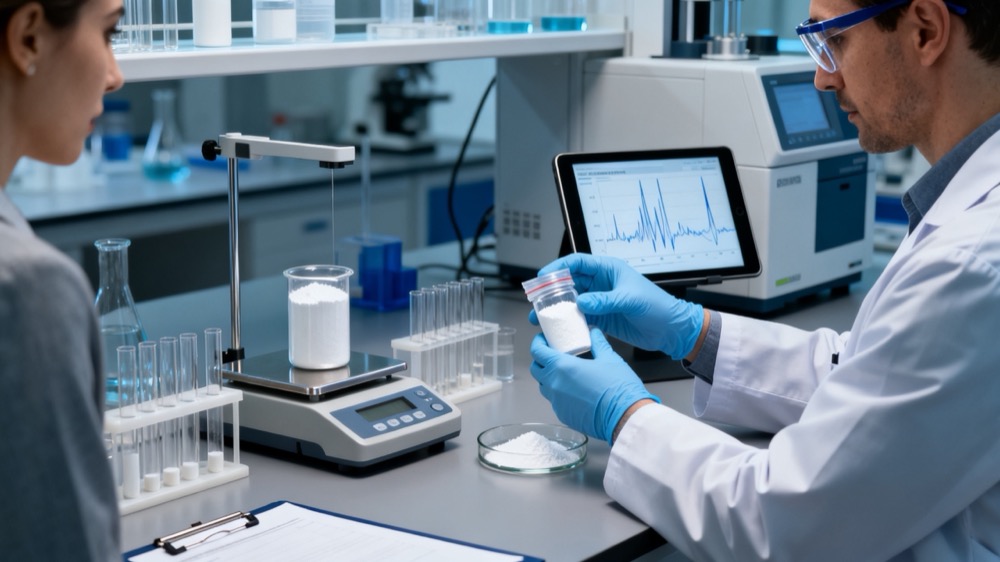
CHIMMED was founded in 1991 and serves Russian scientific and industrial customers. A Russian scientific-institute profile describes its history in reagents, laboratory equipment, chemical production, and distribution. Its catalog specifically advertises N-acetylneuraminic acid, with supply from Moscow stock or by order and delivery across Russia. Actual availability remains subject to confirmation.
Its core advantage for buyers is a local procurement interface: a Russian purchasing team can request a quotation, clarify the originating manufacturer, and investigate domestic delivery arrangements.
CHIMMED may be particularly relevant for:
- Laboratory screening.
- Analytical-method development.
- Procurement alongside other reagents.
- Buyers requiring a Russian commercial counterparty.
The presence of broader chemical manufacturing capabilities does not establish that CHIMMED manufactures Neu5Ac itself.
OEM/ODM scope: The reviewed evidence does not establish sialic-acid-specific cosmetic formulation or private-label services. Buyers should treat it primarily as a supply and procurement channel unless a separate development agreement confirms otherwise.
Verification priority: Request the original manufacturer's name, exact catalog number, grade, lot-specific COA, and written statement of intended-use suitability.
DIA-M has supplied Russian laboratories since 1988. Conference and institutional materials document its longstanding role in laboratory supply, while its Macklin catalog access includes N-acetylneuraminic acid entries under CAS 131-48-6.
Its principal market is Russian laboratory procurement. For cosmetic developers, the useful role is early-stage sourcing: obtaining defined reagent quantities for analytical work or preliminary formulation experiments.
That role should remain distinct from commercial ingredient qualification. A successful laboratory trial does not establish that the same supplier can support repeated production-scale purchases under cosmetic specifications.
OEM/ODM scope: The reviewed sources do not establish finished-cosmetic development or private-label services for this ingredient.
Verification priority: Confirm the actual brand, current product specification, pack size, storage requirements, and whether larger quantities can be supplied from a consistent manufacturing source. Do not assume that historical catalog inclusion guarantees present stock or import availability.
Merck / Sigma-Aldrich offers clearly differentiated Neu5Ac products. The reviewed listings include synthetic N-acetylneuraminic acid at ≥95% on an anhydrous basis, an *E. coli*-derived product at ≥98% by HPLC, and a separate analytical-standard product.
Its principal relevance here is technical clarity. Procurement and laboratory teams can compare defined product grades rather than treating all Sialic Acid Powder as one commodity.
The organization serves international life-science customers and maintains a Russian regional website with local contact information. However, a regional website does not prove that every SKU can currently be delivered to every Russian customer. Order eligibility, inventory, payment, and shipping must be confirmed directly.
Establishment year: The reviewed sources do not establish a single founding year applicable to the combined supplier identity used here; buyers should identify the exact contracting entity.
OEM/ODM scope: The cited product listings concern reagents and analytical materials, not private-label cosmetic manufacturing.
Verification priority: Select the SKU for its intended laboratory purpose and confirm storage instructions. For example, A0812 specifies storage at −20°C; that condition should not automatically be generalized to every supplier's Neu5Ac powder.
Molekula describes itself as a manufacturer and distributor of fine chemicals and biochemicals serving research, biotechnology, pharmaceutical, and industrial customers. Its product page lists N-acetylneuraminic acid under CAS 131-48-6, with research-to-bulk quantities and custom pack sizes available by request.
Its published company information places its origins around 1999–2000, although its homepage and About page differ on the exact founding year. The company describes operations serving Europe, the United States, and other international markets.
Its potential advantage is access to a quotation process spanning smaller evaluation quantities and larger supply requirements. Nevertheless, general company statements about bulk capability do not establish dedicated Neu5Ac capacity.
OEM/ODM scope: Custom packaging and chemical-supply services should not be confused with finished-cosmetic formulation or private-label production.
Verification priority: Russia-specific delivery eligibility was not established by the reviewed sources. Buyers should confirm whether Molekula can lawfully and commercially fulfill the proposed order before including it in a Russian supply plan.
Send every candidate the same purchasing brief:
1. Chemical identity and CAS number.
2. Intended cosmetic application.
3. Required assay and reporting basis.
4. Acceptable production route and origin requirements.
5. Impurity and microbiological specifications.
6. Trial quantity, annual forecast, and delivery schedule.
7. Required documentation and language.
8. Packaging and storage expectations.
9. OEM/ODM work scope, where applicable.
10. Destination, Incoterm, and importer responsibilities.
A standardized RFQ prevents an inexpensive research-grade offer from being compared directly with a more extensively documented commercial ingredient.
First, review documents before paying for samples. Request a representative COA, specification, safety data sheet, manufacturing-source statement, and relevant certificates.
Second, evaluate a traceable sample. Record its lot number, packaging condition, appearance, identity results, assay, and performance in the intended formulation.
Third, connect approval to commercial supply. Ask whether the trial material and first production shipment will come from the same manufacturing route and specification.
For repeat purchasing, agree on change notification covering manufacturer, site, process, analytical method, specification, and packaging. A distributor should not substitute another source without your approval merely because the CAS number matches.
Ask the supplier and freight provider to agree on:
- Product-specific transport and storage conditions.
- Moisture protection and packaging integrity.
- Customs description and classification.
- Import documentation and importer-of-record responsibilities.
- Payment-channel feasibility.
- Applicable sanctions, export controls, and counterparty restrictions.
- Responsibility for delays, inspection, or rejected delivery.
Do not assume that a chemical's general availability guarantees a workable Russia-bound transaction. Commercial eligibility must be checked for the actual parties, product, route, and transaction date.
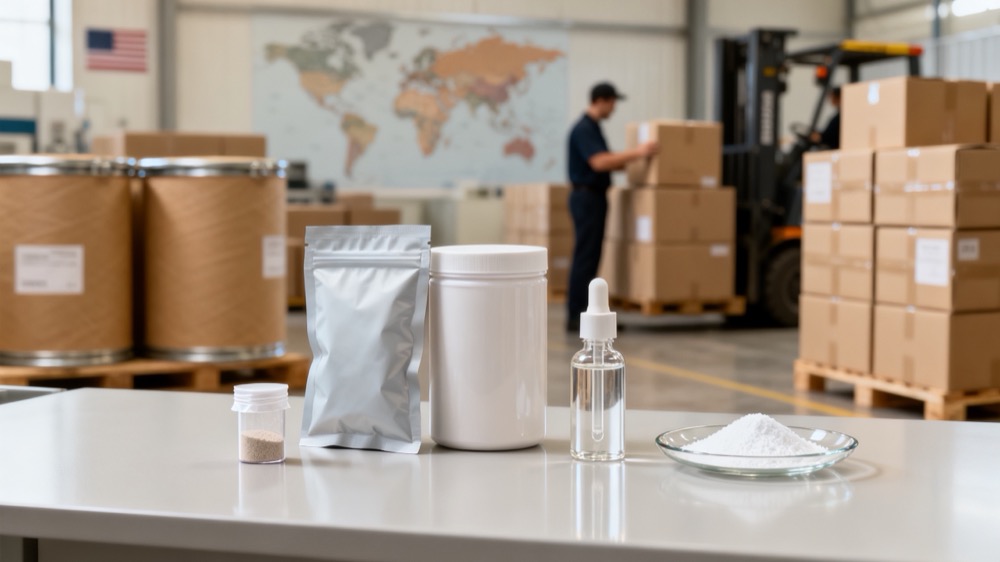
The most avoidable problems include:
- Accepting a catalog description as evidence of manufacturing ownership.
- Comparing different assay methods as though they measure the same thing.
- Treating a botanical or animal-derived extract as equivalent to purified Neu5Ac.
- Accepting generic certificates unrelated to the supplying site.
- Approving a sample without controlling the source of subsequent shipments.
- Using ingredient biology as proof of a finished cosmetic's performance.
Sialic acid has documented biological roles in glycoconjugates and cellular processes, but these roles do not by themselves substantiate a particular topical anti-aging claim. Finished-formula claims require evidence appropriate to that formulation and use.
An easily overlooked purchasing question is: "Does this result measure free Neu5Ac, or total sialic acid after releasing it from other molecules?"
This matters when comparing purified powder with extracts or complex mixtures. Analytical documentation shows that total-sialic-acid methods can use neuraminidase to release NANA from glycoconjugates before measurement. Such a result is not automatically equivalent to the amount of free Neu5Ac present in an untreated powder.
Ask the testing laboratory to state the sample preparation, hydrolysis or enzyme treatment, calibration material, calculation basis, and analyte definition.
Likewise, do not interpret chromatographic area percentage as an as-supplied mass percentage without understanding the method. Ask how water and non-detected components are addressed.
The practical safeguard is a contract specification that defines the measurement—not merely a percentage beside the word "purity."
The most defensible approach to sourcing Sialic Acid Powder in Russia is to separate three needs: laboratory evaluation, repeat commercial ingredient supply, and customized cosmetic development.
CHIMMED and DIA-M provide documented Russian procurement channels. Merck / Sigma-Aldrich offers differentiated research and analytical materials. Molekula provides an international quotation alternative, subject to confirmation of Russia-bound supply. ZHENYIBIO represents an overseas cosmetic-ingredient development candidate whose product-specific Neu5Ac capabilities should be established through documentation and sampling.
For a ZHENYIBIO quotation, submit your target specification, intended application, trial quantity, annual forecast, destination, and OEM/ODM requirements. Request a written response covering manufacturing source, sample availability, analytical documentation, MOQ, lead time, and customization responsibilities.
The objective is not simply to obtain a white powder at an attractive price. It is to establish a traceable ingredient, a reproducible specification, and a supplier relationship that can support the next approved batch.
Obtain the complete certificate, including annexes. Match the legal entity, manufacturing address, standard, certificate number, issuing body, issue date, expiry date, and certified scope.
Then confirm status directly with the issuing certification body through independently obtained contact details. A certificate covering trading or packaging should not be presented as proof that an undisclosed fermentation plant is certified.
For suppliers such as ZHENYIBIO or Molekula that publish certification statements, verify the original documents and the specific site involved in your order.
Not on purity alone. Research product documentation may establish chemical identity and assay without establishing suitability for commercial cosmetic manufacture.
Request the supplier's intended-use position, impurity information, traceability, safety documentation, and the data needed by your product safety assessor. A research reagent and a cosmetic raw material can share a CAS number while differing in release controls and supporting documentation.
The reviewed Sigma-Aldrich products illustrate why SKU-level assessment matters: their source, assay basis, intended applications, and storage information differ.
Request a signed manufacturing-route declaration and clarification of fermentation substrates, processing aids, purification materials, and cross-contact controls.
Define the claim precisely. "Fermentation-derived," "animal-free," "vegan," and "free from viable production organisms" are not identical purchasing requirements.
Where a marketing claim is commercially important, include it in the agreed specification and change-control obligations rather than relying on an informal email.
Ask for product-specific evidence: normal batch size, available allocation, recent commercial batch history, realistic lead time, and contingency arrangements.
If detailed production records are confidential, consider a confidentiality agreement, independent audit, or staged purchasing program.
Do not accept overall factory floor area, total company output, or a broad "multi-tonne supply" statement as proof of dedicated Neu5Ac capacity. The reviewed supplier pages do not establish a comparable product-specific capacity figure across this shortlist.
No. Raw-material documentation supports the assessment but does not replace the applicable finished-product conformity procedure.
The formulation, product category, claims, labeling, and current regulatory requirements must be considered together. The Eurasian Economic Commission's published updates demonstrate why buyers should check the current TR CU 009/2011 framework rather than rely on an old checklist.
- ZHENYIBIO TECHNOLOGY INC — company history, facilities, quality-control statements, and contact information. [zhenyibio]
- CHIMMED — N-acetylneuraminic acid catalog listing and Russian delivery information. [chimmed-new]
- CHIMMED — company history published by a Russian scientific institute. [nioch.nsc]
- DIA-M — Macklin catalog access containing N-acetylneuraminic acid entries. [spb.dia-m]
- Merck — Russian regional life-science website. [sigmaaldrich]
- Sigma-Aldrich — synthetic N-acetylneuraminic acid, product A0812. [sigmaaldrich]
- Sigma-Aldrich — *E. coli*-derived N-acetylneuraminic acid, product A2388. [sigmaaldrich]
- Molekula — N-acetylneuraminic acid product information and company profile. [molekula]
- Eurasian Economic Commission — amendments to standards associated with TR CU 009/2011, including application dates from 2025. [eec.eaeunion]
- Eurasian Economic Commission — amendments to cosmetic composition requirements. [eec.eaeunion]
- *Cell Death Discovery* — review of sialic acid biology and sialylation. [nature]
- Sigma-Aldrich — total-sialic-acid quantitation methodology. [sigmaaldrich]
- DataIntelo — published global sialic acid market estimate for 2025. [dataintelo]
- ReAnIn — alternative global market estimate illustrating the need to verify report scope. [reanin]


