


Views: 268 Author: ZHENYIBIO Publish Time: 2026-11-15 Origin: Site
Content Menu
● 1. Identify How Moisture Affects the Cosmetic Ingredient
>> Distinguish water content from water activity
>> Set acceptance limits for the grade you buy
● 2. Compare Moisture-Barrier Packaging by Format, Not Material Name
>> Read the WVTR data before comparing quotes
● 3. Turn the Ingredient Specification Into a Moisture Budget
● 4. Validate the Finished Pack From Filling Through Dispensing
>> Test unopened storage and in-use handling separately
>> Match the pack size to the amount used per batch
● 5. Specify the Packaging Details That Affect Supplier Approval
● Discuss Packaging With ZHENYIBIO TECHNOLOGY INC
>> Is aluminum foil laminate always the best choice for hygroscopic cosmetic powders?
>> Can a desiccant replace a high-barrier pouch?
>> Is an induction seal enough for a cosmetic raw material bottle?
>> Should a refrigerated powder be opened immediately after removal from cold storage?
>> Does an unopened shelf-life claim apply after the package is opened?
>> What should buyers request when a supplier changes the liner or closure?
The best packaging for moisture-sensitive cosmetic raw materials is the format that keeps the ingredient within specification until the customer uses the last portion. For a hygroscopic botanical powder, that may mean heat-sealed foil laminate pouches sized for one production batch. For a concentrated liquid extract, a compatible rigid bottle with a validated closure may be a better choice. Start with the ingredient's failure point, then assess the complete packaging system under the shipping, storage, and dispensing conditions it will actually face.
For beauty brands, wholesalers, and manufacturers sourcing natural plant actives or fermentation-derived cosmetic ingredients, the choice affects more than shelf life. It also determines how easily receiving teams can inspect a shipment, how reliably operators can dispense the ingredient, and how much material is exposed each time a pack is opened. This guide shows how to turn those practical concerns into a packaging specification buyers and suppliers can use.
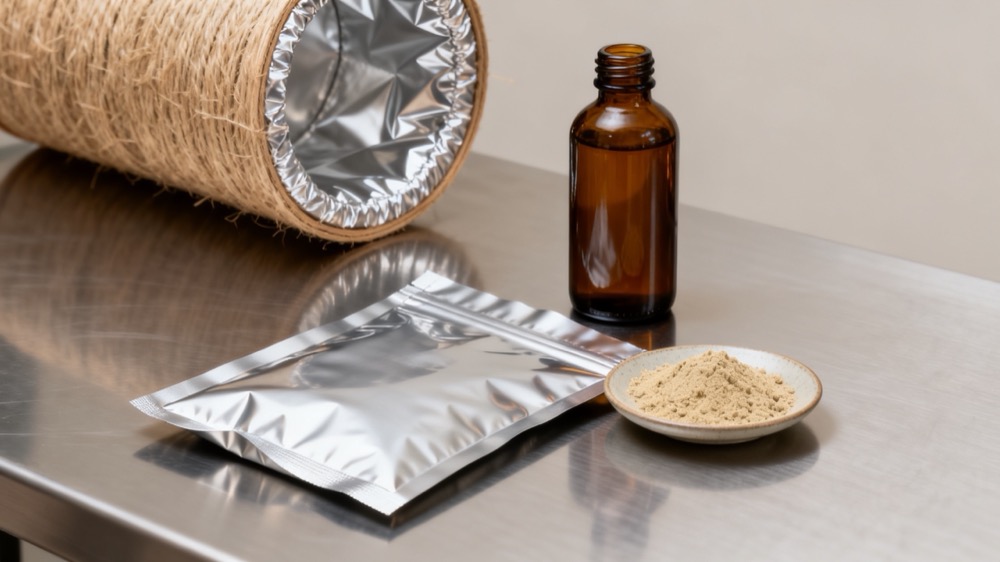
Water content tells you how much water is in a material. Water activity, written as \(a_w\), describes the equilibrium vapor pressure of water in the material relative to that of pure water at the same temperature. Two powders with similar water content can therefore have different water activity. Neither measure, by itself, tells you when a specific botanical extract will stop flowing or fall outside its assay specification.
For a hygroscopic powder—one that absorbs moisture from the air—check which change matters first: clumping, slower dispersion, a shift in color, or a decline in the measured level of an active marker. A powder that still passes its assay may already be unsuitable for a dosing line if it bridges in the hopper or no longer disperses within the approved mixing time.
Ask the ingredient supplier which tests define a usable lot. Depending on the grade, these may include water content, water activity, flow, appearance, dispersibility, marker assay, or microbiological quality. Specify the analytical method as well as the limit. For example, a loss-on-drying result can include volatile substances other than water, so it should not automatically be treated as equivalent to a water-specific result.
For liquid actives, define the direction of concern. A concentrate may lose water through its container, changing its concentration or viscosity. Another grade may be more susceptible to contamination during dispensing. The packaging decision should address the actual failure mode rather than assume that all plant extracts need the same barrier.
| Packaging format | When to shortlist it | What to verify before approval |
|---|---|---|
| Heat-sealed aluminum foil laminate pouch | Dry actives with a narrow moisture tolerance, especially when one pouch can feed one batch | Laminate construction, seal integrity, resistance to handling damage, and ease of opening |
| Heat-sealed polymer barrier pouch | Dry grades with enough moisture tolerance for a documented polymer structure | Water vapor transmission at comparable test conditions and the performance of the finished pouch |
| Rigid bottle or jar with a compatible liner and closure | Powders or liquids that need rigid protection or controlled dispensing | Bottle and closure compatibility, seal application, and performance after opening |
| Drum with a sealed inner liner | Bulk powder shipments that require mechanical protection and efficient handling | Liner barrier, closure of the liner, protection against puncture, and how operators will dispense partial quantities |
A drum can protect a liner against impact without providing the moisture barrier the ingredient needs. Likewise, two pouches described as "foil" can perform differently once they are filled, sealed, folded, and shipped. Specify the actual components and construction rather than approving a generic material description.
WVTR means water vapor transmission rate. For a flat packaging film, it is commonly reported in grams per square meter per day. Ask for the test method, temperature, relative humidity, and exact film construction. A lower number is meaningful only when the conditions and specimens are comparable. ASTM F1249 is one method used to measure water vapor transmission through flexible barrier materials.
Film data are useful for shortlisting, but they do not measure ingress through a finished pouch's seals or a bottle's closure. Where the ingredient has a narrow moisture tolerance, request whole-package testing on the final pack size and closure configuration. A result expressed per package per day can be more useful to the buyer than a flat-film value because it can be compared directly with the ingredient's allowable moisture gain.
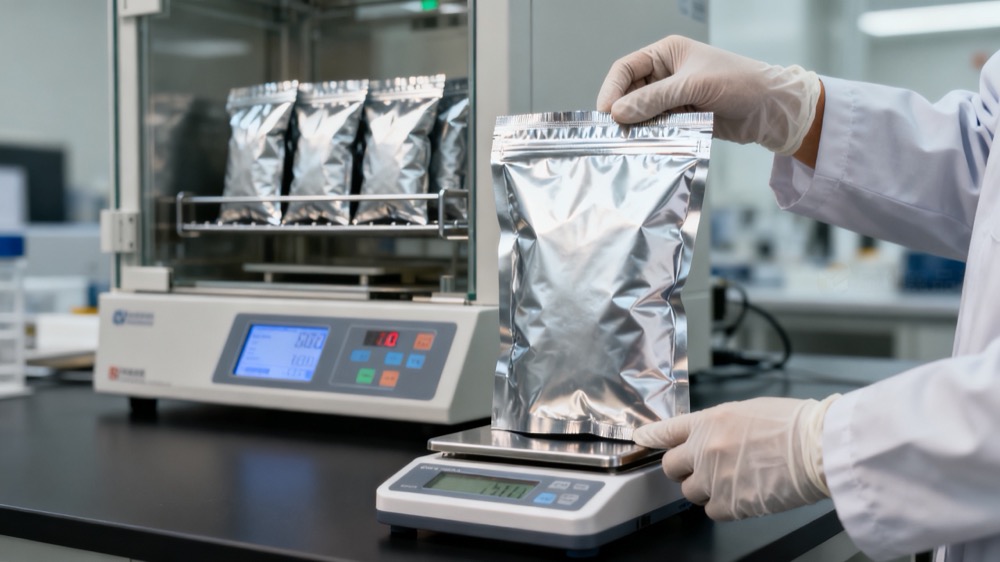
A moisture budget translates a quality limit into a packaging target. Suppose a 5 kg lot contains 2.0% water by weight at packing, and the approved upper limit is 2.2%. If the only change is incoming water, the pack can gain about 10.2 g before reaching that limit. Spread over 365 days, that is about 28 mg per package per day on average, before any safety margin.
That figure is a screening ceiling, not a purchase specification. A commercial lot may start closer to the upper limit, and a powder may cake before its moisture assay fails. The calculation also does not account for exposure during filling or after opening. Use the earliest meaningful failure point, allow for lot variation, and reserve part of the budget for exposure outside sealed storage.
This calculation also gives procurement a better question to ask. Instead of "Which pouch has the best barrier?", ask "Can this sealed 5 kg pack keep moisture gain below our budget across the intended distribution route?" The answer may justify a more protective laminate, a tighter incoming moisture limit, or smaller subpacks. Those changes address different parts of the problem and should be evaluated separately.
1. Define the distribution scenario. Record the expected storage duration, likely temperature and humidity exposures, and whether the shipment will be transferred between environments. Set test conditions that address the intended route rather than borrowing a standard condition and assuming it predicts shelf life.
2. Use production-representative samples. Fill the proposed material into the actual pack size using representative equipment and settings. Include the intended liner, closure, and secondary protection. If powder can contaminate the sealing surface during filling, check how the production process controls it.
3. Check barrier and integrity. Pair moisture transmission testing with an integrity method suited to the package. A seal-strength test tells you how much force is needed to separate the seal. It does not, on its own, show whether a small leak path exists.
4. Recheck the ingredient. Measure the attributes that drove the packaging choice, such as flow, dispersion, or marker assay. Use accelerated testing to compare candidates, but support the intended shelf life with real-time data on the representative package.
5. Simulate partial use. Open, dispense, and reclose the package on the customer's actual schedule. Record the amount remaining, exposure time, and dispensing environment. A pack approved for unopened storage has not necessarily been shown to protect its contents for weeks after the first opening.
Consider a manufacturer that receives a 20 kg botanical powder drum but uses 4 kg per production run. A single liner may be cheaper to purchase, yet the remaining powder is exposed each time the drum is reopened. Five individually sealed 4 kg pouches inside a protective outer drum would let operators open one pack per run.
That alternative is not automatically better. It adds packaging and filling steps, and it may require more receiving checks. Compare the two formats using the actual production cadence, likely hold time after opening, and cost of a rejected or difficult-to-process lot. If the customer uses the entire drum in one shift, a single validated liner may be the more practical choice.
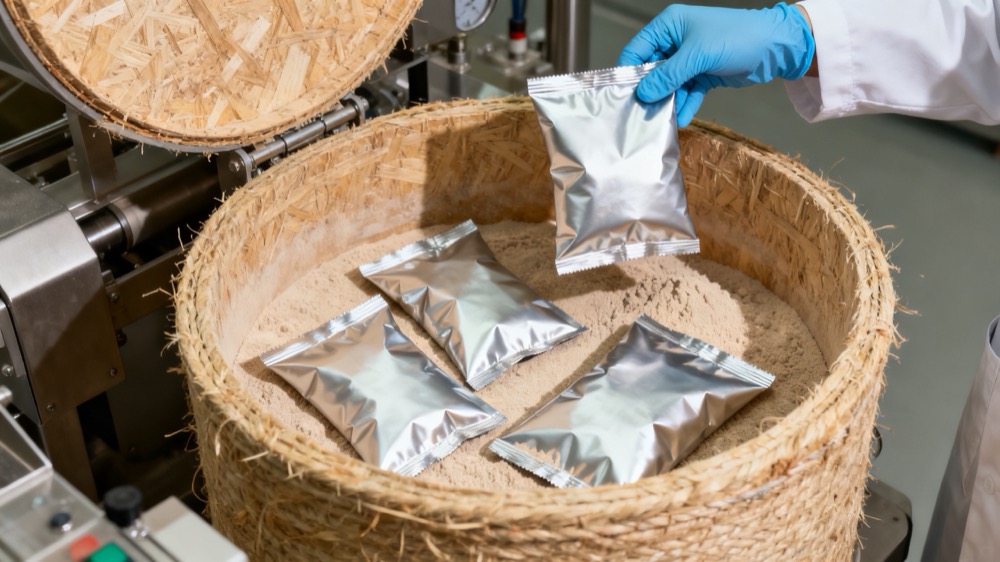
A packaging specification should be detailed enough for quality assurance to identify what changed when a supplier proposes a substitution. At minimum, document:
- The ingredient grade, net fill weight, and whether the package is intended for single-batch or repeated use.
- The product-contact material, laminate or liner construction, dimensions, and approved closure components.
- The barrier test method and conditions, reporting units, and finished-pack acceptance criteria where applicable.
- The sealing or closure controls, inspection procedure, and criteria for rejecting damaged packs at receipt.
- The storage and opening instructions, supported in-use period if established, and changes that require review or requalification.
Evaluate sustainability after establishing which options protect the ingredient. Compare the amount of packaging per usable kilogram, the risk of product loss, and the recovery options in the destination market. A lighter structure is only an improvement if it still protects the ingredient through its intended use. Avoid making a recyclability claim based on the material name alone.
For an OEM or ODM project involving natural botanical actives or fermentation-derived cosmetic ingredients, share your target grade, order volume, destination, typical batch size, and expected time between opening and final use with ZHENYIBIO TECHNOLOGY INC. Ask to review two candidate pack configurations against the same ingredient acceptance criteria before finalizing the commercial order. That gives your formulation, procurement, and quality teams a concrete basis for approval.
No. It is a strong candidate for highly sensitive powders, but the seal, handling durability, and pack size still matter. A qualified polymer pouch can be suitable when the grade has a wider moisture tolerance and the finished pack meets the agreed requirements.
No. A desiccant has finite capacity. Use it only as a supplementary control after evaluating the expected moisture load, compatibility, and how operators will prevent the sachet from entering the production batch.
Not by itself. The bottle, liner, closure, and seal application must work together. Once the original seal is removed, protection depends on the reclosed bottle and the conditions under which the customer dispenses the ingredient.
Generally, avoid opening a cold pack in warm, humid air, where condensation can form on cold surfaces. If the grade's handling instructions permit it, let the sealed pack reach the approved dispensing temperature before opening.
No. Opening changes the ingredient's exposure to ambient humidity and handling. An in-use period should be supported separately using a realistic opening, dispensing, and reclosing schedule.
Ask for the exact old and new constructions, the reason for the change, and comparative evidence covering barrier, integrity, and compatibility as relevant. An unchanged outer drum or bottle label does not demonstrate equivalent protection.
- U.S. Food and Drug Administration. [Water Activity (\(a_w\)) in Foods]. Supports the definition of water activity and its relationship to equilibrium relative humidity. Food-specific limits were not applied to cosmetic ingredients. [fda]
- Intertek. [Water Vapor Transmission Rate (WVTR): ASTM F1249]. Covers flexible barrier film testing and the effects of test conditions and material thickness on interpretation. [intertek]
- United States Pharmacopeia. [General Chapter ⟨671⟩: Containers—Performance Testing]. Provides a methodological reference for measuring moisture transmission through packaging systems, not a cosmetic packaging requirement. [doi.usp]
- International Council for Harmonisation. [Q1A(R2): Stability Testing of New Drug Substances and Products]. Provides a reference for stability-study design and evaluation in the proposed container-closure system. Pharmaceutical test conditions and acceptance criteria were not adopted as cosmetic requirements. [database.ich]%20Guideline.pdf)


