


Views: 231 Author: ZHENYIBIO Publish Time: 2026-11-20 Origin: Site
Content Menu
● 1. Verify the Identity and Composition of the Cosmetic Active Ingredient
>> Botanical extracts: Confirm the species, plant part, and extract profile
>> Fermentation-derived actives: Confirm what is in the supplied grade
● 2. Compare the Cosmetic Ingredient Specification With the Batch Certificate
● 3. Match Cosmetic Ingredient Testing to the Material and Its Intended Use
● 4. Check Manufacturer Traceability, Change Control, and Shelf-Life Support
● 5. Qualify Multiple Lots Before Scaling an OEM or ODM Formula
>> Illustrative case: Three passing lots, one visible formula difference
● 6. Turn Incoming Quality Control Into a Reorder Decision
>> Request a qualification package for your next cosmetic active
>> Is a Certificate of Analysis enough to approve a new supplier?
>> How many lots should buyers test before approval?
>> Can two cosmetic actives with the same INCI name be substituted?
>> Is a standardized botanical extract always consistent?
>> What is the difference between a retest date and an expiry date?
>> Does ingredient quality testing substantiate a finished-product claim?
To ensure consistent quality in cosmetic active ingredients, buyers should verify five things before approving a supplier: the identity of the ingredient, the written specification, the actual results for the lot they will receive, the manufacturer's ability to control changes, and the ingredient's performance in the intended formula. A passing certificate matters, but it cannot tell you whether the next shipment will behave like the sample your formulators approved.
For buyers sourcing botanical extracts and fermentation-derived actives, the practical question is: Can the supplier show what stays within agreed limits, explain what can vary, and notify you before a change affects your product? This guide turns those questions into checks that procurement, quality, and formulation teams can use together.

Start with the International Nomenclature of Cosmetic Ingredients (INCI) name, the supplier's grade code, and the composition of the material as sold. An INCI name helps identify a declared ingredient, but two grades with the same INCI name can differ in concentration, carrier, preservative system, or processing. Those differences matter when you replace one grade with another.
Ask for the botanical name, plant part, extraction solvent, and any carrier or diluent. If the supplier quotes an extract ratio, ask what it compares and whether it refers to the native extract or the commercial blend. A root extract is not automatically interchangeable with a leaf extract, even when both are marketed under the same familiar plant name.
For complex extracts, ask how the supplier verifies identity before and after processing. A chromatographic fingerprint—a pattern of chemical peaks—can help compare an extract with a qualified reference. A marker assay answers a different question: how much of a selected compound is present? Matching that marker alone does not establish that the rest of the extract is comparable.
Clarify whether you are purchasing a purified compound, a filtrate, a lysate, or a formulated blend. Ask which constituents are measured, which carriers or preservatives remain, and how the supplier controls relevant process-related impurities. "Fermentation-derived" describes how an ingredient was made; it is not a specification for the material delivered.
The written specification sets the acceptance criteria. The Certificate of Analysis (CoA) reports how a particular lot was assessed against those criteria. A technical data sheet can guide formulation, and a safety data sheet addresses hazards and handling where applicable. Neither replaces the specification or lot-specific evidence.
| What to check | What to request | What should prompt a follow-up |
|---|---|---|
| Identity and grade | Product code, identity method, and lot number matching the container label | The sample and commercial grade carry different codes |
| Active or marker content | Acceptance range, method, units, reporting basis, and measured result | "Pass" is reported without a value for an assay critical to performance |
| Physical properties | Relevant limits for appearance, pH, moisture, or solubility, with test conditions | The pH is listed without the dilution or temperature needed to compare results |
| Microbial quality and impurities | Limits and testing rationale based on material and use | A generic statement does not identify which contaminants were assessed |
| Storage and dating | Storage conditions and a retest or expiry date, as applicable | The shipping conditions are unclear or conflict with the documented storage requirements |
Check whether assay values are reported on an *as-is* or *dry-weight* basis. For example, a powder with 5% moisture and a 20% dry-basis marker assay contains 19% marker as supplied, assuming moisture is the only correction. If your formula is dosed by the weight of powder received, that distinction affects how much marker you add.

A long test panel is not necessarily a good one. Start with how the material is produced, how it will be used, and where the finished cosmetic will be sold. Then agree with quality and regulatory teams on which tests belong on every CoA, which can be verified periodically, and what would trigger additional testing.
- For plant extracts, evaluate whether pesticide residues, elemental impurities, or residual extraction solvents warrant testing. The decision should reflect the source, processing route, and intended use.
- For aqueous or otherwise microbiologically susceptible ingredients, review microbial limits, relevant organisms, sampling, and how the supplier protects the material during storage and shipment.
- For concentrated or claim-critical actives, ask whether the assay can distinguish the target compound from interfering compounds or degradation products. Agree on a comparable method before treating a third-party result as evidence of a discrepancy.
- For products sold across multiple markets, have the regulatory team check ingredient restrictions, use conditions, and safety documentation needs for each destination. A supplier's blanket statement that an ingredient is "globally compliant" does not answer those questions.
Raw-material testing and finished-product testing serve different purposes. An incoming microbial result tells you about the sampled lot. It does not establish that an aqueous serum's preservative system can withstand contamination during use. Likewise, an ingredient's storage data do not establish the finished serum's stability in its retail packaging.
Ask who manufactures, tests, releases, and, where relevant, repackages each lot. If a distributor supplies the ingredient, confirm that it can link the shipment back to the original manufacturer's lot and retrieve relevant records when a complaint arises. If a supplier presents a good manufacturing practice (GMP) certificate, verify its site address and scope rather than assuming it covers every grade or subcontracted operation.
A useful supplier review follows one lot through the system. Ask the supplier to show how incoming materials link to the finished lot, who approved its release, whether a retained sample is available, and how a complaint would be investigated. Agree in writing on advance notice for changes that could affect identity, composition, safety, or performance. Examples include a new plant source, extraction solvent, carrier, manufacturing site, or analytical method.
Review shelf-life support separately. Ask which packaging and storage conditions the supplier evaluated, which quality attributes were monitored, and whether the dating applies to unopened containers only. If your factory opens a drum repeatedly, ask for handling guidance; unopened-container data do not establish how long a partially used drum remains suitable.
A development sample shows that one lot worked once. For an active that drives a product claim or has a visible effect on the formula, request three independent, representative lots as a practical starting point—not as a universal standard or proof of long-term capability. Three containers filled from one bulk batch do not count as three lots.
1. Compare the raw materials. Record lot numbers, actual CoA values, appearance, and any properties your team can check using agreed methods.
2. Make side-by-side pilot batches. Keep the base formula and processing conditions constant so that ingredient-lot differences are easier to isolate.
3. Evaluate what matters in the finished product. Depending on the formula, check color, clarity, odor, pH, viscosity, or retention of a relevant marker under the planned stability conditions.
4. Document the approved grade. Record the supplier, manufacturing site where relevant, specification revision, and any formula-specific acceptance criteria. In an OEM or ODM agreement, clarify who can authorize a substitution and what evidence is required.
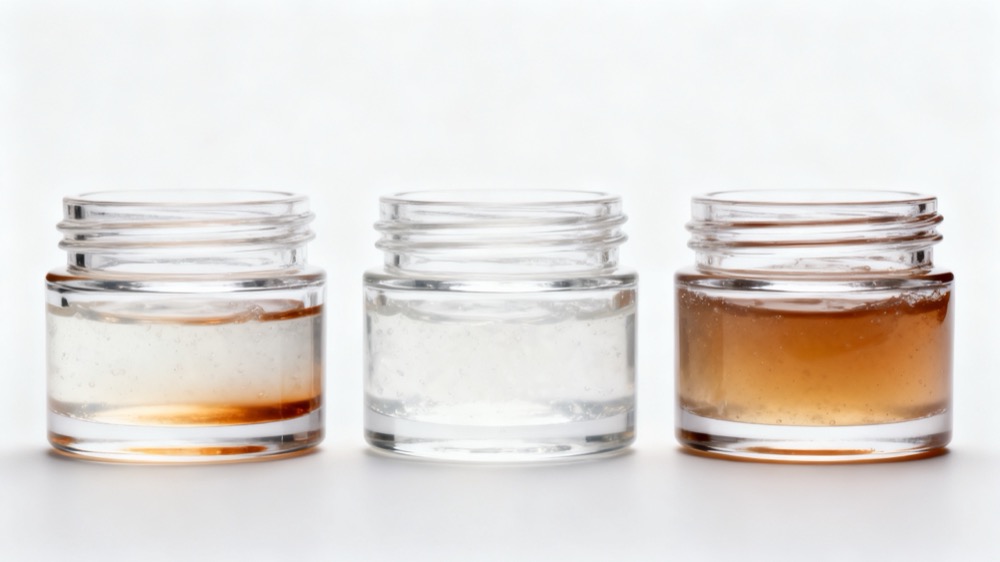
Suppose three lots of a botanical extract report marker values of 9.8%, 10.0%, and 10.2%, all within an agreed range of 9.5% to 10.5%. One lot nevertheless produces a noticeably darker clear gel at the same use level. These figures are hypothetical, not supplier performance data.
Tightening the marker range may not fix the problem: the measured compound may have little to do with the color shift. First, compare the lots at the same dilution and pH and review their composition and extract profiles. If color is commercially important and repeatable, agree on a measurable color limit or a standard comparison procedure at a defined use concentration. The lesson is to specify the property that drives acceptance, not just the one that is easiest to measure.
At receipt, match the label, purchase order, approved grade, and CoA. Inspect the seals and packaging, check transport records where conditions matter, and keep the material on hold until required release checks are complete. If a result falls outside the agreed specification, segregate the lot and investigate rather than repeatedly testing until it passes.
Track actual results over successive deliveries, not just pass or fail. A gradual shift in color, moisture, or assay can justify a supplier discussion even while every lot remains within specification. When a shift appears, check whether the analytical method, reporting basis, raw-material source, or site changed before concluding that the material itself has drifted.
If you are sourcing a plant-derived or fermentation-derived active for an OEM or ODM project, contact ZHENYIBIO TECHNOLOGY INC with your target market, product format, intended use level, and the quality attributes your formula cannot compromise on. Ask which grade specifications, representative lot data, sample options, and formulation support are available for your project. For a clear serum, for example, flag your color and clarity requirements before sampling so both teams can evaluate the same criteria.
No. A CoA documents the assessment of a specific lot. It does not show on its own how the supplier controls manufacturing changes, whether results are comparable across lots, or whether the active works in your formula.
Three independent, representative lots are a useful starting point for a formula-critical active. Adjust the plan according to the risk, the supplier's history, and the strength of available evidence. Increase verification after significant changes or unexplained variability.
Not on the name alone. Compare commercial composition, active concentration, carriers, impurities, and physical properties. Then confirm that the replacement performs in the intended formulation and review whether the change affects the finished product's safety documentation.
No. Standardization to a marker controls the reported amount of that compound within a specified range. It does not necessarily control the entire chemical profile, color, odor, or formulation performance.
A retest date indicates when the material should be reassessed under an approved procedure before further use. An expiry date marks the end of its assigned shelf life. Do not treat either date as permission to extend use without a documented quality decision.
Not by itself. An identity test or marker assay verifies a material attribute. To support a claim about the finished cosmetic, review whether the evidence applies to the grade tested, the concentration used, the final formula, and the wording of the claim.
- U.S. Food and Drug Administration, *Good Manufacturing Practice (GMP) Guidelines/Inspection Checklist for Cosmetics*. Basis for incoming-material identification, lot status, testing, release controls, and retained samples. [fda]
- European Parliament and Council, *Regulation (EC) No 1223/2009 on Cosmetic Products*, Annex I. Basis for distinguishing ingredient information from finished-product safety, stability, microbiological quality, and impurity documentation. [health.ec.europa]
- Scientific Committee on Consumer Safety, *Notes of Guidance for the Testing of Cosmetic Ingredients and Their Safety Evaluation*, 12th revision. Technical context for ingredient characterization, specifications, impurities, and the relevance of evidence to the form used. [health.ec.europa]
- World Health Organization, *Quality Control Methods for Medicinal Plant Materials*, and U.S. Food and Drug Administration, *Botanical Drug Development: Guidance for Industry*. Technical background for botanical identity and chemical profiling; neither is presented as a cosmetic-specific legal requirement. [iris.who]


