


Views: 218 Author: ZHENYIBIO Publish Time: 2026-11-19 Origin: Site
Content Menu
● 1. Define the Cosmetic Ingredient Sample Before You Request It
>> Calculate the Sample Quantity From Your Test Plan
● 2. Ask for the Right Cosmetic Ingredient Technical Documents
>> Ask What the Name Leaves Out
● 3. Send a Sample Request Your Supplier Can Answer in One Reply
>> Cosmetic Ingredient Sample Request Email Template
● 4. Verify Sample Traceability Before You Run a Bench Trial
>> Example: Two Grades With Similar Names Are Not Interchangeable
>> Use a Comparison That Can Explain a Failed Trial
● 5. Separate Sample Approval From Launch Approval
● Request Samples and Technical Documents From ZHENYIBIO
>> Are cosmetic ingredient samples free?
>> Can I start testing with a generic CoA?
>> Is an INCI name enough to compare two botanical ingredients?
>> What if the supplier won't disclose the full composition?
>> How do I request a cosmetic ingredient sample from overseas?
>> Should I request a new sample before placing a bulk order?
To request cosmetic ingredient samples and technical documents from a supplier, specify the ingredient grade, finished product, target markets, test quantity, and evaluation date in your first email. Ask for the technical data sheet, the applicable safety data sheet, and a certificate of analysis for the lot you'll receive. If the lot hasn't been assigned, request an example certificate for initial review and the matching certificate before testing.
The goal is not simply to get a sample. It's to determine whether the material in your lab is the same grade your supplier can quote, document, and deliver at production scale. That distinction is especially important for botanical extracts and fermented plant ingredients, where similar trade names can describe grades with different carriers, concentrations, or formulation requirements.

A supplier can make a better recommendation when you describe the formula rather than only naming the desired benefit. "A water-dispersible botanical active for a fragrance-free leave-on serum at pH 5.2" gives a technical team more to work with than "Send your best soothing extract."
Include these details in your request:
- Product format and intended use: Identify the serum, cream, cleanser, or other format, and say whether it's leave-on or rinse-off.
- Formula constraints: Share your working pH, processing temperature, and any restrictions on carriers, preservatives, fragrance, or color.
- Preferred grade: Give the supplier's product code if you have it. Otherwise, describe the desired plant source, physical form, or standardized marker.
- Target markets and claims: Name the countries or regions where you plan to sell and the cosmetic benefits you want to substantiate.
- Project stage and timing: State whether this is an initial screen, a stability study, or a pilot run. Give the date the sample needs to arrive, not just the date it needs to ship.
Multiply the total formula mass by the planned inclusion rate, then allow for repeat batches, handling losses, and retained material. For four 250 g prototypes at a 2% inclusion rate, you need 20 g of ingredient before any allowance. A 30 g request would leave 10 g for additional work. If you also need material for a separate identity test or a pilot batch, list that quantity separately so the supplier understands the request.
Request documents by name and tell the supplier what you need each one to establish. A missing document is easier to resolve when the supplier knows whether the issue is lot release, formula compatibility, workplace handling, or a safety assessor's need for composition data.
| Document | What to request | What it helps you decide |
|---|---|---|
| Technical data sheet (TDS) | Exact grade, physical form, recommended use range, incorporation method, and known pH or temperature limits | Whether the ingredient fits your formula and process |
| Certificate of analysis (CoA) | Sample lot number, test parameters, acceptance limits, and reported results or pass/fail status | Whether the supplied lot meets the stated release criteria |
| Safety data sheet (SDS) | Current version for the exact grade, where applicable, with handling, storage, and hazard information | How your team should handle the material |
| Product specification | Current acceptance criteria, test methods or method references, and relevant microbiological limits | What future lots will be measured against |
| Composition and naming statement | International Nomenclature of Cosmetic Ingredients (INCI) names, carriers, preservatives, and composition details as needed | Whether the grade fits your formula restrictions and what information your regulatory team still needs |
| Supporting evidence | Study summaries, contaminant data, or sourcing records relevant to the project | Whether safety, performance, or sourcing claims merit further review |
A specification gives the limits an acceptable lot must meet. A CoA reports how a particular lot performed against the applicable criteria. A TDS guides formulation, while an SDS addresses hazards and safe handling. None replaces the others, and none establishes that your finished cosmetic is safe or that its claims are supported.
For a botanical extract, request the botanical name, plant part, extraction solvent, carrier, and any marker compound used to standardize the grade. If a marker level matters, ask whether it's guaranteed or merely typical, and whether the result is expressed on a dry basis or for the material as supplied. That distinction can change how you compare a powder with a liquid dispersion.
For a fermentation-derived ingredient, clarify what the commercial grade contains: for example, a filtrate, a lysate, or another processed fraction. Ask about the plant substrate, added carriers or preservatives, and the measurements used to control lot-to-lot consistency. Evaluate the supplied material against your needs rather than treating the word *fermented* as evidence of performance or sustainability.
Put the three decisions you need up front: whether the grade fits, whether the sample can arrive on time, and which documents the supplier can provide. Here's an email a brand, wholesaler, or contract manufacturer can adapt.
> Subject: Sample and technical document request — [ingredient or grade] for [product]
> Hello [Name],
> We're evaluating [ingredient or grade] for a [leave-on/rinse-off product] intended for [markets]. Our formula target is [pH], with a maximum processing temperature of [temperature]. We're screening at [inclusion rate] for [intended cosmetic benefit].
> Could you recommend a suitable commercial grade and quote [quantity] for delivery to [city, country, postal code] by [date]? Please confirm sample availability, fees, freight terms, and whether the sample represents the grade currently offered for production orders.
> Please send the current TDS, applicable SDS, product specification, composition or INCI statement, and CoA for the lot you intend to ship. If the lot hasn't been assigned, an example CoA is fine for initial review. Please provide the matching CoA once the lot is confirmed.
> If you have performance data relevant to [product type or claim], please include the grade tested, concentration, test design, and outcome. Let us know which documents require a nondisclosure agreement.
> Please also confirm commercial pack sizes, minimum order quantity, lead time, and the best contact for technical follow-up.
> Thank you,
> [Name, company, role, and contact details]
Match the sample label against the CoA before you open the package. Check the product code, grade, and lot number. Record the date received, packaging condition, and any stated expiry or retest date. If the codes don't match, ask for corrected documentation before attributing any test results to the commercial grade.
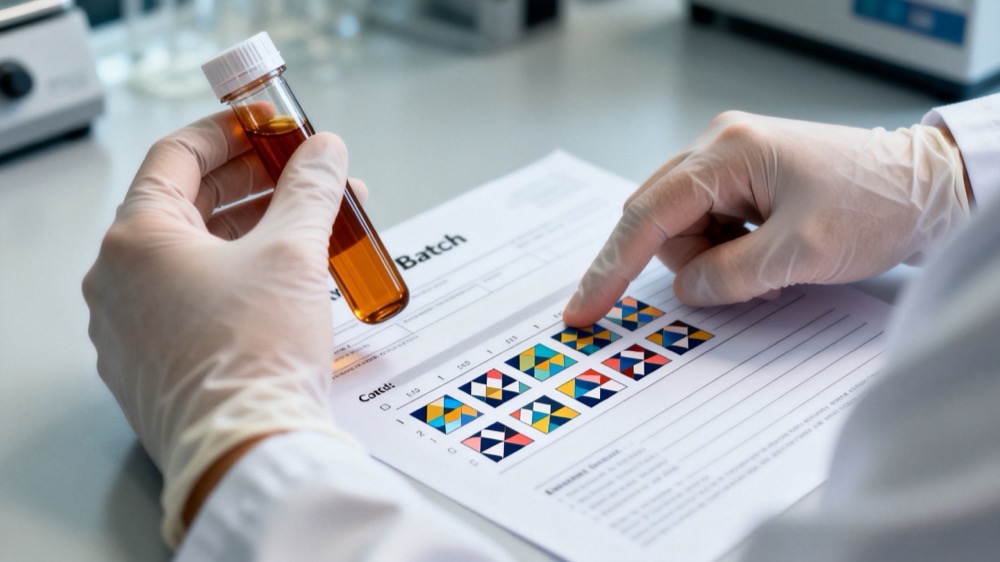
Imagine a skincare team requests a water-dispersible fermented botanical for a clear serum. The sample passes an initial appearance check, but the CoA lists a different suffix from the quoted product code. The supplier confirms that the sample and quoted grades use different carriers.
The buyer has two options: request the quoted grade and repeat the trial, or ask for a production quote and matching documents for the grade already tested. What the buyer should not do is approve the quoted grade on the strength of the first sample. The successful trial applies to the material that was tested, not to every product sold under a similar name.
Prepare a control formula without the ingredient and compare it with your test formula under the same conditions. Record the order of addition, mixing conditions, pH, appearance, and odor at planned checkpoints. If the ingredient comes in a carrier that could affect the result, consider a carrier-matched control when feasible.
If haze appears after a pH adjustment, the batch notes give the supplier a specific problem to investigate. If the team changes the pH, carrier, and addition order all at once, it becomes harder to identify what caused the difference.
A bench trial answers whether an ingredient works in an early formulation. Commercial approval also requires your team to consider repeat supply, quality controls, finished-product safety, and whether the evidence supports the intended claims.
- For EU projects, ask your safety assessor which raw-material data they need for the Cosmetic Product Safety Report. Relevant information can include composition, purity, impurities, microbiological quality, and toxicological data.
- For U.S. projects, route supplier evidence to the team responsible for finished-product safety substantiation. A supplier's ingredient dossier can contribute to that review, but it does not replace records supporting the finished product.
- For performance claims, ask whether the supplier studied the exact grade and whether the concentration, vehicle, test conditions, and measured outcome are relevant to your claim. A study on a different extract or a higher concentration may help you choose what to test next; it doesn't necessarily substantiate the same claim for your formula.
- For sourcing or environmental claims, ask the supplier to define what its evidence covers: the plant source, a manufacturing step, or the ingredient as sold. Don't extend a claim beyond that scope.
Before placing a production order, confirm the approved grade, specification revision, packaging, minimum order quantity, and lead time. Ask how the supplier communicates changes to the source, carrier, specification, or manufacturing site, and decide which changes would trigger a new review. For OEM or ODM projects, agree on who approves substitutions, owns the formula, keeps the technical records, and coordinates finished-product testing.
Contact ZHENYIBIO TECHNOLOGY INC with your product format, target markets, formula pH, desired botanical benefit, and sample delivery date. Ask for a commercial grade recommendation, sample availability, and the documentation available for that grade. If you're evaluating OEM or ODM services rather than sourcing a standalone ingredient, include your finished-product brief so both teams can clarify formulation, testing, and manufacturing responsibilities before work begins.
It depends on the supplier, the grade, and the quantity. Ask for sample charges, freight, and any handling fees upfront. Also confirm whether a sample fee can be credited against a later production order.
Use an example CoA to preview which tests the supplier reports. It doesn't tell you whether the material you received passed those tests. If you begin exploratory work before receiving a lot-specific CoA, mark the results as provisional and obtain the matching record before qualifying the material.
No. Compare the plant part, extraction method, carrier, concentration, marker specification, and formulation behavior. Two materials with the same listed name may not behave the same way or support the same claims.
Ask what can be shared under a nondisclosure agreement or sent directly to your safety assessor. Identify the information your team needs before investing in extensive trials, and keep qualification open if essential data are still missing.
Provide the destination country, postal code, consignee details, and requested arrival date. Before dispatch, confirm who handles freight and customs, which shipping documents are needed, and whether the sample has special transport or storage requirements.
Request another sample if the grade, specification, source, or process has changed, or if the first sample was not representative of commercial supply. If nothing has changed, confirm how the production lot will be checked against the approved specification and whether you need a pre-shipment sample.
- European Parliament and Council. Regulation (EC) No 1223/2009 on cosmetic products, Annex I: Cosmetic Product Safety Report. Supports the discussion of composition, microbiological quality, impurities, and toxicological information. [European Commission regulation text] [health.ec.europa]
- U.S. Food and Drug Administration. *Modernization of Cosmetics Regulation Act of 2022 (MoCRA)*. Supports the distinction between supplier evidence and finished-product safety substantiation records. [FDA overview] [fda]
- Occupational Safety and Health Administration. *29 CFR 1910.1200, Appendix D: Safety Data Sheets*. Supports the description of the SDS and its role in hazard communication. [OSHA standard] [osha]


