


Views: 264 Author: ZHENYIBIO Publish Time: 2026-10-24 Origin: Site
Content Menu
● Fine Powder vs. Coarse Powder: What Is the Difference?
>> Understanding Dv10, Dv50, and Dv90
>> Primary Particles vs. Agglomerates
● Fine Powder vs. Coarse Powder: Comparison Table
● How Particle Size Affects Cosmetic Ingredient Dispersion
>> 1. Wetting: Why Fine Powders Can Float
>> 2. Deagglomeration: Mixing Is Not Always Milling
>> 3. Stabilization: Uniform Today Does Not Mean Stable Tomorrow
● Dispersion vs. Dissolution: A Critical Distinction for Botanical Actives
>> Fine Powder Can Dissolve Faster Without Becoming More Soluble
>> Botanical Powders Are Not Interchangeable
● How Particle Size Changes Stability, Texture, and Performance
>> Sedimentation: Smaller Can Help, Within Limits
>> Skin Feel: Check the Coarse Tail
>> Active Performance: Avoid Unsupported Conclusions
● Three Practical Insights That Improve Powder Selection
>> Insight 1: The Same Median Can Hide Different Behavior
>> Insight 2: Larger Granules Can Be Designed to Disperse
>> Insight 3: Compare Cost per Successful Batch
● A Practical Protocol for Comparing Fine and Coarse Botanical Powders
>> Step 1: Control the Comparison
>> Step 2: Define the Intended Application
>> Step 3: Standardize Powder Addition
>> Step 4: Measure More Than Appearance
>> Step 5: Verify at Pilot Scale
● What Buyers Should Request from a Cosmetic Powder Supplier
● Safety Considerations for Fine Cosmetic Powders
● Build the Right Powder Specification with ZHENYIBIO
>> Is Fine Powder Always Easier to Disperse?
>> Does Smaller Particle Size Make Botanical Extracts Water-Soluble?
>> Which Particle Size Is Best for Cosmetic Serums?
>> Can Coarse Powder Work in Leave-On Cosmetics?
>> Why Does a Fine Powder Still Produce Grit?
>> What Is More Useful: Mesh Size or Dv50?
Fine powder vs. coarse powder is more than a texture comparison. In cosmetic ingredient dispersion, particle size influences how powders wet, dissolve, remain suspended, and feel on the skin. However, finer particles do not automatically produce better formulations. A finely milled botanical extract can form stubborn clumps, while a larger, engineered granule may disperse efficiently.
For brands, wholesalers, and manufacturers sourcing natural cosmetic actives, the right question is: which particle characteristics deliver reliable performance in the intended formula?
At ZHENYIBIO TECHNOLOGY INC, our focus on plant-derived actives and modern biofermentation provides the context for this formulation-first approach. This guide explains the trade-offs and offers a practical framework for ingredient selection and OEM/ODM development.

Fine and coarse describe relative particle sizes, not universal cosmetic ingredient grades. Suppliers may use these terms differently, so purchasing decisions should rely on measured specifications rather than labels alone.
A powder also contains a distribution of sizes—not one identical particle diameter.
Laser diffraction commonly reports volume-based particle size percentiles:
- Dv10: 10% of the measured particle volume lies below this diameter.
- Dv50: the volume median diameter.
- Dv90: 90% of the measured particle volume lies below this diameter.
These values are not particle-count percentages.
Two powders can share the same Dv50 but have different coarse tails. That difference may affect visible specks, sedimentation, or skin feel. Request the distribution, measurement method, and sample preparation conditions—not simply an "average size."
A primary particle is an individual constituent particle. An agglomerate is a cluster of particles held together.
This distinction matters because a nominally fine powder can behave like a coarse material when its particles remain clustered. Particle size measured after intensive laboratory dispersion may not represent what ordinary production mixing achieves.
The following tendencies assume comparable chemistry, density, shape, and surface treatment. Actual performance requires testing.
| Property | Fine powder | Coarse powder |
|---|---|---|
| Surface area per unit mass | Generally higher | Generally lower |
| Wetting behavior | Can resist wetting and form clumps | May wet more easily, depending on surface properties |
| Dissolution rate | Often faster after effective wetting | Often slower for the same soluble material |
| Suspension behavior | Individual particles generally settle more slowly | Individual particles generally settle faster |
| Skin feel | May support smoother textures | May introduce noticeable texture |
| Dry handling | Can be cohesive and dusty | Often easier to handle, but not universally |
| Dispersion requirements | May need controlled addition and deagglomeration | May need stronger suspension support |
| Main purchasing risk | Assuming "finer" means instantly dispersible | Overlooking coarse tails and sedimentation |
Compatibility matters more than fineness alone: the powder, liquid phase, mixing process, and finished-product structure must work together.
Dispersion involves three connected tasks: wetting particle surfaces, breaking down agglomerates, and preventing particles from regrouping.
Before a powder disperses, liquid must replace air around its surface.
Fine powders provide more surface area to wet. When liquid–solid affinity is poor, they can float, collect at the vessel wall, or form lumps with dry interiors.
Adding more mixing speed may not solve an underlying wetting problem. Depending on ingredient compatibility, a suitable pre-wetting liquid or dispersing agent may help.
For example, glycerin may be worth screening for an aqueous botanical slurry. It is not a universal solution: the extract, carrier, viscosity, and formulation composition still determine performance.
Agitation can distribute powder throughout a vessel without breaking persistent clusters.
A rotor–stator mixer may help deagglomerate some materials, but successful operation depends on the equipment, concentration, viscosity, and powder properties.
Distinguish between:
- Distributing particles through the batch.
- Separating particle clusters.
- Fracturing individual particles through milling.
These are different processes. Unnecessary processing can add heat, air, energy consumption, and manufacturing time.
Once particles separate, the formulation must keep them appropriately distributed.
Stability depends on particle interactions, liquid-phase properties, density differences, and the rheological structure of the product. A batch can look uniform immediately after mixing and still develop sediment or flocculation during storage.
The practical lesson is simple: evaluate dispersion after manufacture and throughout relevant stability testing.
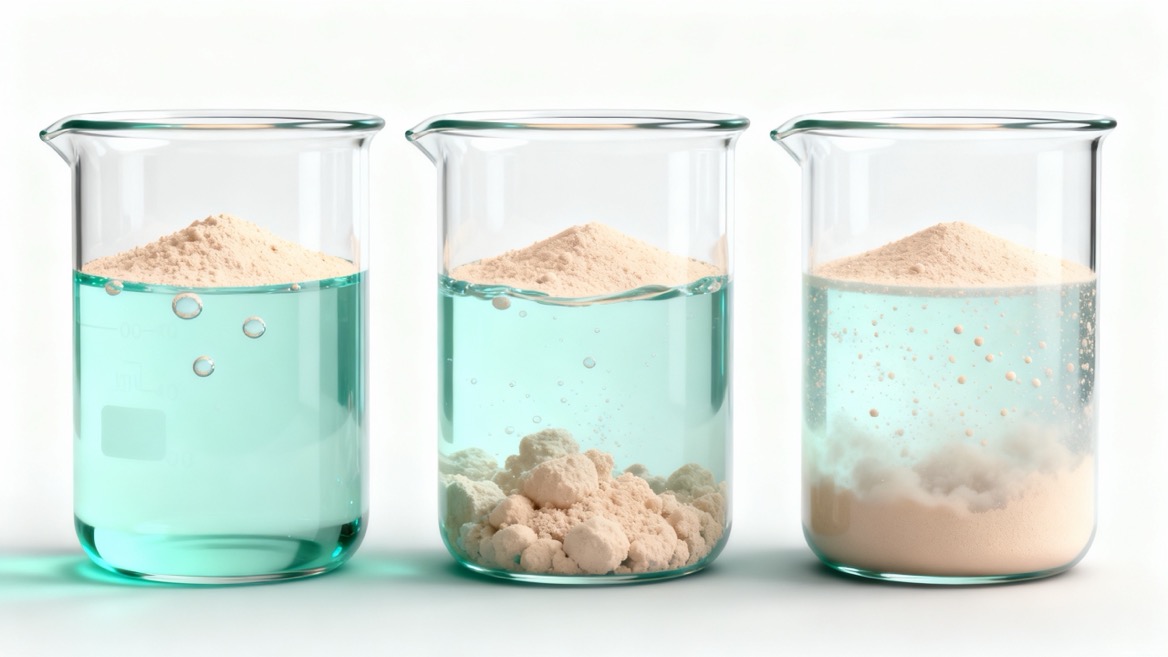
Dispersion distributes solid particles through a liquid. Dissolution incorporates soluble material into the liquid phase at the molecular or ionic level.
A uniformly cloudy mixture may be dispersed without being dissolved.
For the same soluble material under comparable conditions, reducing particle size increases available surface area and can accelerate dissolution.
However, faster dissolution does not establish a meaningful increase in equilibrium solubility. If a botanical constituent is poorly soluble in the chosen vehicle, ordinary micronization does not guarantee a clear serum.
That distinction helps prevent unrealistic expectations during ingredient sourcing.
A whole-plant powder, standardized dry extract, and fermentation-derived powder can differ substantially in composition.
Possible contributors include:
- Insoluble plant tissue.
- Soluble extract components.
- Drying carriers.
- Residual fermentation solids.
- Different moisture levels.
Consequently, "water-dispersible" should not be interpreted as "fully water-soluble."
For transparent products, request dissolution conditions, appearance criteria, and information about insoluble residue. Particle size alone cannot answer these questions.
In an idealized dilute suspension, Stokes' law predicts that settling velocity increases with the square of particle diameter, assuming other conditions remain unchanged.
Real cosmetic products are more complicated. Particles may agglomerate, interact with polymers, or sit within a structured emulsion or gel.
Reducing primary particle size may therefore improve suspension behavior, but only if those particles remain separated and the formulation supports them.
A low median particle size does not guarantee a grit-free product.
A relatively small coarse fraction may remain detectable during application. Particle shape, hardness, concentration, and agglomeration also influence sensory perception.
For leave-on products, assess both instrumental measurements and controlled application tests. Establish acceptance criteria in the actual base rather than assuming one particle-size threshold applies everywhere.
Smaller particles do not automatically provide greater skin penetration, stronger biological activity, or superior consumer results.
Those claims require ingredient-specific and finished-product evidence.
For botanical and fermentation-derived actives, particle engineering should support delivery consistency and manufacturing performance—not substitute for efficacy substantiation.
FRITSCH published a cosmetic powder comparison in which both samples showed a distribution maximum around 20 µm. One sample also exhibited a coarser maximum around 50–60 µm and poorer aqueous dispersibility.
This is an equipment supplier's application example, not a universal rule linking price to quality.
Its useful lesson is narrower: the complete distribution and dispersion behavior can reveal differences that a single central value misses.
A larger dry granule is not necessarily a permanently coarse particle.
An engineered agglomerate may break apart during hydration and release smaller constituent particles. Conversely, an extremely fine powder may form persistent lumps when added directly to water.
When comparing suppliers, test both the delivered powder and its behavior after realistic mixing. Do not rank ingredients solely by dry particle size.
The lowest powder price does not always produce the lowest manufacturing cost.
A useful procurement comparison includes:
- Active content and required dosage.
- Mixing time and energy.
- Additional dispersants or processing aids.
- Filtration losses.
- Cleaning requirements.
- Rework and rejected batches.
A more expensive grade may be commercially preferable if validated trials demonstrate simpler, more consistent processing. Treat that as a measurable possibility, not an assumed benefit.
The following is a proposed screening workflow, not a validated universal method or a report of ZHENYIBIO production results.
Where possible, compare grades with equivalent composition, active assay, carrier system, and moisture specification.
Otherwise, differences attributed to particle size may actually reflect different ingredients.
Record the target dosage, liquid phase, pH, processing temperature, appearance, and sensory requirements.
A transparent essence and an opaque botanical mask need different acceptance criteria.
Keep batch size, addition rate, mixer geometry, mixing time, and temperature consistent.
Compare direct addition with a compatible pre-slurry where appropriate. Record floating powder, lump formation, foam, and residue.
Use a combination of:
1. Microscopy or another suitable particle assessment.
2. Wetting and incorporation time.
3. Insoluble residue where relevant.
4. Viscosity and pH.
5. Sedimentation or separation during storage.
6. Active assay when processing could affect the ingredient.
Visual clarity alone does not confirm complete dissolution or preserved active content.
Laboratory success does not guarantee manufacturing success.
Powder addition location, vessel circulation, shear exposure, and heat removal can change during scale-up. Confirm the process using representative equipment before fixing commercial specifications.

A useful technical package should explain both ingredient identity and processing behavior.
| Purchasing question | Information to request |
|---|---|
| What is the ingredient? | INCI, botanical identity, plant part, and relevant process description |
| What determines potency? | Active-marker specification and assay method |
| How is size controlled? | Particle size distribution, method, and preparation conditions |
| What supports processing? | Recommended phase, addition sequence, pH, and temperature limits |
| What else is present? | Carriers, processing aids, and relevant residual specifications |
| How is quality documented? | Certificate of analysis, technical data, and safety information |
| How is consistency assessed? | Relevant batch-to-batch acceptance limits |
Do not assume a mesh designation is equivalent to a laser-diffraction distribution. Ask suppliers to explain the test basis.
For sustainability claims, request evidence relevant to the ingredient and process. "Natural," "fermented," and "finely milled" do not independently demonstrate a lower environmental footprint.
Fine powder is not automatically a nanomaterial, and particle size alone does not establish safety.
Where nanoscale characteristics are relevant, assessment may need to consider size distribution, agglomeration, surface properties, solubility, impurities, and intended exposure.
Powder handling also deserves a specific exposure assessment. Dust generation and inhalation potential depend on the material and operation; appropriate controls should follow the safety documentation and workplace assessment.
Loose powders, sprays, and conventional creams should not be treated as equivalent exposure scenarios.
The best fine powder vs. coarse powder decision starts with the finished product—not the smallest available particle.
For botanical and biofermentation-based cosmetic development, define the required appearance, active content, sensory profile, processing conditions, and stability targets first.
Contact ZHENYIBIO TECHNOLOGY INC with your target formula type, intended dosage, market requirements, and OEM/ODM objectives. Request a discussion of suitable ingredient grades, available technical documentation, and sample evaluation before commercial ordering.
No. Fine particles can form cohesive agglomerates and resist wetting. Surface chemistry, addition technique, and liquid compatibility may matter as much as size.
Not necessarily. Smaller particles can dissolve faster when the material is soluble, but milling does not automatically make insoluble plant constituents dissolve.
There is no universal optimum. Clear serums generally require sufficient ingredient solubility, while opaque systems may accommodate appropriately stabilized dispersed particles.
Potentially, provided the finished product meets sensory, stability, and safety requirements. Evaluate particle shape, hardness, concentration, and the coarse fraction in the actual formula.
Possible causes include incomplete wetting, persistent agglomerates, a coarse particle tail, or precipitation after incorporation. Identify the cause before changing the milling specification.
Neither alone completely describes performance. Mesh provides sieve-based information, while Dv50 provides a volume median under a specified measurement method. Request the full distribution and test conditions.
1. KRÜSS Scientific. "Wettability of Cosmetic Powders and Pigments." Technical discussion of wetting, contact angle, surface energy, and dispersion stability. [kruss-scientific]
2. Technical University of Denmark research repository. "Mathematical Modeling of Pigment Dispersion Taking into Account …" Research manuscript describing wetting, agglomerate breakage, and stabilization. [backend.orbit.dtu]
3. Malvern Panalytical. "Questions Fréquemment Posées sur la Diffraction Laser et l'Analyse …" Explanation of volume-based particle-size percentiles, including Dv10, Dv50, and Dv90. [malvernpanalytical]
4. FRITSCH. "Particle Size Analysis of Make-Up Powder." Application example comparing particle-size distributions and aqueous dispersion behavior. [fritsch-france]
5. U.S. Food and Drug Administration. "Guidance for Industry: Safety of Nanomaterials in Cosmetic Products." Guidance addressing characterization, exposure, and safety considerations; PDF hosted by Taiwan's Food and Drug Administration. [fda.gov]
6. "Nanosystems in Cosmetic Products: A Brief Overview of Functional, Market, Regulatory and Safety Concerns." Review available through PubMed Central, 2021. [pmc.ncbi.nlm.nih]
7. "Effect of Particle Size on Solubility, Dissolution Rate, and Oral Bioavailability: Evaluation Using Coenzyme Q10 as Naked Nanocrystals." Research examining size-dependent dissolution; its oral bioavailability findings should not be extrapolated to topical cosmetics. [scispace]


