


Views: 263 Author: ZHENYIBIO Publish Time: 2026-10-25 Origin: Site
Content Menu
● What Does a COA Prove About Cosmetic Active Ingredients?
● 1. Confirm Product Identity and Batch Traceability
>> Match the COA to the Material Being Purchased
>> Verify Botanical and Fermentation Identity
● 2. Read Assay Results Beyond the Headline Percentage
>> Ask What the Assay Actually Measures
>> Check Units, Methods, and Reporting Basis
● 3. Examine Specifications, Actual Results, and Detection Limits
● 4. Review Contaminants According to Ingredient Risk
>> Botanical Extracts: Metals, Pesticides, and Residual Solvents
>> Fermentation-Derived Actives: Process-Related Residues
● 5. Check Microbiological Quality Without Confusing Raw Materials and Finished Products
● 6. Assess Physical Properties That Affect Formulation
● 7. Connect Shelf Life, Packaging, and Delivery Conditions
>> Distinguish Expiry Dates From Retest Dates
>> Treat Packaging as Part of Quality Protection
● 8. Practical Example: Comparing Two "20%" Botanical Extracts
● 9. Build a Five-Step COA Approval Workflow
● 10. Recognize Red Flags and Evaluate Supplier Service
● Source Cosmetic Actives With Clearer Expectations
>> Is a COA enough to approve a cosmetic ingredient supplier?
>> Should every COA contain numerical results?
>> Can I accept a typical COA before placing an order?
>> Does high assay guarantee better cosmetic performance?
>> Must every contaminant be tested on every batch?
>> What should I do when the shipment label and COA disagree?
Before purchasing cosmetic active ingredients, buyers should check whether the Certificate of Analysis identifies the exact batch, confirms ingredient identity, reports meaningful test results, and matches agreed specifications. Review assay methods, contaminants, microbiological quality, shelf life, and storage conditions—not simply the word "Pass."
For brands, wholesalers, and manufacturers sourcing botanical extracts or fermentation-derived actives, the central question is traceability: can every important claim be connected to the material actually delivered?
At ZHENYIBIO TECHNOLOGY INC, our focus combines traditional botanical knowledge with modern bio-fermentation and OEM/ODM development. From this ingredient-development perspective, a useful COA should help purchasing, quality, and formulation teams make the same informed decision.
This guide explains what to inspect, which questions reveal hidden differences, and when an apparently acceptable document still needs further investigation.

A Certificate of Analysis records test results for an identified batch against specified acceptance criteria. It supports a purchasing decision by showing what was tested and whether the reported results meet those criteria.
However, a COA is not an all-purpose approval document.
It does not independently establish:
- Clinical effectiveness in your finished formula.
- Compatibility with every preservative or emulsifier.
- Compliance in every destination market.
- Organic status, sustainable sourcing, or environmental performance.
- Stability after repackaging or unsuitable transportation.
Those questions require supporting documentation and, where appropriate, additional testing.
A useful purchasing principle is simple: match each supplier claim to the evidence capable of supporting it.
Start with the product name, grade, product code, and batch or lot number. Compare them with the quotation, approved sample, purchase order, and container label.
A typical COA can support preliminary evaluation. It cannot release a different commercial batch.
Check for:
| COA field | What buyers should verify |
|---|---|
| Product name and code | Same ingredient and grade as ordered |
| Batch or lot number | Matches the supplied containers |
| Manufacturer or issuing organization | Clear identity and traceable responsibility |
| Specification reference | Correct document and revision |
| Analysis and release dates | Credible chronology |
| Expiry or retest date | Adequate remaining usability |
| Authorization | Identifiable approval or verifiable electronic release |
For distributors, clarify how the supplied lot connects to the original manufacturer's batch. Repacking should not break that link.
An ingredient's commercial name may hide important differences.
For botanical actives, request the scientific plant name, plant part, extraction solvent, and relevant processing details. Root, leaf, and fruit extracts should not be treated as interchangeable.
For fermented ingredients, establish whether the material is a filtrate, lysate, isolated compound, or formulated blend. Ask about the substrate and production organism where relevant to identity and safety assessment.
These details may appear in a technical specification rather than on the COA itself. What matters is consistent documentation.
"Active content: 98%" is incomplete without a defined analyte, method, and calculation basis.
Buyers should distinguish between:
- A specifically identified compound.
- A group of related compounds.
- A botanical marker.
- Total solids.
- Chromatographic area percentage.
- Active concentration in a carrier-containing blend.
These measurements answer different questions.
A marker can help standardize a botanical extract without proving that it accounts for all biological activity. Likewise, a total-polyphenol result is not automatically equivalent to a compound-specific assay.
Determine whether the result is reported on an as-is, dry, or solvent-free basis. Confirm whether percentages mean weight/weight, weight/volume, or something else.
Where critical, ask for the method identifier, version, and evidence that the method suits the material.
An internal method is not automatically inferior to a published method. Its suitability, specificity, and control matter more than the label.
Also distinguish chromatographic area percentage from mass purity. Different compounds can produce different detector responses, so the two figures are not necessarily interchangeable.
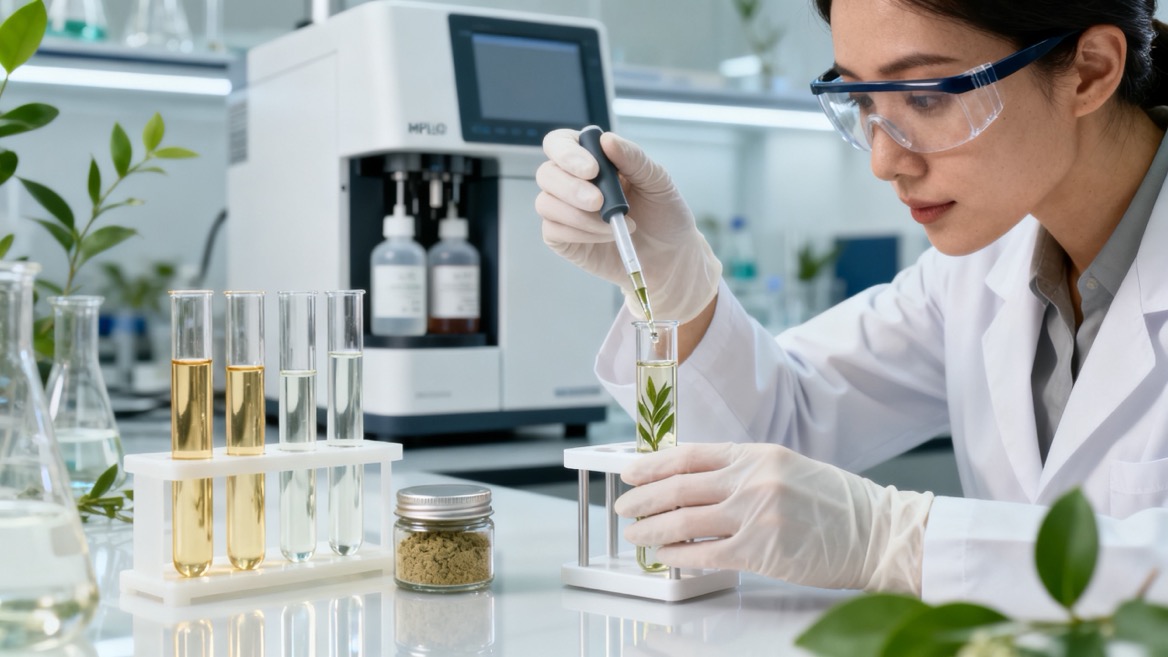
A useful COA separates the acceptance limit from the result obtained.
For quantitative attributes such as assay, moisture, or metals, numerical results are generally more informative than "Conforms." Qualitative identification tests may appropriately report a descriptive result or conformity statement.
Ask three questions:
1. What is the acceptance criterion?
2. What result was obtained?
3. Which method produced that result?
"Not detected" needs context. It means the substance was not detected under the method's conditions—not that its concentration is absolutely zero.
For a contaminant with a contractual limit, the method must be sensitive enough to support the decision. A detection or quantification threshold above that limit leaves an important gap.
Where a result is close to a specification boundary, ask how measurement uncertainty and the laboratory's conformity decision rule are handled.
There is no single contaminant panel suitable for every cosmetic raw material. The appropriate controls depend on the source, manufacturing process, application, and destination market.
For plant-derived actives, consider:
- Individually specified metals where relevant.
- Pesticide risks associated with cultivation and sourcing.
- Residual extraction solvents.
- Mycotoxins where the plant material and storage history justify assessment.
- Adulterants or unwanted naturally occurring constituents.
A combined "heavy metals" figure may not answer a question about a particular element.
Similarly, "pesticide-free" is not meaningful without understanding the tested panel, reporting limits, and sampling basis.
Agree which controls apply to every batch and which are supported through supplier qualification or periodic testing.
Fermentation changes the questions; it does not remove the need for scrutiny.
Depending on the ingredient and downstream purification, buyers may need information about residual substrates, processing aids, preservatives, or unwanted metabolites.
Ask the supplier to explain the risk assessment behind the testing program. Do not assume that "bio-fermented" means residue-free, sterile, or automatically safer.
Microbiological requirements should reflect the ingredient's characteristics and intended use.
A water-rich botanical solution presents different handling considerations from a dry, low-water-activity powder. Neither should be assessed solely by appearance.
Review:
- Total microbial counts where specified.
- Yeast and mold results.
- Relevant specified microorganisms.
- Test methods and sample quantities.
- Controls for interference from the ingredient itself.
An antimicrobial ingredient can interfere with microbial recovery. Appropriate method suitability helps prevent misleadingly low results.
Do not automatically copy finished-cosmetic limits into a raw-material specification. Instead, establish justified purchasing criteria with your quality team.
The ingredient COA also does not replace finished-product microbiological assessment or preservation testing.
A batch can meet its chemical assay and still behave differently during manufacturing.
Depending on the ingredient, review:
| Property | Why it matters |
|---|---|
| Appearance and color | Influences consistency and finished-product appearance |
| Odor | May affect fragrance requirements |
| Moisture or loss on drying | Helps characterize material condition |
| pH | Useful when measured under defined conditions |
| Solubility or dispersibility | Affects processing and formulation suitability |
| Particle size | Can influence wetting, dissolution, and texture |
| Density or viscosity | Supports liquid handling and dosing consistency |
Request defined test conditions. A pH value without the solution concentration or solvent may be difficult to compare.
For botanical extracts, some natural variation may be acceptable. The practical question is whether that variation remains within agreed limits and your formulation can tolerate it.
An expiry date and a retest date serve different purposes.
A retest date indicates when reassessment is needed under an established procedure. It does not automatically authorize indefinite extension.
Before ordering, confirm:
- Remaining shelf life at shipment and arrival.
- Required storage temperature.
- Protection from moisture, light, or oxygen.
- Handling after opening.
- Whether stability support applies to the supplied packaging.
A passing result at release cannot guarantee quality after uncontrolled storage.
Good packaging is more than a clean outer carton. It should protect the ingredient under agreed transport and storage conditions.
Depending on material sensitivity, discuss sealed liners, light protection, moisture barriers, temperature control, and tamper evidence.
At receipt, compare container labels with the COA and inspect for damaged seals, leakage, wet packaging, or unexpected clumping.
Hold questionable material for investigation. Documentation and physical condition must support the same release decision.
Consider this hypothetical purchasing comparison:
| Item | Supplier A | Supplier B |
|---|---|---|
| Reported content | 20% total polyphenols | 20% named marker |
| Method | Colorimetric assay | Compound-specific chromatographic assay |
| Reporting basis | Dry basis | As supplied |
| Carrier | Not disclosed | Declared |
| Identity details | Common plant name | Scientific name and plant part |
Both quotations display "20%," but the materials are not demonstrated to be equivalent.
Before comparing prices, ask both suppliers to align the identity, analyte, reporting basis, and composition.
If a liquid contains 20% active by weight and you add it at 1% by weight, the nominal active contribution is 0.2%. That calculation does not establish efficacy; it only clarifies dosage.
This example illustrates why price per kilogram can mislead when specifications differ.
A repeatable workflow reduces misunderstandings between purchasing and quality teams.
1. Define requirements before requesting quotations.
Specify identity, assay basis, critical contaminants, packaging, and intended application.
2. Review the qualification package.
Compare the COA with the technical specification, safety information, composition statement, and relevant supporting evidence.
3. Evaluate a representative sample.
Check critical attributes and formulation behavior. Record whether it represents the future production grade.
4. Approve the commercial batch.
Confirm lot identity, results, deviations, and shipping conditions before release.
5. Monitor ongoing supply.
Review complaints, analytical trends, packaging performance, and changes to source materials or processes.
Independent testing is particularly useful for new suppliers, critical attributes, unexplained discrepancies, or significant changes. Its frequency should follow risk rather than a universal schedule.
Pause approval when you encounter:
- A batch number that does not match the shipment.
- Unexplained changes between document versions.
- Missing methods for critical tests.
- Results reported on incompatible bases.
- Unsupported "zero contaminants" claims.
- Refusal to clarify a significant discrepancy.
Identical results across batches deserve questions, although they are not proof of fabrication.
Service quality becomes visible in the response: does the supplier provide a clear explanation, supporting records, and a documented resolution?
Truthful promotion means acknowledging what a COA proves and what it does not. Excellent service means helping buyers close evidence gaps. Protective packaging preserves the quality those documents describe.
These are useful supplier-selection criteria, not substitutes for verification.
For botanical and fermentation-derived ingredients, the strongest purchasing decisions connect analytical evidence with formulation needs and delivery conditions.
ZHENYIBIO TECHNOLOGY INC serves overseas brands, wholesalers, and manufacturers through natural plant-active ingredient development and OEM/ODM collaboration.
Send our team your target ingredient, destination market, intended application, and required specifications. Request the relevant batch COA, technical documentation, and proposed packaging conditions so your purchasing and quality teams can review the project before committing to bulk supply.
No. It supports batch assessment, but supplier approval also requires appropriate identity, safety, manufacturing, traceability, and change-control information.
Quantitative tests generally benefit from numerical results. Qualitative identification tests can appropriately use descriptive outcomes or conformity statements.
Yes, for preliminary evaluation. Obtain the actual supplied batch's COA before final quality release.
No. Performance also depends on ingredient identity, delivery, concentration, stability, formulation compatibility, and supporting efficacy evidence.
Not necessarily. Testing frequency should follow applicable requirements, agreed specifications, process knowledge, and a justified risk assessment.
Quarantine the material and request documented reconciliation. Do not release it solely on an informal assurance.
1. World Health Organization. *WHO Good Practices for Pharmaceutical Quality Control Laboratories*. WHO Technical Report Series 1052, Annex 4, 2024. Laboratory quality systems, reporting, records, and certificates of analysis. [Official publication]. [who]
2. World Health Organization. *WHO Good Practices for Pharmaceutical Quality Control Laboratories*. WHO Technical Report Series 957, Annex 1, 2010. Section 19 describes batch identification, specifications, test results, and other certificate information. [Full guidance]. [who]
3. European Commission, Scientific Committee on Consumer Safety. *SCCS Notes of Guidance for the Testing of Cosmetic Ingredients and Their Safety Evaluation*. Explanatory fact sheet based on the ninth revision, September 2015. Used for the general distinction between ingredient testing and case-specific cosmetic safety assessment, not as a current technical-limit reference. [Official fact sheet]. [health.ec.europa]
4. European Commission. *Cosmetics*. Regulatory overview covering cosmetic safety responsibilities, scientific assessment, and ingredient information. [Official sector overview]. [single-market-economy.ec.europa]


