


Views: 218 Author: ZHENYIBIO Publish Time: 2026-10-26 Origin: Site
Content Menu
● Why Source Nicotinamide Mononucleotide Powder from China?
>> What Does Recent Market Research Show?
● How We Selected These Suppliers
● Understanding NMN Powder Specifications Before Comparing Suppliers
>> Purity and Assay Are Different Purchasing Questions
>> Match the Grade to the Intended Application
>> Which Certifications Matter?
● The Top 10 Nicotinamide Mononucleotide Powder Manufacturers and Supply Partners to Evaluate
>> 1. ZHENYIBIO TECHNOLOGY INC
>> 3. EffePharm
>> 6. Inner Mongolia Kingdomway Pharmaceutical Limited
>> 9. Shaanxi Hongda Phytochemistry
>> 10. Shaanxi Guanjie Technology
● Supplier Comparison: Capacity, MOQ, and Certification Visibility
● Buyer's Guide: How to Qualify an NMN Powder Supplier
>> 1. Define the Application Before Requesting Prices
>> 2. Verify the Factory Behind the Quotation
>> 3. Use a Controlled Sample-to-Order Process
>> 4. Evaluate Delivery Reliability, Not Just Quoted Lead Time
>> 5. Match Packaging and Logistics to Stability Evidence
● The Overlooked Purchasing Trap: Buying Peak-Area Purity Instead of Active Content
● Regulatory Issues International Buyers Should Not Overlook
● Conclusion: Select the Partner That Can Document the Whole Supply Chain
>> 1. How can I verify whether a supplier's ISO certificate has expired or been suspended?
>> 2. Can two NMN powders both claim 99% purity but deliver different value?
>> 3. Does an accepted regulatory notification cover every downstream brand?
>> 4. How should buyers handle a sample that passes while the commercial shipment fails?
>> 5. What should a cosmetic brand request beyond a raw-material certificate of analysis?
China offers professional buyers a broad choice of nicotinamide mononucleotide powder suppliers, from enzyme-engineering specialists and integrated biotechnology groups to cosmetic ingredient companies supporting customized product development.
However, selecting a long-term partner requires more than comparing a quoted purity percentage or a price per kilogram. Procurement teams need to establish who actually manufactures the material, which production site holds the relevant certifications, how batch quality is measured, and whether the supplied ingredient fits its intended market.
This guide examines ten companies worth evaluating, with particular attention to manufacturing transparency, research capabilities, quality documentation, commercial flexibility, and OEM/ODM support.

China's supplier landscape includes companies working across enzyme catalysis, fermentation, purification, nutritional ingredients, and cosmetic actives. Examples include Shenzhen-based BONTAC and Hygieia, Suzhou-based Leadsynbio, Shanghai-linked SyncoZymes, and Xi'an-based cosmetic ingredient suppliers. This provides buyers with several technical and commercial sourcing models rather than one uniform type of factory.
The locations also suggest useful sourcing corridors:
- Shenzhen and the surrounding Guangdong region offer access to biotechnology and enzyme-engineering companies.
- Shanghai, Suzhou, and Zhejiang connect research, pharmaceutical intermediates, biocatalysis, and industrial production.
- Xi'an and Shaanxi offer established networks of botanical, cosmetic, and nutritional ingredient suppliers.
These are practical sourcing concentrations illustrated by the companies in this guide, not a statistical ranking of regional NMN output.
A market report published by Verified Market Research in September 2026 estimates the global nicotinamide mononucleotide market at USD 210.64 million in 2025 and projects USD 428.14 million by 2033. These are the publisher's estimates, not official production or export statistics. Buyers should check the report's market definition before using its figures in investment or purchasing forecasts.
Commercial market estimates also do not establish any individual factory's available capacity. A supplier's installed equipment, actual annual output, and uncommitted production slots remain separate due-diligence questions.
A useful supplier evaluation should prioritize traceability over promotional claims.
The companies below were selected because public materials identify relevant NMN products, biotechnology capabilities, or ingredient supply services. The evaluation framework focuses on six procurement dimensions.
| Evaluation dimension | What professional buyers should examine |
|---|---|
| Manufacturing transparency | Legal entity, factory address, ownership, subcontracting arrangements, and production-site identification |
| Technical capability | Production route, purification controls, analytical methods, and application support |
| Quality systems | Current certificates, certification scope, batch records, deviation handling, and release procedures |
| Product consistency | Identity, quantitative assay, impurities, moisture, microbiology, and stability |
| Supply reliability | Available capacity, batch size, maintenance schedules, inventory policy, and delivery commitments |
| Commercial support | Sample access, pilot orders, packaging options, documentation, and clearly defined OEM/ODM responsibilities |
This framework does not imply that every listed supplier has passed a factory audit. Where founding dates, annual capacity, minimum order quantities, or certification details could not be established from the reviewed materials, those gaps are stated explicitly.
Nicotinamide mononucleotide, commonly abbreviated as NMN, is not interchangeable with niacinamide, nicotinamide riboside, NAD+, or reduced NMN, also called NMNH. Purchasing documents should identify the exact substance rather than relying on a broad "NAD precursor" description.
For β-nicotinamide mononucleotide, supplier specifications commonly identify CAS 1094-61-7. Hygieia's published product listing, for example, specifies this CAS number and a molecular weight of 334.22.
A high chromatographic purity result does not automatically establish how much NMN is present in each kilogram of delivered powder.
A 2026 analytical study explicitly distinguishes chromatographic peak-area purity from other quality attributes, including content, moisture, and structural identity. It also notes that HPLC-UV may not detect every trace impurity.
A purchasing specification should therefore distinguish:
- Identity: Does the material contain the intended molecule?
- Chromatographic purity: What proportion of detected chromatographic peaks belongs to NMN?
- Quantitative assay: How much NMN is present by mass?
- Reporting basis: Is the assay reported as supplied, on a dried basis, or on another defined basis?
- Moisture and impurities: What else contributes to the delivered weight?
"Cosmetic grade," "food grade," and "pharmaceutical grade" should not replace a written specification and destination-market assessment.
For a cosmetic project, buyers need relevant ingredient documentation, formulation compatibility information, safety support, and finished-product testing. For an ingestible product, food or supplement requirements must be evaluated separately.
An ingredient's use in an oral clinical study does not, by itself, substantiate the performance of a topical serum containing that ingredient.
Relevant documentation may include ISO 9001, ISO 22000, FSSC 22000, applicable manufacturing-practice records, and halal or kosher certificates where required by the project. Different companies in this guide report different combinations of these credentials.
CE marking and RoHS are not meaningful substitutes for ingredient quality, food-safety, or cosmetic compliance documentation in an NMN procurement specification.
Similarly, an enzymatic or fermentation production route should not automatically be described as environmentally superior without supporting information on energy, water, solvents, waste treatment, and production yield.
Founded: 2012
Location: Xi'an, Shaanxi
Published market coverage: More than 50 countries across Asia, Europe, and the Americas
ZHENYIBIO TECHNOLOGY INC focuses on natural plant-active cosmetic raw materials and related ingredient solutions. Its public company profile describes a 10,000-square-meter production area, a 1,500-square-meter research and development center, and a portfolio including glutathione, hyaluronic acid, polyglutamic acid, asiaticoside, peptides, and liposomes.
For small and medium-sized beauty brands, its potential appeal lies in coordinating raw materials and product-development requirements through one commercial relationship. This makes it a relevant featured candidate for buyers seeking ingredient sourcing alongside OEM/ODM project support.
The company describes quality checks covering purity, water content, heavy metals, residual solvents, and microbiology, together with third-party testing relationships. Its website also lists quality-system and religious-certification claims. Buyers should obtain the original, current certificates rather than relying on website logos or abbreviated standard descriptions.
OEM/ODM scope to discuss:
- Customized ingredient specifications and packaging.
- Cosmetic formulation and finished-product development.
- Pilot quantities and staged purchasing.
- Batch documentation and third-party testing.
- A named technical contact and agreed response times.
The company's flexibility, communication efficiency, and cost-effectiveness should be evaluated through a real quotation and pilot project—not assumed from positioning alone.
Procurement limitation: The reviewed company profile does not establish NMN-specific annual capacity, MOQ, production route, or dedicated manufacturing-site ownership. These points require direct confirmation before describing ZHENYIBIO as an audited NMN producer.
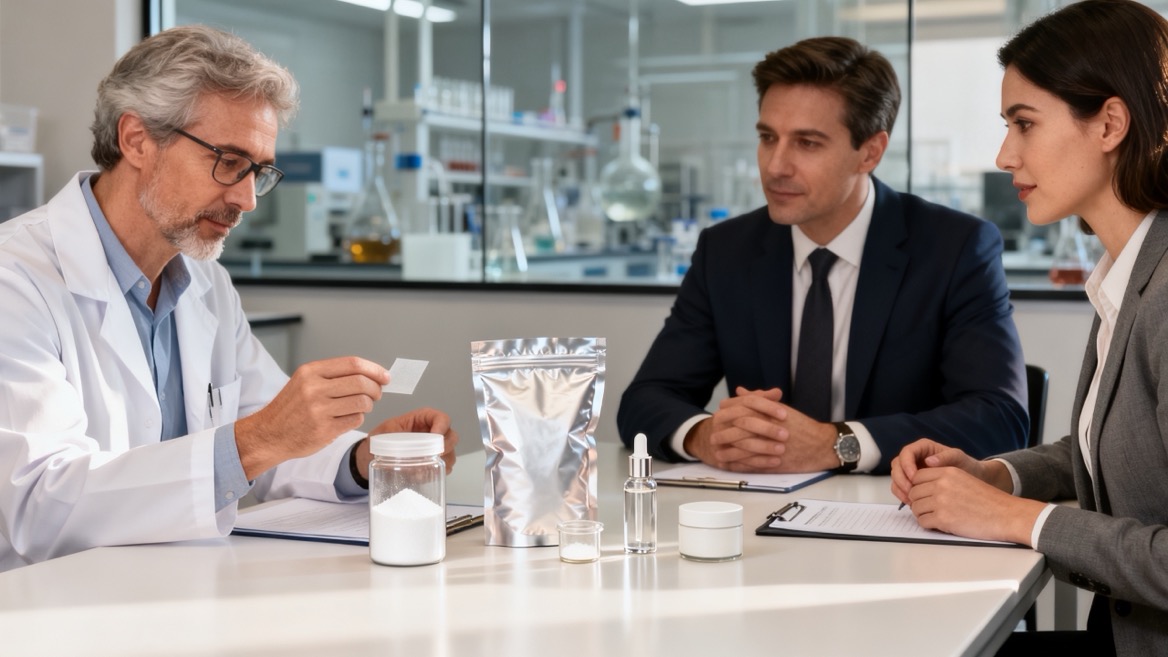
Founded: July 2012
Location: Shenzhen, Guangdong
Market orientation: International biotechnology and ingredient buyers; regional sales proportions were not established
BONTAC describes enzyme catalysis as its core technology and lists coenzymes, natural products, cosmetic ingredients, dietary supplements, and pharmaceutical intermediates among its business areas. Its public materials identify NMN as a product and describe proprietary enzymatic production capabilities.
Its technical positioning makes it a relevant candidate for buyers who want to discuss enzyme-based manufacturing, purification, and coenzyme supply with a specialist.
OEM/ODM discussion should distinguish bulk ingredient customization from finished-product manufacturing. Buyers should ask which services BONTAC performs directly and which involve external partners.
Procurement priority: Request the current NMN specification, production-site details, three recent batch records, and an explanation of how chromatographic purity relates to quantitative assay.
Founded: Not established in the reviewed sources
Business focus: Branded nutritional ingredients, including UTHEVER® NMN
Published market coverage: More than 50 countries across its business
EffePharm supplies UTHEVER® NMN and emphasizes ingredient-specific research, branded ingredient licensing, and formulation applications. Its website reports international distribution and describes bulk NMN suitable for capsules, tablets, sachets, and customized formulations.
This makes it particularly relevant to supplement brands that value a named ingredient platform rather than an unbranded powder.
The company's UTHEVER® materials list halal and kosher certification and manufacturing in quality-managed facilities. These remain claims to verify against the exact production site and product being purchased.
OEM/ODM scope: Bulk ingredient supply, formulation options, and branded-ingredient cooperation are supported by its public positioning. Turnkey private-label manufacturing should be confirmed separately.
Procurement priority: Check ingredient trademark terms, access to supporting studies, permitted marketing statements, and whether the quoted material matches the ingredient used in the cited research.
Founded: Not established in the reviewed sources
Manufacturing footprint: Shanghai and Zhejiang-linked operations
Market orientation: International coenzyme and biocatalysis supply, including documented U.S. regulatory engagement
SyncoZymes lists NMN, NAD, NADH, and NADP among its coenzyme products. Its Zhejiang operation also describes biological enzymes and pharmaceutical products, indicating a broader biocatalysis and manufacturing platform.
The Natural Products Association reported in December 2025 that the U.S. regulator reinstated an earlier response concerning SyncoZymes' NMN new dietary ingredient notification. This is a meaningful regulatory-history point, but it is not blanket approval of every NMN product or supply chain.
OEM/ODM scope: Ingredient and technical cooperation are the clearest fit. Finished-product services require confirmation.
Procurement priority: Obtain the relevant regulatory correspondence and establish whether the purchased material, manufacturing route, and intended conditions of use fall within its scope.
Founded: 2004, according to its public company profile
Headquarters: Hong Kong
Market orientation: NMN and enzymatic biotechnology; current regional sales proportions were not verified
GeneHarbor's public company profile identifies enzymatic production technology and NMN among its activities. Its Hong Kong headquarters should be distinguished from whichever manufacturing entity and site will supply a buyer's order.
For procurement teams, the company is relevant as a biotechnology-focused candidate rather than simply a general chemical catalogue supplier.
OEM/ODM scope: Ask directly about bulk powder, customized packaging, finished products, and the legal entities responsible for each activity. These should not be inferred from the company's broader biotechnology positioning.
Procurement priority: Resolve the relationship between the contracting company, manufacturing plant, product brand, and exporter before issuing a purchase order.
Founded: March 2004
Location: Tuoketuo Industrial Park, Hohhot, Inner Mongolia
Market orientation: Nutritional and pharmaceutical ingredients; NMN-specific regional sales were not disclosed
This company is a wholly owned subsidiary of Xiamen Kingdomway Group. Its official profile lists β-nicotinamide mononucleotide alongside coenzyme Q10, DHA algal oil, ARA, and vitamin K2.
Its published credentials include ISO 9001, ISO 14001, FSSC 22000, kosher, and other certifications. Buyers must verify which certificates cover the NMN manufacturing operation rather than assuming every listed credential applies to every product.
OEM/ODM scope: Bulk ingredient procurement is the most directly supported fit. Finished-product development and private-label packaging require a separate commercial discussion.
Procurement priority: Request NMN-specific capacity, production allocation, certificate scope, and change-control commitments.
Founded: 2019 for the Shenzhen entity, according to its supplier profile
Locations represented in public materials: Shenzhen and Chengdu
Published markets: Asia, North America, Central and South America, and Eastern and Western Europe
Hygieia describes a strain-construction and enzyme-engineering platform and lists NMN among its industrialized biosynthetic ingredients. Its ingredient listing specifies β-NMN at 99.8% purity and packaging formats including 1 kg bags and 25 kg drums. Packaging sizes are not the same as minimum order quantities.
Unlike companies whose public materials focus only on raw ingredients, Hygieia explicitly advertises custom NMN supplement contract manufacturing, including development, processing, and packaging.
OEM/ODM scope: Custom supplements, formulation support, processing, and packaging.
Procurement priority: Confirm whether the Shenzhen or Chengdu entity will contract, manufacture, test, and export the goods. Obtain certificates for the actual production location.
Founded: 2015
Headquarters: Suzhou, Jiangsu
Manufacturing footprint: Hunan and Anhui
Market orientation: Global ingredient supply; regional NMN sales proportions were not disclosed
Leadsynbio operates a synthetic biology platform with research and manufacturing activities across multiple locations. Its official profile identifies manufacturing facilities in Hunan and Anhui and research centers in Suzhou and the United States.
Its NMN product page states purity of at least 99.5% and content of at least 99.0%. Publishing purity and content separately gives procurement teams a useful starting point for technical comparison.
The company also describes kiloton-scale production facilities. That statement should not be converted into an NMN-specific capacity figure without further evidence.
OEM/ODM scope: Ingredient supply and process-related technical cooperation are the clearest public fit; finished-product services require confirmation.
Procurement priority: Request NMN-dedicated output, available production slots, impurity specifications, and stability documentation for the proposed packaging.
Founded: January 2001, according to its published supplier profile
Location: Shaanxi, with a Xi'an commercial address
Market orientation: International ingredient supply; NMN-specific market distribution was not established
Hongda publishes a bulk β-NMN product offering with a stated HPLC purity of at least 99.5%. Its broader company profile describes a phytochemistry business established in 2001.
It may be relevant to buyers consolidating NMN with other ingredients, particularly where purchasing efficiency and supplier coordination matter.
OEM/ODM scope: Confirm customized packing, blending, formulation assistance, and finished-product services individually.
Procurement priority: Establish whether the NMN is manufactured in-house, produced under contract, or sourced from another manufacturer. A broad ingredient portfolio does not prove ownership of every listed production process.
Founded: 2004, according to a published company press release
Location: Shaanxi
Market orientation: Ingredients for pharmaceutical, supplement, food, and cosmetic applications; regional sales were not verified
Guanjie's published company material lists NMN within a wider portfolio that includes resveratrol, ferulic acid, and other specialized compounds. It also reports the use of HPLC, UV, and GC methods for selected ingredients. Because this information appears in a company press release, it should be treated as supplier-provided evidence rather than an independent audit.
The company is a candidate for buyers seeking a broader ingredient supply relationship rather than an NMN-only specialist.
OEM/ODM scope: Request written confirmation of specification customization, packaging, blending, and finished-product capabilities.
Procurement priority: Verify the original NMN manufacturing site, batch traceability, analytical scope, and whether third-party testing covers the exact lot offered.
The reviewed sources do not provide a consistent, independently verified set of NMN-specific capacity and MOQ figures for all ten companies. The table therefore identifies information gaps instead of presenting unsupported numbers.
| Supplier | Publicly reviewed capacity information | NMN MOQ | Certification or quality information to verify |
|---|---|---|---|
| ZHENYIBIO | Reports 10,000 m² production area; not NMN-specific capacity | Request quotation | Website lists quality-system, halal, and kosher claims |
| BONTAC | NMN manufacturing described; comparable current tonnage not established | Request quotation | Request current site-specific certificates |
| EffePharm | Bulk supply described; current available tonnage not established | Request quotation | UTHEVER® materials list halal, kosher, and manufacturing-system claims |
| SyncoZymes | Coenzyme production described; current NMN-only output not established | Request quotation | Review site credentials and relevant regulatory correspondence |
| GeneHarbor | Enzymatic production positioning; current NMN capacity not verified | Request quotation | Request manufacturer-specific documents |
| Kingdomway subsidiary | NMN listed among manufactured products; dedicated capacity not established | Request quotation | Official profile lists ISO 9001, ISO 14001, FSSC 22000, kosher, and others |
| Hygieia | Product and pack sizes published; NMN-only capacity not established | Request quotation | Verify current certificates and contracting entity |
| Leadsynbio | Kiloton-scale facilities advertised; not verified as NMN-only capacity | Request quotation | Official profile describes ISO/GMP-compliant facilities |
| Hongda | NMN product listed; dedicated capacity not established | Request quotation | Request current site and product documentation |
| Guanjie | Portfolio includes NMN; dedicated capacity not established | Request quotation | Request certificates and lot-specific analytical evidence |
The distinctions in this table follow the reviewed supplier materials; none of the entries should be read as independent certification verification.
An effective request for quotation should state:
- Destination country.
- Cosmetic, supplement, research, or other intended use.
- Exact ingredient identity.
- Required assay and reporting basis.
- Impurity, moisture, and microbiological limits.
- Expected annual demand and first-order quantity.
- Packaging requirements.
- Required regulatory and certification documents.
This prevents suppliers from quoting materially different products under the same general description.
Ask for the legal manufacturer's name, production address, and relationship to the exporter. During a live factory review, follow the material flow from incoming raw materials through production, purification, drying, packing, quarantine, and release.
If a supplier uses a contract manufacturer, that arrangement is not automatically unacceptable. The important questions are whether it is disclosed, controlled, and traceable.
A practical qualification sequence is:
1. Review the specification and a recent certificate of analysis.
2. Request a sample tied to an identifiable production lot.
3. Conduct independent identity, assay, and risk-based impurity testing.
4. Run a formulation or manufacturing trial.
5. Place a pilot order.
6. Compare the pilot shipment with the approved sample.
7. Approve routine purchasing only after resolving material differences.
Published testing of finished NMN products demonstrates why quantitative verification matters; label claims and actual measured content should not be assumed equivalent. That evidence concerns consumer products, however, and does not establish misconduct by any supplier listed here.
Request separate timelines for production, testing, batch release, export documentation, and transport.
For larger contracts, agree on:
- Forecast commitments and firm-order windows.
- Reserved production slots.
- Minimum remaining shelf life at dispatch.
- Change-notification requirements.
- Rules for substitutions and subcontracting.
- Handling of delayed or rejected batches.
A short lead time is only useful when it includes a realistic release process.
NMN quality evaluation should consider moisture and thermal stability, not simply initial purity. Recent analytical research treats both as important quality attributes and reports different stability behavior among the tested materials. Those results should not be generalized to every commercial product or manufacturing route.
Ask suppliers to justify storage and transport conditions using data for the actual material and packaging.
Do not assume that every NMN shipment requires the same cold-chain arrangement. Equally, do not accept "room-temperature stable" without defined conditions and supporting evidence.
One of the most useful technical checks is to ask what "99%" actually measures.
A chromatogram may show that NMN accounts for 99% of detected peak area. That does not necessarily mean the delivered powder contains 990 grams of NMN per kilogram. Moisture, salts, non-detected components, and the calculation basis can affect that relationship.
The 2026 analytical study's distinction between purity, content, and moisture supports treating these as separate specification fields.
To avoid an unequal price comparison, request:
- Quantitative NMN assay expressed by mass.
- The assay basis.
- The reference standard and test method.
- Water-content results.
- A complete chromatogram.
- An explanation of unspecified impurities.
- Agreement on the method used for acceptance testing.
A useful commercial calculation is:
Cost per kilogram of assayed NMN=Price per kilogram of supplied powder/NMN mass fraction
This is a screening tool, not a replacement for evaluating stability, impurity control, compliance, or technical support.
The Natural Products Association reported that, on September 29, 2025, the U.S. regulator reversed its earlier drug-preclusion position and concluded that NMN was not excluded from the dietary supplement definition.
That development does not remove every regulatory obligation. Legal analysis of the decision emphasizes that new dietary ingredient requirements and other compliance questions remain relevant. Buyers should verify the applicability of supplier-specific documentation to their own product and supply chain.
An official European Commission consultation document identifies NMN as a novel food. More recent industry material reports progress concerning EffePharm's safety assessment, but a favorable scientific opinion and a final market authorization are different regulatory steps. Buyers should confirm the current authorization, permitted uses, and conditions for the exact ingredient before commercialization.
Cosmetic projects require a separate assessment. Food-supplement status should not be used as a substitute for cosmetic ingredient and finished-product compliance review.
China offers several credible starting points for NMN supplier qualification, but the right partner depends on the project.
Enzyme and synthetic-biology specialists may suit technically demanding ingredient programs. Branded ingredient suppliers may suit companies seeking research-linked positioning. Broader cosmetic ingredient partners may suit smaller brands that need coordinated sourcing and product-development support.
For a ZHENYIBIO project, submit the destination market, intended application, target specification, pilot quantity, and packaging requirements. Request an NMN-specific technical dossier, a lot-linked sample, and a written division of OEM/ODM responsibilities before progressing to commercial production.
Request the full certificate rather than a cropped image or logo.
Check the legal entity, site address, standard, certificate number, scope, issue date, expiry date, certification body, and accreditation details. Search the certificate through the issuing body and, where applicable, IAF CertSearch, which provides accredited certificate verification. If the record is missing or inconsistent, contact the certification body directly.
A valid certificate for a sales office or unrelated factory does not establish certification of the NMN production site.
Yes. The claims may refer to different test methods or calculation bases. Chromatographic peak-area purity is not automatically the same as quantitative mass content.
Compare assay, water content, impurity profiles, and reporting basis before comparing prices. Analytical research specifically supports evaluating these attributes separately.
Do not assume so.
Ask for the actual correspondence and supporting conditions, then evaluate whether the ingredient source, manufacturing process, specification, intended use, and supply arrangement match the documentation. The 2025 reversal of NMN's drug-preclusion status did not eliminate other U.S. supplement obligations.
The purchase agreement should define sampling, test methods, acceptance limits, and dispute procedures before shipment.
Use identifiable lot numbers, retain sealed reference samples, and appoint an agreed independent laboratory when necessary. A release decision should rely on the contracted specification, not on a supplier's general statement that the product is "equivalent."
Also investigate whether the approved sample and commercial lot came from the same manufacturer, production route, and specification.
Request ingredient identity and safety documentation, a technical data sheet, an SDS, recommended handling information, and application-specific stability support.
Then test the finished formula in its intended packaging. Raw-material purity alone does not demonstrate stability, compatibility, or cosmetic performance in a finished product. The importance of moisture and thermal behavior in NMN quality testing reinforces the need for product-specific development work.
- ZHENYIBIO TECHNOLOGY INC — Company profile, facilities, international coverage, and quality-control statements. [zhenyibio]
- BONTAC — Company background and enzyme-catalysis positioning. [bontac]
- EffePharm — Corporate overview and UTHEVER® NMN product information. [effepharm]
- SyncoZymes — Zhejiang manufacturing profile and coenzyme product scope. [en.zjsynco]
- GeneHarbor — Public company profile and stated founding year. [linkedin]
- Kingdomway — Official profile of Inner Mongolia Kingdomway Pharmaceutical Limited. [kingdomway]
- Hygieia — Company and product profiles, plus contract-manufacturing services. [echemi]
- Leadsynbio — Official corporate profile and NMN specifications. [en.leadsynbio]
- Shaanxi Hongda — NMN product page and published company history. [21food]
- Shaanxi Guanjie — Company-issued press release describing its ingredient portfolio. [natlawreview]
- Verified Market Research — NMN market report published in 2026, including its 2025 market estimate. [verifiedmarketresearch]
- Natural Products Association — September and December 2025 NMN regulatory updates. [npanational]
- European Commission — Official consultation document on NMN novel-food status. [food.ec.europa]
- IAF CertSearch — Accredited management-system certificate verification. [iafcertsearch]
- Food Quality and Safety — Multi-technique evaluation of NMN identity, purity, content, moisture, and stability. [academic.oup]
- Published NMN product-testing study — Quantitative assessment of commercial consumer products. [pmc.ncbi.nlm.nih]


