


Views: 263 Author: ZHENYIBIO Publish Time: 2026-09-20 Origin: Site
Content Menu
● Why Oily Scalps Develop Follicular Congestion
● What Is Capryloyl Salicylic Acid?
>> How Capryloyl Salicylic Acid Supports Scalp Renewal
>> Safety and Development Considerations
>> Why Tea Saponin Fits Natural Scalp-Care Concepts
>> The Important Limitation of Tea Saponin
● Capryloyl Salicylic Acid vs. Tea Saponin at a Glance
● Which Ingredient Performs Better for Oily Scalp Buildup?
>> Best Choice by Product Type
● A Better Formulation Strategy: Use a Two-Step System
>> Step 1: Targeted Pre-Wash Scalp Treatment
>> Step 2: Gentle Rinse-Off Cleansing
● Formulation Checklist for Product Developers
>> 1. Identify the True Consumer Problem
>> 2. Match the Ingredient to Contact Time
>> 4. Test Finished Products, Not Just Raw Materials
>> 5. Build Claims Around Measurable Outcomes
● Expert Perspective: Do Not Confuse "Gentle" With "Weak"
● Choosing the Right Partner for Scalp Innovation
● FAQ
>> Is Capryloyl Salicylic Acid better than Tea Saponin for oily scalp?
>> Can Tea Saponin remove sebum from hair and scalp?
>> Can Capryloyl Salicylic Acid be used in shampoo?
>> Is Tea Saponin suitable for sulfate-free shampoo?
>> Can Capryloyl Salicylic Acid and Tea Saponin be used together?
>> What claims are appropriate for an oily scalp cosmetic product?
For formulators developing products for oily scalp concerns, Capryloyl Salicylic Acid vs. Tea Saponin is not simply a comparison between a synthetic active and a botanical ingredient. It is a strategic choice between two different mechanisms: one works primarily on compacted corneocytes and lipid-rich follicular debris, while the other helps lift surface oil and impurities through mild plant-derived cleansing action.
In practical oily scalp formulations, Capryloyl Salicylic Acid is generally the more targeted option for persistent follicular congestion and visible buildup. Tea Saponin is often the stronger choice when a brand needs gentle cleansing, natural-origin positioning, foam support, and daily-use scalp comfort. The most sophisticated shampoo, scalp serum, scrub, or pre-wash treatment may use them in different formats—or combine their strengths in a carefully balanced regimen.
For global haircare brands, private-label buyers, salon suppliers, and contract manufacturers, the best decision depends on the product format, target consumer, rinse-off or leave-on exposure, regional requirements, claim strategy, and tolerance profile. At ZHENYIBIO TECHNOLOGY INC, we view ingredient selection as a formulation-system decision rather than a single-ingredient decision.

An oily scalp does not only mean "too much oil." The visible and sensory problem is usually a combination of sebum, corneocyte accumulation, styling residue, sweat, airborne particles, and microbial by-products.
Sebum has an important biological role. It lubricates the scalp surface and hair shaft, supports the skin barrier, and contributes to scalp comfort. Problems arise when oil combines with retained dead skin cells and product residue around the follicular opening. This can create a dense, tacky environment that consumers often describe as:
- Greasy roots shortly after washing
- Heavy, flat, or separated hair strands
- Waxy scalp residue
- Rough scalp texture
- Itching or discomfort associated with buildup
- Recurrent flakes that return rapidly after cleansing
- Small follicular bumps or visible clogged openings
For a formulator, the challenge is not to remove every trace of scalp lipid. Over-cleansing can trigger dryness, tightness, reduced comfort, and poor consumer compliance. The goal is selective removal and controlled renewal: clear excess oil and accumulated debris while preserving a pleasant after-feel and minimizing irritation risk.
This is where the difference between Capryloyl Salicylic Acid and Tea Saponin becomes commercially important.
Capryloyl Salicylic Acid, often abbreviated as CSA and sometimes referred to as LHA in ingredient discussions, is a lipophilic derivative of salicylic acid. Its oil-affinity makes it especially relevant for scalp applications where excess sebum and lipid-rich buildup are central concerns.
Unlike a conventional cleansing surfactant, Capryloyl Salicylic Acid is primarily selected for its surface-renewal and follicular-decongesting potential. Because it has affinity for oily environments, it can be positioned in scalp formulas designed to support a cleaner-looking scalp surface and reduce the feel of compacted buildup.
A well-designed Capryloyl Salicylic Acid scalp formula may help support a more refined scalp surface through several complementary actions:
- It can help loosen the cohesion of accumulated corneocytes at the scalp surface.
- Its lipophilic character makes it relevant for oily zones and follicular openings.
- It may support the removal of adherent oil, cellular debris, and product buildup during shampooing.
- It can enhance the "deep-clean scalp" perception without relying only on high-detergency surfactants.
- It is suitable for targeted formats such as scalp tonics, exfoliating serums, pre-shampoo treatments, and intensive scalp masks.
The commercial appeal of Capryloyl Salicylic Acid is its ability to address a consumer pain point that standard cleansing alone may not solve: the persistent feeling of clogged roots even after washing.
However, this does not make it a universal solution. Its suitability depends heavily on concentration, pH, solvent system, delivery format, contact time, consumer sensitivity, and the legal status of the finished product in the destination market.
Capryloyl Salicylic Acid requires a cautious, evidence-led development process. A 2024 safety assessment by the Cosmetic Ingredient Review Expert Panel concluded that the available data were insufficient to make a final safety determination for Capryloyl Salicylic Acid under intended cosmetic-use conditions. At the same time, the assessment discussed human repeat-insult patch-test data for certain finished products, including products containing up to 2%, that were classified as non-sensitizing in those specific test settings.
For product development teams, this means one thing clearly: do not transfer a generic concentration claim from one product type to another. A rinse-off shampoo, an exfoliating scalp lotion, and a leave-on scalp serum have fundamentally different exposure profiles.
Before commercial launch, responsible brands should complete:
1. Formula-specific stability and compatibility testing
2. Preservative efficacy testing where applicable
3. Human compatibility testing suitable for the intended use
4. Challenge testing for microbiological robustness
5. Regional ingredient, claim, labeling, and notification reviews
6. Additional evaluation for sensitive scalp, damaged barrier, or frequent-use positioning
Tea Saponin is a naturally occurring group of saponin compounds commonly derived from tea seeds or tea seed-processing materials, including sources associated with *Camellia oleifera*. It is valued in personal care because it functions as a plant-derived surface-active material with foaming, wetting, emulsifying, and cleansing properties.
From a formulation perspective, Tea Saponin is not a direct substitute for Capryloyl Salicylic Acid. It does not primarily act as a keratolytic scalp-renewal ingredient. Instead, it helps a shampoo or cleanser disperse and remove oil, soil, and loosely attached impurities from the hair and scalp surface.
This distinction matters. Tea Saponin can help wash away the material that contributes to a greasy scalp appearance, while Capryloyl Salicylic Acid is better aligned with addressing compacted follicular debris and uneven scalp texture.
Tea Saponin offers several formulation and marketing advantages for botanical haircare collections:
- It supports a plant-based cleansing story.
- It contributes foaming and wetting functions.
- It can help emulsify scalp oils and styling residue.
- It aligns with sulfate-free or reduced-sulfate cleansing concepts.
- It can support a soft, less aggressively stripped hair feel when properly formulated.
- It is relevant to sustainable ingredient narratives when sourced responsibly from tea-seed supply chains.
A review of plant-derived saponins reports that Tea Saponin has surface-active properties including foaming, emulsifying, and wetting activity, and can lower water surface tension from 72 mN/m to approximately 50 mN/m. The same review identifies its potential value as a multifunctional cosmetic ingredient, while also emphasizing that botanical saponins require appropriate formulation and safety evaluation.
Natural origin does not automatically mean high performance in every cleansing challenge. Tea Saponin may provide moderate detergency rather than the aggressive oil-removal profile produced by conventional anionic surfactants.
In one hair-tress sebum-removal experiment, crude *Camellia oleifera* saponins removed 53.8% of sebum, compared with 90.4% for 0.5% sodium lauryl sulfate and 77.6% for Tween 80 under the study conditions. The study concluded that the saponin extract had excellent foam characteristics but moderate detergency.
For brands, this is not necessarily a weakness. It is a formulation signal. Tea Saponin may be ideal for consumers who want a gentler daily wash, but it may need support from co-surfactants, chelators, scalp-conditioning agents, or periodic exfoliating treatments when the target concern is severe oily buildup.
| Comparison Point | Capryloyl Salicylic Acid | Tea Saponin |
|---|---|---|
| Primary function | Scalp-surface renewal and support for follicular decongestion | Plant-derived cleansing, wetting, foam, and oil dispersion |
| Best suited to | Persistent buildup, oily roots, uneven scalp texture, clogged-feeling follicles | Daily cleansing, natural-origin shampoo concepts, light-to-moderate surface oil |
| Main mechanism | Helps loosen retained corneocytes and oil-associated debris | Helps lift and disperse sebum, soil, and loose residue during cleansing |
| Ingredient identity | Lipophilic salicylic-acid derivative | Botanical saponin mixture, often from tea seeds |
| Typical product formats | Scalp serum, treatment shampoo, pre-wash exfoliant, rinse-off mask | Shampoo, cleansing gel, scalp wash, body wash, foam-support system |
| Consumer perception | Targeted, high-performance, clarifying, treatment-oriented | Botanical, mild-cleanse, sulfate-free-friendly, sensory-focused |
| Key formulation challenge | Tolerance, regulatory review, solubility, pH, and exposure control | Standardization, odor/color management, foam consistency, detergency balance |
| Best claim direction | “Helps reduce the feel of scalp buildup” or “supports clearer-looking roots” | “Gently cleanses excess oil” or “plant-derived cleansing support” |
| Best use frequency | Depends on product format and tolerance testing | Often suitable for frequent rinse-off use when the formula is mild |
The key takeaway is simple: Capryloyl Salicylic Acid targets congestion; Tea Saponin supports cleansing.
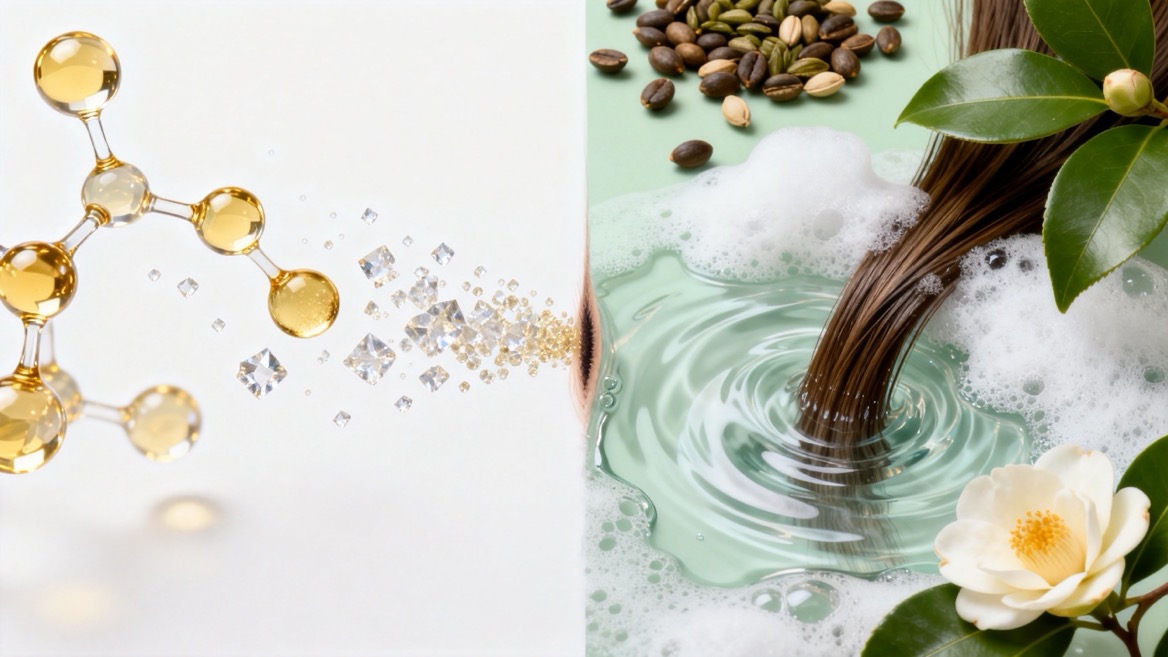
The answer depends on what the formula is expected to do.
If the brief is "create a botanical shampoo that helps oily hair feel fresh without a harsh sulfate system," Tea Saponin is highly relevant. It provides a naturally derived cleansing narrative and may contribute to foam and wetting performance. It is especially useful in products positioned for frequent washing, scalp comfort, or environmentally conscious consumers.
If the brief is "develop a targeted treatment for stubborn scalp buildup, waxy roots, and blocked-feeling follicles," Capryloyl Salicylic Acid is usually the more technically relevant active. It offers a different route to performance by focusing on retained cellular material and lipid-associated congestion rather than cleansing alone.
| Product Concept | Stronger Starting Ingredient | Why |
|---|---|---|
| Daily shampoo for mildly oily hair | Tea Saponin | Supports mild cleansing and a natural-origin story |
| Clarifying shampoo for oily roots | Tea Saponin + compatible cleansing system | Helps disperse sebum while allowing sensorial adjustment |
| Weekly scalp reset treatment | Capryloyl Salicylic Acid | Better aligned with scalp renewal and persistent buildup |
| Pre-shampoo exfoliating scalp serum | Capryloyl Salicylic Acid | Allows focused treatment before the cleansing step |
| Botanical scalp cleanser | Tea Saponin | Matches plant-based positioning and foaming needs |
| Premium oily-scalp regimen | Both, used across separate products | Creates a staged routine: treatment plus cleansing |
In my experience reviewing commercial scalp-care concepts, the most effective oily-scalp portfolio rarely depends on one ingredient alone. Consumers with oily roots often alternate between a mild daily shampoo and an occasional deeper scalp treatment.
A practical two-step system can offer better performance while avoiding the harshness associated with overly aggressive cleansing.
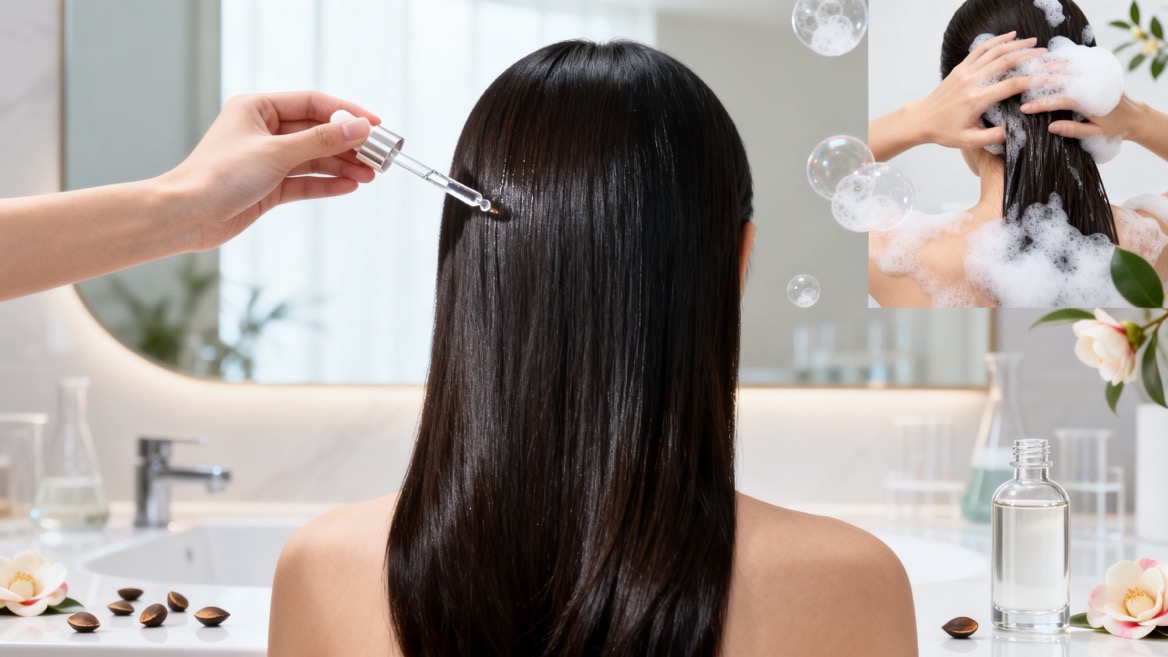
Use Capryloyl Salicylic Acid in a controlled, formula-specific treatment format designed to help loosen scalp buildup before shampooing.
The treatment concept can focus on:
- Oily scalp and visible root buildup
- Styling-product residue
- Rough scalp feel
- Scalp-refreshing routines before washing
- Weekly or periodic deep-cleansing rituals
The formula should prioritize precise delivery, low irritation potential, appropriate solubilization, clear directions for use, and tested compatibility with the intended consumer group.
Follow with a Tea Saponin-containing shampoo system that helps remove loosened oils, residue, and detached debris. This stage can be paired with amphoteric or nonionic co-surfactants to improve foam, viscosity, cleansing consistency, and rinse feel.
A well-designed Tea Saponin shampoo should not depend on "natural" positioning alone. It must deliver the sensory outcomes consumers expect:
- Easy spread through wet hair
- Satisfying but controlled foam
- Efficient scalp rinse-off
- Minimal squeaky or stripped after-feel
- Softness at the lengths
- Reduced rapid re-greasing perception
This two-step approach gives brands a more credible and differentiated oily-scalp platform: renew first, cleanse second.
Before selecting Capryloyl Salicylic Acid, Tea Saponin, or both, development teams should define the following factors.
Do not label every oily scalp as "dandruff" or "folliculitis." Those terms involve different considerations and may require a different regulatory and clinical pathway.
Clarify whether the consumer primarily experiences:
- Excess oil
- Visible flakes
- Styling residue
- Scalp itch
- Waxy buildup
- Malodor
- Follicular bumps
- Hair flattening at the roots
A strong formula starts with a precise problem statement.
Tea Saponin naturally fits rinse-off formats. Capryloyl Salicylic Acid can be used in rinse-off or leave-on concepts, but exposure time, frequency, concentration, and delivery system should guide the safety assessment.
A cosmetic product can support a cleaner scalp appearance, softer scalp feel, or reduced perception of oil and buildup. It should not imply diagnosis, treatment, or cure of a medical scalp condition without the appropriate evidence and regulatory basis.
Raw-material data are useful, but the final formula determines real-world tolerance and performance. Surfactant blend, pH, fragrance, preservative, botanical extracts, packaging, temperature exposure, and consumer usage all influence the finished product.
For a credible launch, consider consumer-use studies and instrumental or professional assessments that evaluate:
- Time to perceived root oiliness
- Visible scalp residue
- Hair volume at the roots
- Scalp comfort after washing
- Ease of rinsing
- Consumer perception of freshness
- Frequency of re-washing
The haircare market often creates a false choice: either powerful but harsh cleansing, or natural but ineffective cleansing. Advanced formulation can avoid this trade-off.
Tea Saponin offers value because it can be part of a gentler cleansing architecture. Yet a botanical surfactant system still needs technical discipline. Extraction quality, active-content standardization, color, odor, microbial control, compatibility, and foam behavior all affect market performance.
Likewise, Capryloyl Salicylic Acid should not be presented as a universal scalp miracle. It is a targeted ingredient that requires thoughtful use. For sensitive scalp consumers, poorly balanced exfoliating systems can cause dryness or discomfort, undermining the product's long-term value.
The best oily scalp products respect both biology and behavior. They reduce the feeling of congestion, but they also make consumers want to use the product consistently.
For international brands and manufacturers, ingredient selection is only the first step. The real commercial advantage comes from translating ingredient science into a stable, compliant, consumer-ready product.
ZHENYIBIO TECHNOLOGY INC combines traditional botanical knowledge with modern biotechnology and fermentation expertise to support sustainable cosmetic ingredient and formulation development. For oily scalp programs, we can help partners evaluate botanical actives, Tea Saponin-based cleansing concepts, targeted scalp-care systems, and customized OEM or ODM product opportunities.
Whether your brand is developing a botanical daily shampoo, a high-performance scalp reset serum, a sulfate-free clarifying wash, or a full oily-scalp product line, our technical team can help transform an ingredient concept into a differentiated market solution.
Contact ZHENYIBIO TECHNOLOGY INC to discuss customized Tea Saponin, scalp-active, OEM, and ODM solutions for your next oily scalp formulation project.
Capryloyl Salicylic Acid is generally more relevant when the key concern is persistent follicular congestion, compacted scalp buildup, or rough scalp texture. Tea Saponin is more relevant for gentle removal of surface oil and impurities in rinse-off cleansing products.
Yes. Tea Saponin has surface-active properties that help disperse oil and soil during cleansing. However, available experimental data suggest that crude Tea Saponin extracts may provide moderate rather than highly aggressive sebum removal, so formulators often balance it with other cleansing components.
It can be considered for shampoo and scalp-treatment concepts, but suitability depends on the complete formula, use concentration, pH, contact time, regional rules, and finished-product compatibility testing. A rinse-off shampoo and leave-on scalp serum should not be developed using the same assumptions.
Tea Saponin can support sulfate-free shampoo concepts because it contributes foaming, wetting, and cleansing functions. In practice, it may be combined with other mild surfactants to achieve the desired foam density, viscosity, cleaning performance, and hair feel.
Yes, but they are often most effective when assigned different roles. Capryloyl Salicylic Acid can support scalp renewal and decongestion, while Tea Saponin can support the subsequent rinse-off cleansing stage. They may also be used in separate products within the same oily-scalp routine.
Appropriate cosmetic-oriented language may include "helps remove excess oil," "helps reduce the feel of scalp buildup," "leaves roots feeling fresh," or "supports a cleaner-looking scalp." Claims that imply treating disease or a clinical scalp disorder require a different evidence and regulatory assessment.
1. Cosmetic Ingredient Review. "[Safety Assessment of Capryloyl Salicylic Acid as Used in Cosmetics]." *International Journal of Toxicology*, 2024.
2. Johnson, W. et al. "[Safety Assessment of Capryloyl Salicylic Acid as Used in Cosmetics]." *International Journal of Toxicology*, 2024.
3. Cosmetic Ingredient Review. "[Safety Assessment of Capryloyl Salicylic Acid as Used in Cosmetics (PDF)]."
4. Vinu, M. et al. "[Plant-Derived Saponins and Their Prospective for Cosmetic and Personal Care Applications]." *Sustainable Chemistry and Pharmacy*, 2024.
5. Feng, X. et al. "[Foam Properties and Detergent Abilities of the Saponins From Camellia oleifera]." *Journal of Surfactants and Detergents*, 2010.
6. European Commission Scientific Committee on Consumer Safety. "[Opinion on Salicylic Acid]." 2023.
7. Cosmetics & Toiletries. "[Ingredient Profile: Salicylic Acid]." 2021.


