


Views: 299 Author: ZHENYIBIO Publish Time: 2026-11-24 Origin: Site
Content Menu
● What Do Peptide Purity and Assay Actually Measure?
>> Why HPLC Purity Is Not Peptide Content
>> Why the Meaning of "Assay" Must Be Defined
● Step 1: Define the Cosmetic Peptide Raw Material
● Step 2: Confirm Identity Before Interpreting Purity
>> Review Mass Spectrometry Results
● Step 3: Evaluate HPLC Purity Beyond the Headline Number
>> Request the Full Chromatographic Record
>> Check What the Method Might Miss
● Step 4: Verify Peptide Assay and Reporting Basis
>> Review Reference Standards and Method Performance
● Step 5: Investigate Water, Counterions, and Process Impurities
● A Practical Cost Comparison: Buy Verified Content
● How to Review a Cosmetic Peptide Certificate of Analysis
● Build a Risk-Based Incoming Quality Workflow
>> Before the First Commercial Order
● Verify Stability in the Intended Formulation
● Discuss Your Peptide Qualification Requirements With ZHENYIBIO
>> Is 99% HPLC purity enough to approve cosmetic peptide raw materials?
>> What is the difference between net peptide content and target-peptide assay?
>> Can amino acid analysis confirm the peptide sequence?
>> Should a peptide solution have the same assay specification as a powder?
>> Does high chemical purity guarantee biological activity?
>> When is third-party testing most valuable?
Evaluating the purity and assay of cosmetic peptide raw materials requires more than checking a "99% purity" claim. Buyers need to establish the peptide's identity, distinguish chromatographic purity from actual content, and confirm that analytical results apply to the material being purchased.
For international brands, wholesalers, and manufacturers, these distinctions affect formulation accuracy, purchasing costs, and batch consistency. A highly purified peptide powder and a diluted peptide solution cannot be compared using the same headline percentage.
At ZHENYIBIO TECHNOLOGY INC, our focus on plant-derived actives, modern biofermentation, and OEM/ODM collaboration shapes a practical sourcing principle: evaluate ingredients through measurable specifications, not marketing descriptions. This guide explains how to assess cosmetic peptide quality and turn laboratory results into better purchasing decisions.

Three questions should guide every technical review: Is this the right peptide? How well is it separated from impurities? How much relevant peptide material does the supplied ingredient contain?
| Quality attribute | What it establishes | Typical analytical approach |
|---|---|---|
| Identity | Whether the material matches the intended peptide | Mass spectrometry, supplemented where necessary |
| Chromatographic purity | Target peak area relative to included chromatographic peaks | RP-HPLC or UHPLC |
| Target-peptide assay | Quantity of the specified peptide on a defined basis | Calibrated quantitative chromatography |
| Net peptide content | Peptidic material relative to the total supplied mass | Amino acid analysis or suitable elemental analysis |
| Biological activity | Performance in a defined biological system | Relevant, qualified activity assay |
HPLC purity commonly describes the target peak's percentage of the integrated detector response:
HPLC purity (%)=Target peak area/Total included peak area×100
It is not automatically a weight percentage.
Water, counterions, and other components may contribute material mass without contributing proportionately to the integrated peptide signal. Co-eluting impurities can also remain hidden within the main peak.
Consequently, a powder showing 99% chromatographic purity does not necessarily contain 990 mg of target peptide per gram.
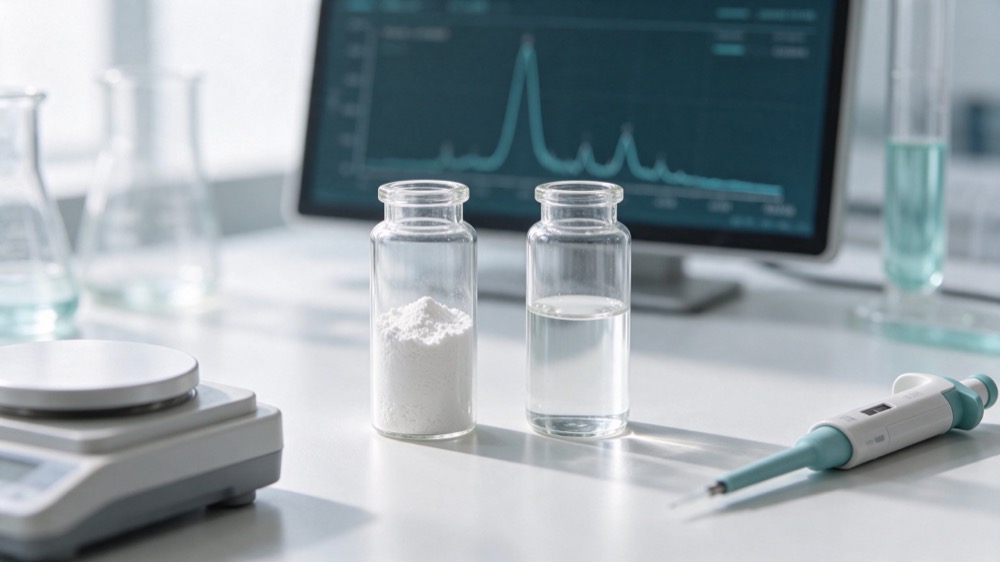
Assay is not a universally interchangeable label. One supplier may use it for target-peptide content measured against a reference standard. Another may report net peptide content derived from nitrogen analysis.
Net peptide content can include peptide-related impurities. It does not inherently establish the amount of the correct sequence.
Always ask: "What exactly is measured, by which method, and on what reporting basis?"
Before evaluating laboratory numbers, establish what the commercial ingredient contains.
A useful specification identifies:
- INCI name and product code.
- Peptide sequence, where available.
- Molecular formula and molecular weight.
- Terminal modifications, such as acetylation or amidation.
- Salt or counterion form.
- Powder, solution, or formulated-blend presentation.
- Declared concentration and measurement units.
For a peptide solution, request the complete carrier composition, including water, glycols, preservatives, or other excipients.
A "peptide complex" may describe a formulated blend rather than a single purified molecule. Its recommended inclusion level is not necessarily its peptide concentration.
Likewise, a plant-derived or fermentation-based positioning does not establish how a particular peptide was manufactured. Request product-specific origin and process documentation rather than extending company-level claims to every ingredient.
A clean chromatogram is useful only when the main peak represents the intended substance.
Mass spectrometry provides evidence that the observed molecular mass is consistent with the expected peptide.
Request a report showing:
- Expected molecular mass.
- Observed mass or mass-to-charge values.
- Relevant charge-state assignments.
- Sample identification and batch number.
- Interpretation against the specified structure.
However, matching mass alone does not prove every structural detail. Isomeric sequences or stereochemical differences may require additional investigation.
When a known structural risk matters, ask whether tandem mass spectrometry, reference-standard comparison, or another suitable technique is necessary. The analytical package should address the actual uncertainty.
RP-HPLC separates peptides according to their interactions with the stationary and mobile phases. Separation depends on method conditions, so results from different methods are not automatically comparable.
A useful report includes:
- Column and mobile-phase details.
- Gradient and flow rate.
- Detection wavelength.
- Sample preparation.
- Injection volume.
- Chromatogram and integration table.
- Integration rules and system-suitability results.
A cropped image showing one tall peak is insufficient to evaluate separation quality.
Look for shoulders, overlapping peaks, unusually broad peaks, and unexplained baseline treatment. Ask how the method separates expected synthesis impurities and degradation products.
A single attractive peak does not prove that every relevant impurity has been resolved. Where warranted, a second chromatographic method with different selectivity can provide additional confidence.
Avoid setting a universal purity threshold solely because competitors advertise it. Acceptance criteria should reflect the peptide, impurity profile, intended use, and safety assessment.
A quantitative result becomes commercially useful only when its basis is clear.
Ask whether content is reported:
- As received.
- On a dried or anhydrous basis.
- As free peptide or a specified salt.
- In percent weight/weight, mg/g, or mg/mL.
- For the target molecule or total peptidic material.
These distinctions prevent purchasing and formulation errors.
For a calibrated target-peptide assay, request information about the reference standard's identity, assigned content, and storage conditions.
Then assess whether the method demonstrates appropriate:
- Specificity.
- Accuracy and recovery.
- Repeatability and intermediate precision.
- Reportable range.
- Quantitation capability at the relevant concentration.
ICH Q2(R2) offers a useful framework for these concepts. It addresses pharmaceutical analytical procedures; citing it does not make a cosmetic ingredient compliant with a pharmaceutical standard.
For diluted peptide blends, recovery and selectivity should be demonstrated in the actual carrier matrix, not merely in a clean solvent.
Purity and assay results need supporting tests that explain the material's composition.
| Attribute | Potential analytical approach | Why it matters |
|---|---|---|
| Water | Karl Fischer titration | Helps interpret content and moisture uptake |
| Counterions | Suitable chromatographic or other quantitative method | Clarifies salt composition and non-peptide mass |
| Residual solvents | Validated gas chromatography | Addresses route-specific solvent residues |
| Elemental contaminants | Appropriate elemental analysis, such as ICP-MS | Addresses identified contamination risks |
| Microbiological quality | Suitable microbiological methods | Supports ingredient suitability for intended use |
| Related peptides | Stability-indicating chromatography | Tracks synthesis impurities and degradation |
These are risk-based considerations, not a universal mandatory panel.
Synthetic and fermentation-derived materials may require different impurity investigations. For fermentation-derived ingredients, ask how purification controls relevant process residues and microbial risks.
For complexed peptides, such as metal-binding materials, the specification may also need to address complex composition and unbound components. A peptide-only measurement may not describe the complete ingredient.
Consider two hypothetical powder offers:
| Parameter | Supplier A | Supplier B |
|---|---|---|
| Price per kilogram | $1,000 | $1,150 |
| Target-peptide assay, as received | 75% | 90% |
| Target peptide per kilogram | 750 g | 900 g |
| Cost per gram of target peptide | $1.33 | $1.28 |
Although Supplier B charges more per kilogram, its verified target-peptide cost is lower.
The calculation is:
Cost per gram of target peptide=Price per kilogram/(1,000×Assay fraction)
These figures are illustrative, not market quotations.
Use a directly measured target-peptide assay when available. Do not automatically multiply net peptide content by HPLC area purity unless the analytical assumptions justify that estimate, including impurity detector-response considerations.
A certificate of analysis should connect an identified batch to an agreed specification.
Check for:
1. Product identity and batch number.
2. Manufacturing and retest or expiry dates.
3. Test methods or method identifiers.
4. Acceptance criteria and actual results.
5. Content units and reporting basis.
6. Authorized quality approval.
"Conforms" may be suitable for some qualitative tests. For critical quantitative attributes, request numerical results.
Compare multiple production batches where practical. Trends in assay, water, or impurity levels can reveal variability that a single sample cannot.
Treat unexplained identical chromatograms, mismatched batch identifiers, or missing assay definitions as reasons to investigate—not automatic proof of misconduct.

A practical qualification process connects documentation, testing, and supplier communication.
Agree on specifications before approving a quotation. Obtain the technical data sheet, safety data sheet, representative analytical records, storage guidance, and relevant origin documentation.
For critical or unfamiliar materials, use a qualified independent laboratory to confirm selected attributes. Align sample preparation and methods before interpreting differences between laboratories.
Set incoming checks according to supplier history and material risk. Retain samples and track results against established specifications.
Require notification of meaningful changes, including synthesis route, fermentation process, purification, counterion, carrier composition, or manufacturing location.
Quarantine the disputed batch while investigating sampling, shipping exposure, reference-standard assignment, units, and analytical procedures.
Do not resolve a genuine discrepancy by repeatedly testing until a passing result appears. Document the cause and agree on corrective action.
A compliant raw material can still behave differently after incorporation into a finished product.
Assess compatibility with the intended pH, processing temperature, excipients, packaging, and storage conditions. Evaluate both chemical content and physical characteristics where relevant.
Ask whether the analytical procedure can distinguish the intact peptide from its degradation products. Appearance alone cannot establish peptide stability.
Likewise, chemical purity does not prove finished-product efficacy. Activity claims require evidence relevant to the ingredient, concentration, formulation, and proposed benefit.
Storage recommendations should come from product-specific data. Avoid applying one universal temperature or shelf life to all cosmetic peptides.
For brands, wholesalers, and manufacturers developing peptide-based products, the most useful starting point is a clear technical brief.
Contact ZHENYIBIO TECHNOLOGY INC with your target peptide or INCI name, required concentration, delivery format, destination market, and OEM/ODM objectives.
Request a product-specific discussion covering available specifications, analytical documentation, formulation compatibility, and qualification requirements before sample approval or commercial purchasing.
No. It does not independently establish identity, target-peptide content, microbiological quality, or the absence of relevant non-detected impurities. Review it alongside assay and supporting risk-based tests.
Net peptide content describes peptidic material relative to the supplied mass and can include peptide impurities. A selective target-peptide assay quantifies the specified molecule on a stated basis.
Not by itself. Hydrolysis-based amino acid analysis provides composition and can support content determination, but it removes sequence information. Additional identity testing is necessary.
No. A solution requires a concentration specification appropriate to its declared dilution and carrier matrix. Always compare equivalent units and reporting bases.
No. Chemical measurements establish specific quality attributes. Biological activity and finished-product benefits require separate evidence appropriate to the proposed application.
It is particularly useful during initial supplier qualification, after significant process changes, or when batch results are disputed. Testing scope should follow material risk and supplier performance.
1. Bachem. [Quality Control of Amino Acids & Peptides: A Guide]. Technical guidance on identity, chromatographic purity, amino acid analysis, and product content. [bachem]
2. Bachem. [FAQ—Frequently Asked Questions]. Definitions of HPLC purity, elemental-analysis assay, and net peptide content. [bachem]
3. Bachem. [Peptide Content & Concentration Calculator]. Explains relationships between gross weight, purity, assay, and calculated peptide quantity. [bachem]
4. International Council for Harmonisation. [ICH Q2(R2): Validation of Analytical Procedures]_Guideline_2023_1130.pdf). Final guideline, adopted November 2023; framework for analytical specificity, accuracy, precision, and range. [database.ich]_Guideline_2023_1130.pdf)
5. U.S. Food and Drug Administration. [Q2(R2): Validation of Analytical Procedures]. March 2024 guidance explaining the analytical-validation framework and pharmaceutical context. [fda]
6. Mant, C. T., et al. [HPLC Analysis and Purification of Peptides]. *Methods in Molecular Biology*, 2007. Technical discussion of peptide chromatography, separation selectivity, and counterion effects. [pmc.ncbi.nlm.nih]
7. Bachem. [Care and Handling of Peptides]. Guidance on peptide handling and the contribution of counterions and moisture to supplied mass. [bachem]


