


Views: 264 Author: ZHENYIBIO Publish Time: 2026-11-21 Origin: Site
Content Menu
● 1. Define the Salicylic Acid Grade Your Application Requires
>> Separate Botanical Positioning From Manufacturing Origin
● 2. Evaluate Salicylic Acid Purity Beyond the Headline Percentage
>> Understand Assay Versus Chromatographic Purity
>> Review Related Substances and Process Impurities
● 3. Read the Certificate of Analysis Like a Buyer, Not a Spectator
● 4. Understand Salicylic Acid Solubility Before Blaming Purity
>> Distinguish Dissolution Speed From Equilibrium Solubility
>> Evaluate the Actual Solvent System
● 5. Run a Controlled Salicylic Acid Sample-Testing Protocol
>> Step 1: Inspect the Unopened Sample
>> Step 2: Confirm Identity and Critical Quality Attributes
>> Step 3: Compare Dissolution Under Fixed Conditions
>> Step 4: Challenge the Finished Formula
● 6. Investigate Recrystallization With a Formulation-First Decision Tree
● 7. Assess Supplier Reliability and Commercial Risk
>> Use a Risk-Weighted Supplier Scorecard
● 8. Confirm Market Suitability Before Final Approval
● 9. Turn Evaluation Into a Clear Purchasing Specification
>> What Is the Best Salicylic Acid Purity for Cosmetics?
>> Does 99.9% Purity Mean Better Solubility?
>> Why Does Salicylic Acid Recrystallize After Cooling?
>> Is a Supplier's Certificate of Analysis Enough?
>> Is All Salicylic Acid Plant-Derived?
>> Should Particle Size Be Included in the Specification?
Evaluating salicylic acid purity, solubility, and quality before purchasing requires more than comparing percentages on supplier quotations. For cosmetic brands, wholesalers, and manufacturers, the right material must combine verified identity, controlled impurities, predictable formulation performance, and reliable documentation.
My starting point for ingredient evaluation is straightforward: purity describes only part of the purchasing risk. A high-assay powder can still create problems if its impurity profile is unclear, its dissolution behavior varies, or its manufacturing origin cannot be traced.
For ZHENYIBIO TECHNOLOGY INC, whose focus combines botanical actives with modern biofermentation, evidence-based sourcing is especially important. Plant-inspired positioning should never replace analytical verification.
This guide explains how to compare salicylic acid suppliers, interpret certificates, test samples, and establish practical acceptance criteria before committing to commercial orders.

Before requesting prices, define what you are buying and how it will be used.
Salicylic acid has the INCI name Salicylic Acid and CAS number 69-72-7. However, matching these identifiers does not establish that every available grade is suitable for your application.
| Purchasing consideration | What to confirm | Why it matters |
|---|---|---|
| Ingredient identity | INCI name, chemical name, CAS number | Prevents substitution or documentation errors |
| Intended grade | Cosmetic specification or named pharmacopoeial standard | Establishes the applicable quality requirements |
| Physical form | Crystals, powder, or formulated solution | Affects handling and processing |
| Manufacturing origin | Production route and manufacturing site | Supports traceability and sourcing claims |
| Commercial application | Product category and destination market | Determines regulatory review requirements |
"Cosmetic grade" should be supported by a written specification, not treated as a universally standardized quality designation.
Likewise, a pharmaceutical-grade claim should identify the relevant pharmacopoeia and applicable edition. Do not assume that one impressive assay value proves compliance with every requirement of a monograph.
Salicylic acid occurs in plant-related biological systems, but this does not establish that a commercial batch is extracted from plants or produced through fermentation.
Request evidence supporting any claims such as plant-derived, fermentation-derived, renewable, or naturally sourced.
For buyers developing botanical skincare ranges, this distinction protects both technical credibility and labeling accuracy.
A quotation stating "99.5% purity" immediately raises three questions:
1. What analytical method produced the result?
2. Is the result reported on an as-is or dried basis?
3. Which impurities were measured separately?
Without those answers, comparisons between suppliers may be misleading.
An assay measures salicylic acid content using a defined procedure. Depending on the specification, this may involve titration or a chromatographic method.
Chromatographic purity often describes the relative size of detected peaks. An HPLC area percentage is not automatically equivalent to an absolute mass percentage.
Detector response, undetected components, and method selectivity influence interpretation.
My purchasing rule is to request both a defensible assay and an appropriate impurity assessment rather than allowing one result to substitute for the other.
Dried-basis results account for the material after correction for the specified drying loss. As-is results describe the supplied material without that correction.
For illustration, a material assaying at 99.5% on a dried basis with 0.5% drying loss would contain approximately 99.0% active material as supplied, provided the drying-loss correction is applicable.
This distinction can affect dosing calculations and supplier comparisons.
Do not treat loss on drying as identical to water content unless the method justifies that interpretation; volatile substances may also contribute.
Ask the supplier to explain controls for:
- Phenol and relevant related substances.
- Individual unspecified impurities.
- Total chromatographic impurities.
- Residual solvents where relevant to the process.
- Elemental impurities based on manufacturing risk.
- Nonvolatile inorganic residue.
Acceptance limits should follow the agreed specification, intended application, and relevant requirements. There is no responsible universal limit covering every supplier, process, and market.
A certificate of analysis should connect a specific batch to meaningful release results.
At minimum, review:
- Manufacturer and product identification.
- Batch number and manufacturing date.
- Retest or expiry date.
- Specification limits.
- Actual numerical results where appropriate.
- Analytical methods or method references.
- Authorized quality approval.
"Conforms" can be appropriate for identification or appearance. For quantitative characteristics such as assay and water content, actual results make comparison and trending more useful.
Request several recent commercial-batch certificates. Three batches can provide an initial comparison, although this is a purchasing recommendation rather than a universal regulatory rule.
Look for unexplained method changes, inconsistent units, and certificates that identify only a distributor without establishing manufacturing traceability.
A safety data sheet serves a different purpose. It supports hazard communication and handling; it does not replace batch-specific quality evidence.
Salicylic acid has limited solubility in room-temperature water. Merck product information reports approximately 2 g/L at 20°C—roughly 0.2% weight/volume.
Consequently, a clear 2% aqueous product cannot normally be designed by simply adding unmodified salicylic acid to water at room temperature.
This is a formulation constraint, not automatic evidence of poor raw-material quality.
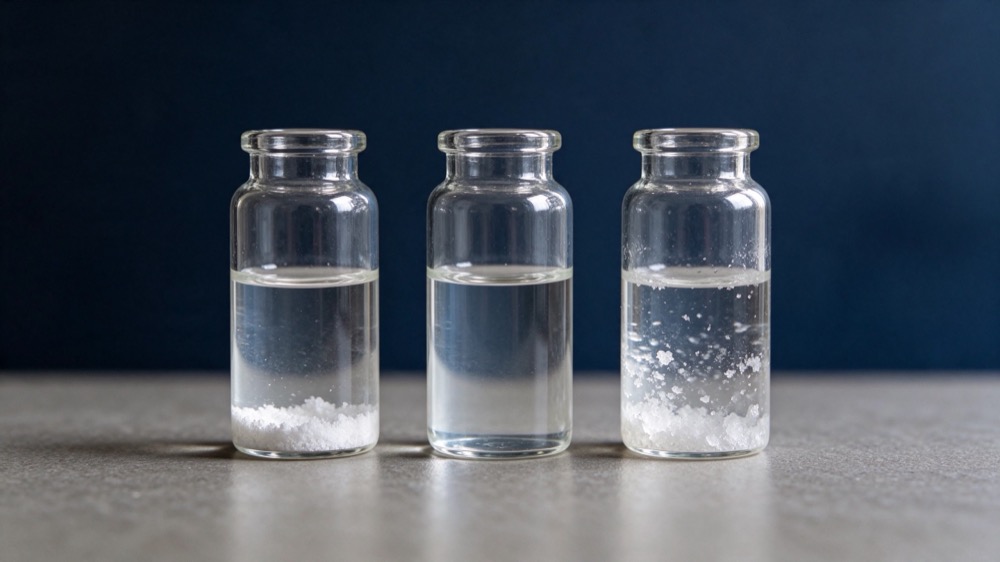
Fine particles may dissolve faster because they expose more surface area. They do not necessarily produce a higher equilibrium solubility under otherwise identical conditions.
Keep these concepts separate when comparing samples:
- Dissolution speed concerns how quickly material enters solution.
- Equilibrium solubility concerns how much remains dissolved under defined conditions.
- Dispersion concerns particle distribution and does not prove dissolution.
A visually uniform mixture can still contain suspended crystals.
Solubility depends on the complete formulation, including solvent composition, pH, temperature, and other ingredients.
Potential approaches include compatible cosolvents or appropriately designed solubilization systems. Suitability must be demonstrated in the intended formula.
Raising pH increases ionization and can improve apparent solubility. However, neutralization changes the balance between free acid and salicylate. It should not be treated as a performance-neutral processing adjustment.
Most importantly, clarity while warm does not establish stability after cooling.
Before bulk purchasing, agree on a written comparison protocol. Use the same equipment, sample size, solvent system, and processing conditions for every candidate.
Record packaging integrity, batch identification, and signs of contamination or moisture exposure.
After opening under appropriate laboratory controls, examine color, foreign matter, and caking. Appearance is a screening tool, not proof of identity or purity.
For initial qualification, consider an appropriately competent independent laboratory.
Testing may include:
| Test | Purchasing question answered |
|---|---|
| Infrared identification | Is the material consistent with salicylic acid? |
| Assay | Does active content meet the agreed specification? |
| Related-substances analysis | Are relevant impurities adequately controlled? |
| Water or drying loss | Is the result suitable for handling and dosing? |
| Risk-based elemental analysis | Are relevant elemental contaminants controlled? |
Melting behavior can provide supporting evidence, but it should not replace a specific identification method.
Document solvent composition, loading, temperature, stirring conditions, and addition sequence.
Record dissolution time and inspect for residual particles. Where the decision is consequential, measure dissolved concentration analytically rather than relying only on appearance.
Evaluate samples in the actual product base.
Use a justified stability program covering relevant storage and transport conditions. Monitor crystal formation, pH, appearance, assay, and packaging compatibility.
These development checks support purchasing decisions; they do not replace a complete finished-product safety and stability assessment.
Consider an illustrative scenario: two suppliers provide high-assay salicylic acid. Both samples dissolve during heated processing, but crystals appear in one pilot batch after cooling.
Rejecting that supplier immediately would be premature.
Investigate in this order:
1. Confirm that both batches followed the same manufacturing procedure.
2. Check final pH and solvent composition.
3. Assess whether evaporation changed the solvent balance.
4. Confirm dissolved salicylic acid concentration.
5. Compare impurity profiles and particle characteristics.
6. Repeat the experiment under controlled conditions.
The practical lesson is that raw-material quality and formulation robustness interact.
A formula operating close to its solubility limit may reveal small process differences that a more robust formulation would tolerate. Qualification should therefore establish a workable formulation margin, not merely demonstrate one clear laboratory sample.
A technically acceptable sample is only the beginning.
Evaluate the supplier's ability to reproduce that quality and communicate changes before they affect production.
Request information covering:
- Manufacturing-site traceability.
- Quality-management responsibilities.
- Batch-release procedures.
- Complaint investigation.
- Retained samples.
- Storage and transport instructions.
- Change notification.
- Supply continuity.
Quality-system certificates are useful supporting documents, but they do not independently prove that a particular batch meets your specification.
The following is an illustrative internal purchasing model, not an industry-mandated standard:
| Evaluation category | Suggested weighting |
|---|---|
| Identity, assay, and impurity control | 35% |
| Formulation and dissolution performance | 25% |
| Documentation and traceability | 20% |
| Supply reliability and technical support | 15% |
| Price and payment terms | 5% |
Set mandatory rejection criteria before calculating scores. Failed identity testing, unacceptable impurities, or unresolved traceability should not be offset by a low price.
This approach keeps purchasing focused on usable, reproducible material rather than nominal cost per kilogram.
Raw-material purity does not establish that a finished product is legally marketable.
For the European Union, salicylic acid is addressed through restricted-ingredient and preservative provisions. Permitted conditions depend on intended function, product category, concentration, and other restrictions.
Review the current applicable legal text for each destination market. Do not apply a single concentration limit across all cosmetic products or assume that a scientific safety opinion automatically changes legislation.
Marketing claims also matter. Claims about treating acne or disease may change product classification in some jurisdictions.
For OEM and ODM projects, resolve these questions before finalizing ingredient specifications, packaging, and commercial commitments.
The most useful outcome is a signed specification and qualification record.
Document:
- Accepted identity and analytical methods.
- Assay limits and reporting basis.
- Relevant impurity limits.
- Physical characteristics where process-critical.
- Approved packaging and storage.
- Retest arrangements.
- Required batch documentation.
- Change-notification expectations.
- Sample-to-commercial-batch comparability requirements.
Reassess approval when the manufacturing site, production route, or critical processing conditions change.
For ZHENYIBIO TECHNOLOGY INC projects, the commercial conversation should connect ingredient evidence with the customer's formulation, sourcing priorities, and destination market.
Contact ZHENYIBIO TECHNOLOGY INC with your intended product type, target market, required documentation, and pilot-batch needs to discuss a defined raw-material evaluation and OEM/ODM development brief.
There is no universal percentage that independently guarantees suitability. Select material meeting an agreed specification for identity, assay, impurities, and application. Verify the method and reporting basis behind any advertised purity figure.
Not necessarily. Solubility depends primarily on the chemical form and formulation conditions. A higher assay does not remove salicylic acid's limited room-temperature water solubility.
Heating can temporarily accommodate more dissolved material than cooler conditions allow. Solvent changes, pH shifts, and insufficient solubilization capacity can also contribute. Investigate both the formulation and manufacturing process.
It is essential but may be insufficient for initial qualification. Use document review, appropriate independent verification, and formulation trials according to risk. Continue checking incoming-batch identity and agreed critical attributes.
No. Botanical associations do not establish commercial manufacturing origin. Request traceable evidence before making plant-derived, renewable-feedstock, or fermentation-derived claims.
Include it when it materially affects handling, dissolution time, or process consistency. Particle size can influence dissolution speed, but it should not be confused with equilibrium solubility.
1. National Center for Biotechnology Information. [PubChem Compound Summary: Salicylic Acid, CID 338]. Chemical identity and physicochemical background. [pubchem.ncbi.nlm.nih]
2. Merck / Sigma-Aldrich. [Salicylic Acid, Fine Powder, EMPROVE ESSENTIAL, Ph Eur, BP, USP—Product 100635]. Product identity, grade information, and water solubility at 20°C. [sigmaaldrich]
3. United States Pharmacopeia. [USP–NF Monograph: Salicylic Acid]. Monograph-specific assay basis and reference standards; confirm the applicable current edition before setting contractual requirements. [doi.usp]
4. European Commission. [Commission Regulation (EU) 2019/1966]. Historical amendment establishing relevant salicylic acid restrictions; consult subsequent amendments and current consolidated legislation for compliance decisions. [eur-lex.europa]
5. SGS. [EU Amends Cosmetics Regulation in Response to CMR Substances]. Explanation of the 2021 changes to salicylic acid product-category restrictions. [sgs]
6. COSMILE Europe. [Salicylic Acid—Ingredient Information]. Ingredient functions, restriction framework, and links to scientific assessments. [cosmileeurope]
7. Merck / Sigma-Aldrich. [Quality and Supply Chain Transparency Guidelines]. Quality documentation, analytical information, and distinctions between quality-system support levels. [sigmaaldrich]
8. Merck / Sigma-Aldrich. [Change Notification Program]. Quality agreements and supplier change communication. [sigmaaldrich]


