


Views: 287 Author: ZHENYIBIO Publish Time: 2026-08-08 Origin: Site
Content Menu
● Why Acute UV Damage Can Lead to Uneven Tone
● L-Glutathione Powder: Multi-Pathway Support for Brightening Formulas
>> How L-Glutathione May Influence Melanin Formation
>> Evidence and Commercial Reality
● L-Ergothioneine: Targeted Cellular Defense After UV Stress
>> How L-Ergothioneine Addresses Photo-Stress
>> A Meaningful Pigment-Control Difference
● L-Glutathione Powder vs. L-Ergothioneine at a Glance
● Which Ingredient Is Better for Acute UV-Related Pigmentation?
● Formulation Guidance for Product Developers
>> 1. Protect L-Glutathione From Oxidation
>> 2. Design for the Consumer Routine
>> 3. Build a Multi-Mechanism System
● Avoid the "Instant Whitening" Trap
● Partner With ZHENYIBIO for Custom Brightening Solutions
>> Is L-Glutathione Powder better than L-Ergothioneine for dark spots?
>> Can L-Ergothioneine be used in daily skin-care products?
>> Does glutathione replace sunscreen?
>> Why does L-Glutathione Powder sometimes cause formula yellowing?
>> Can L-Glutathione and L-Ergothioneine be formulated together?
>> How quickly can consumers expect visible brightening results?
Acute UV exposure can trigger visible dullness, uneven tone, redness, and delayed pigmentation long before consumers describe the skin as "sun damaged." For formulators developing post-sun, brightening, and urban-defense products, L-Glutathione Powder and L-Ergothioneine are two highly relevant sulfur-containing actives—but they should not be treated as interchangeable ingredients.
Both materials can help address oxidative stress and pigment-pathway activity after UV exposure. However, L-Glutathione works most directly as a redox-supporting tripeptide with multiple melanogenesis-related actions, while L-Ergothioneine is a highly stable cellular antioxidant with strong relevance for UVA-associated oxidative stress, inflammation, and resilience. The best choice depends on whether a formula is primarily designed for pigment control, rapid antioxidant defense, barrier-oriented recovery, or a multi-active brightening system.

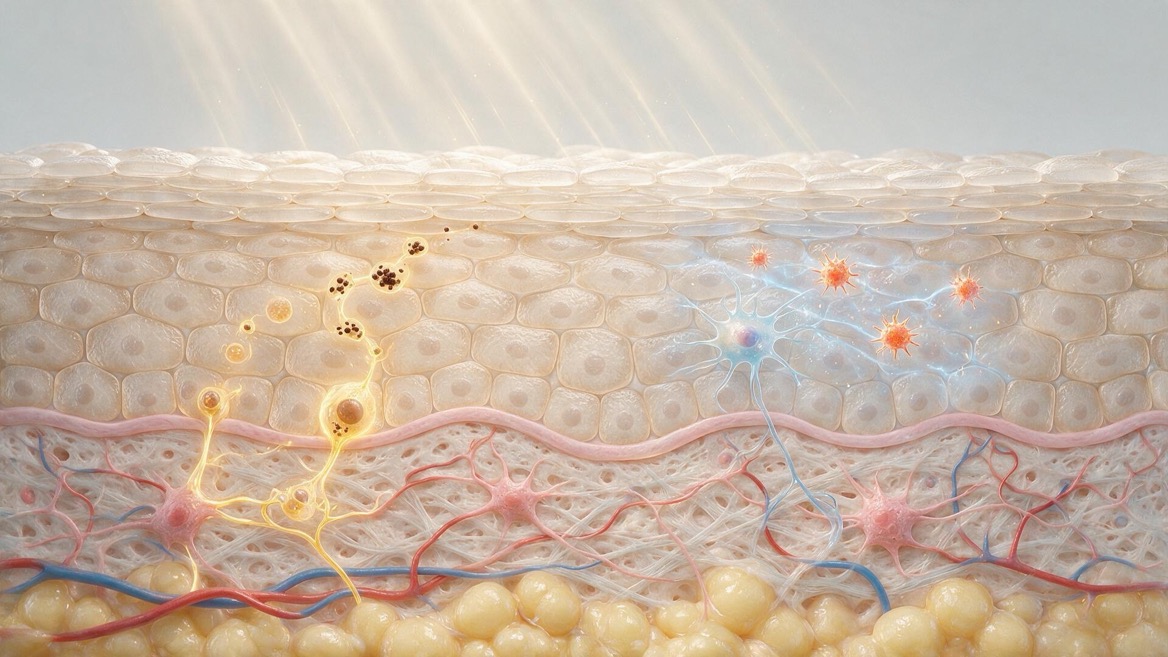
UV radiation does more than cause temporary redness. In the skin, UVB is strongly associated with surface inflammation and erythema, while UVA penetrates more deeply and contributes substantially to oxidative stress, collagen degradation, and persistent pigmentation concerns.
Following UV exposure, several processes can occur simultaneously:
- Reactive oxygen species (ROS) increase rapidly.
- Inflammatory mediators can stimulate melanocyte activity.
- Tyrosinase activity may rise, accelerating melanin production.
- Dopaquinone and other melanin intermediates can move toward darker eumelanin formation.
- Skin barrier stress may make the complexion appear rougher, duller, or less even.
For ingredient buyers and product developers, the critical point is that post-UV brightening is not only a tyrosinase story. A high-performing system should consider oxidation, inflammation, pigment signaling, formula stability, and consumer-friendly sensory performance.
L-Glutathione is a naturally occurring tripeptide composed of glutamic acid, cysteine, and glycine. Its reduced form, commonly called GSH, is central to cellular antioxidant systems. In cosmetic development, L-Glutathione Powder is widely considered for brightening, antioxidant, anti-dullness, and post-exposure skin-care concepts.
Its advantage is not one isolated mechanism. Rather, it can influence several steps associated with UV-induced pigmentation.
L-Glutathione is often selected when a brand wants a broad pigment-management story. Its proposed actions include the following:
- Copper interaction: The sulfhydryl group may interact with copper at the active site of tyrosinase, a key enzyme in melanin formation.
- Antioxidant activity: By helping neutralize reactive species, glutathione may reduce oxidative signals that promote melanogenesis.
- Melanin-pathway shift: Thiol-containing compounds can react with dopaquinone intermediates, encouraging conditions more associated with lighter pheomelanin rather than darker eumelanin.
- Redox balance: Supporting the cellular redox environment is relevant because oxidative imbalance can intensify visible signs of photo-stress.
This multi-angle mechanism makes L-Glutathione Powder particularly relevant for formulations positioned around radiance, tone refinement, dark-spot prevention, and antioxidant recovery.
Topical and oral glutathione research has reported potential improvements in melanin-index-related outcomes in sun-exposed skin. However, the clinical literature remains limited in size and consistency. Responsible product communication should therefore avoid guaranteeing skin whitening or claiming a medical treatment effect.
From an ingredient-development perspective, the more credible approach is to describe glutathione as supporting:
- A more even-looking complexion.
- Antioxidant defense against environmental stress.
- Reduced appearance of post-exposure dullness.
- A brighter and healthier-looking skin tone over consistent use.
Formulation quality matters greatly. Glutathione is oxidation-sensitive, so its real-world performance depends heavily on raw-material quality, metal control, packaging, pH, compatible antioxidants, and manufacturing conditions.
L-Ergothioneine is a naturally occurring sulfur-containing amino acid derivative found in certain fungi and other biological sources. It has a distinctive thiol/thione structure; under physiological conditions, it predominantly exists in the more stable thione form. This characteristic contributes to its notable resistance to oxidation compared with many conventional antioxidant materials.
For topical innovation, L-Ergothioneine is especially interesting because skin cells can take it up and use it in their antioxidant defense processes.
L-Ergothioneine is best understood as a cellular-defense active. Its value after UV exposure extends beyond visible tone.
Research indicates that it may help with several photo-stress pathways:
- Reducing intracellular ROS generated by UVA or UVB exposure.
- Supporting antioxidant-response signaling, including the Nrf2/ARE pathway.
- Helping limit oxidative damage to DNA, proteins, lipids, and mitochondria.
- Reducing pro-inflammatory signals associated with UV stress.
- Inhibiting tyrosinase activity and reducing dopaquinone-related pigment reactions.
This broader defense profile makes L-Ergothioneine a strong candidate for daily serums, antioxidant essences, anti-pollution products, urban skin-defense formulas, and recovery-focused moisturizers.
L-Ergothioneine can contribute to visible brightening, but its most differentiated commercial value is not simply "another melanin inhibitor." Its strength lies in connecting tone concerns to the upstream oxidative and inflammatory stress that can make pigmentation more persistent.
One recent study reported reversible, non-competitive tyrosinase inhibition by ergothioneine and observed reductions in melanin-related measures in UVA-irradiated skin at low topical use levels. This supports its relevance in modern brightening products that prioritize a gentler, prevention-led approach.
For brands targeting sensitive, stressed, or frequently sun-exposed skin, L-Ergothioneine offers a sophisticated protection-first narrative.
| Comparison point | L-Glutathione Powder | L-Ergothioneine |
|---|---|---|
| Chemical category | Tripeptide containing a reactive sulfhydryl group | Sulfur-containing amino acid derivative with thiol/thione behavior |
| Core role | Redox support and multi-pathway melanin management | Stable cellular antioxidant and photo-stress defense |
| Tyrosinase relevance | May interact with copper at the enzyme active site | Reported reversible, non-competitive inhibition |
| Melanin-pathway effect | Can influence dopaquinone reactions and eumelanin/pheomelanin balance | May reduce oxidative pigment signaling and dopaquinone-related reactions |
| Best fit | Brightening serums, dark-spot concepts, tone-correction formulas | Daily defense serums, post-sun care, anti-pollution, sensitive-skin recovery |
| Formula challenge | Oxidation and discoloration risk require careful stabilization | Generally valued for high molecular stability, but compatibility testing remains necessary |
| Positioning style | Direct brightening and antioxidant support | Prevention-led defense, resilience, and photoaging support |
| Acute UV focus | Useful when oxidative stress and pigment formation are central concerns | Particularly compelling for UVA-driven oxidative and inflammatory stress |
There is no universal winner. The right selection depends on the product brief, target consumer, claim strategy, and delivery system.
Choose L-Glutathione Powder when the formula needs:
- A clearly recognizable brightening active.
- A mechanism linked to melanin synthesis and tyrosinase.
- Support for complexion radiance and uneven-tone routines.
- Synergy with ingredients such as niacinamide, alpha-arbutin, tranexamic-acid derivatives, licorice actives, or vitamin C derivatives.
- A premium antioxidant story built around cellular redox support.
Choose L-Ergothioneine when the formula needs:
- Strong positioning around daily environmental defense.
- A stable antioxidant active for UVA and pollution-related stress.
- A gentle, prevention-oriented approach for reactive-looking skin.
- Support for products addressing dullness, photoaging signs, and uneven tone together.
- A differentiated concept for sophisticated dermocosmetic or high-end skin-care lines.
For many brands, the most commercially compelling route is a dual-active strategy: use L-Ergothioneine to help manage the oxidative and inflammatory triggers of UV stress, then use L-Glutathione Powder to reinforce antioxidant capacity and pigment-pathway control.
Ingredient efficacy on paper is only the starting point. The final formula determines whether consumers receive a stable, elegant, and repeatable experience.
Glutathione can oxidize during processing and storage, potentially causing potency loss or formula discoloration. Development teams should evaluate:
- Raw-material purity and residual metal specifications.
- Air exposure during manufacturing.
- Water quality and metal-ion management.
- Chelator selection.
- Antioxidant-support systems.
- Opaque and air-restrictive packaging.
- Accelerated stability under heat and light.
A practical starting point for aqueous brightening formulas is to maintain a skin-compatible pH while screening chelators and compatible co-antioxidants. Every finished system should undergo color, odor, pH, active-content, and microbial stability testing.
Acute UV-stress formulas work best when consumers understand where the product fits. A clear routine can improve both satisfaction and repeat purchase:
1. Apply a broad-spectrum sunscreen generously every morning.
2. Reapply sunscreen during extended outdoor exposure.
3. Use a soothing antioxidant serum after cleansing.
4. Add a brightening treatment consistently, rather than expecting overnight change.
5. Avoid combining multiple strong exfoliating products immediately after sun exposure.
This practical education is valuable because skin discomfort after excessive sun exposure may require professional medical assessment rather than a cosmetic product alone.
A single active rarely addresses every consequence of UV exposure. Consider pairing these sulfur-based ingredients with complementary technologies:
- Ectoin for stress-protection and hydration support.
- Panthenol for comfort and barrier-oriented care.
- Niacinamide for tone, barrier, and texture benefits.
- Licorice-derived actives for antioxidant and tone-supporting concepts.
- Vitamin E derivatives for lipid-phase antioxidant protection.
- Hyaluronic acid for hydration and immediate sensorial improvement.
The goal is not to overload the formula. It is to create a coherent system in which each material has a defined function.
In ingredient sourcing conversations, brands sometimes ask which raw material can produce the fastest whitening result after sun exposure. That is the wrong development question.
Acute UV damage can involve inflammation, dehydration, barrier disruption, and oxidative stress before visible pigmentation fully develops. A formula that focuses only on suppressing melanin may overlook the conditions that keep skin looking irritated and uneven.
A better question is: How can the formula help skin look calmer, more hydrated, and more even while supporting long-term pigment control?
This is where the distinction between L-Glutathione Powder and L-Ergothioneine becomes commercially useful. Glutathione can be the more direct brightening anchor. Ergothioneine can elevate the formula into a broader defense-and-recovery platform.
ZHENYIBIO TECHNOLOGY INC develops natural plant-active cosmetic ingredients for global beauty brands, manufacturers, and distributors. Our team can support OEM and ODM projects that combine botanical expertise with modern fermentation and active-delivery considerations.
Whether your project is a post-sun serum, antioxidant ampoule, brightening essence, barrier-recovery lotion, or premium daily-defense cream, we can help evaluate the right active combination, positioning direction, and raw-material supply approach.
Contact ZHENYIBIO to discuss L-Glutathione Powder, L-Ergothioneine, customized formulas, bulk supply, and development support for your next skin-brightening launch.
L-Glutathione Powder is often the more direct choice when a formula centers on melanin-pathway support and complexion brightening. L-Ergothioneine is especially valuable when dark-spot prevention is linked to UV-driven oxidative stress and inflammation. A combined formula may offer a more complete strategy.
Yes. Its stability and antioxidant profile make it suitable for daily serums, moisturizers, essences, and environmental-defense products. Compatibility and stability testing are still essential in each finished formula.
No. Glutathione is an antioxidant ingredient, not a UV filter. Broad-spectrum sunscreen remains essential for reducing UV exposure and helping prevent visible sun-related skin changes.
Glutathione is sensitive to oxidation, particularly when exposed to oxygen, light, heat, or trace metal ions. High-quality raw materials, chelation, controlled processing, and protective packaging can help manage this risk.
Yes, they can be considered for combination systems after appropriate compatibility, stability, preservation, and performance testing. The pairing can unite glutathione's pigment-focused potential with ergothioneine's cellular-defense profile.
Visible results depend on baseline pigmentation, UV exposure, product format, concentration, routine consistency, and sunscreen use. Brightening products should be positioned as consistent-care solutions rather than instant tone-changing treatments.
1. Zhou, L. et al. "Metabolic Basis and Clinical Evidence for Skin Lightening Effects of Thiol Compounds." *Journal of Cosmetic Dermatology* / PubMed. [Read the publication]. [pubmed.ncbi.nlm.nih]
2. Hseu, Y.-C. et al. "Dermato-Protective Properties of Ergothioneine Through Induction of Nrf2/ARE-Mediated Antioxidant Genes in UVA-Irradiated Human Keratinocytes." *Free Radical Biology and Medicine* / PubMed. [Read the publication]. [pubmed.ncbi.nlm.nih]
3. Cheah, I. K. et al. "Skin Cells and Tissue Are Capable of Using L-Ergothioneine as an Efficient Natural Antioxidant." *Experimental Dermatology* / PubMed. [Read the publication]. [pubmed.ncbi.nlm.nih]
4. Liu, Y. et al. "Experimental and Theoretical Studies on Inhibition Against Tyrosinase Activity and Melanin Biosynthesis by Antioxidant Ergothioneine." *Biochemical and Biophysical Research Communications* / PubMed. [Read the publication]. [pubmed.ncbi.nlm.nih]
5. Sonthalia, S. et al. "The Clinical Effect of Glutathione on Skin Color and Other Related Skin Conditions: A Systematic Review." *Journal of Cosmetic Dermatology*. [Read the publication]. [onlinelibrary.wiley]
6. Lontchi-Yimagou, E. et al. "Systematic Review of the Efficacy and Safety of Topical Glutathione." *PMC*. [Read the publication]. [pmc.ncbi.nlm.nih]
7. ZHENYIBIO TECHNOLOGY INC. "Natural Plant Active Cosmetic Ingredients and Functional Raw Materials." [Visit the company page]. [zhenyibio]


