Views: 222 Author: ZHENYIBIO Publish Time: 2026-05-31 Origin: Site
Content Menu
● How We Evaluate L Glutathione Suppliers
● China's Position in the L Glutathione Market
● Transparent Selection Criteria for This Top 10 List
● Top 10 L Glutathione Powder Manufacturers in China (2026 Update)
>> 1. ZHENYIBIO TECHNOLOGY INC (Xi'an, Shaanxi)
>> 2. Anhui GSH Bio‑Technology Co., Ltd.
>> 3. Suzhou Easy Chemical Co., Ltd.
>> 4. Xi'an‑based Plant Extract & Cosmetic Raw Material Producers
>> 5. Guangzhou‑Area Nutraceutical and Cosmetic OEMs
>> 6. Wuhan‑Region Chemical and Peptide Suppliers
>> 7. Xi'an Natural Field Bio‑Technique Co., Ltd. (Liposomal Glutathione)
>> 8. Multi‑Category Cosmetic Raw Material Houses
>> 9. Pharmaceutical‑Oriented Glutathione Producers
>> 10. Integrated Beauty Industry Clusters (Shanghai / Fengxian)
● Quick Comparison of Key Supplier Types
● Industry Pain Points and Hidden Risks
● Internal "Insider" Pitfall: The COA Trap
● Buyer's Guide: Due Diligence and Practical Steps
● Frequently Asked High‑Level Questions
Top L glutathione powder manufacturers in China combine strong process control, cosmetics-grade documentation, and export experience, but they differ widely in R&D depth, OEM/ODM flexibility, and regulatory readiness. For long-term buyers, shortlisting a small number of audited factories and then validating their documentation, stability data, and ISO/FDA status is the most reliable way to de-risk supply. [made-in-china]
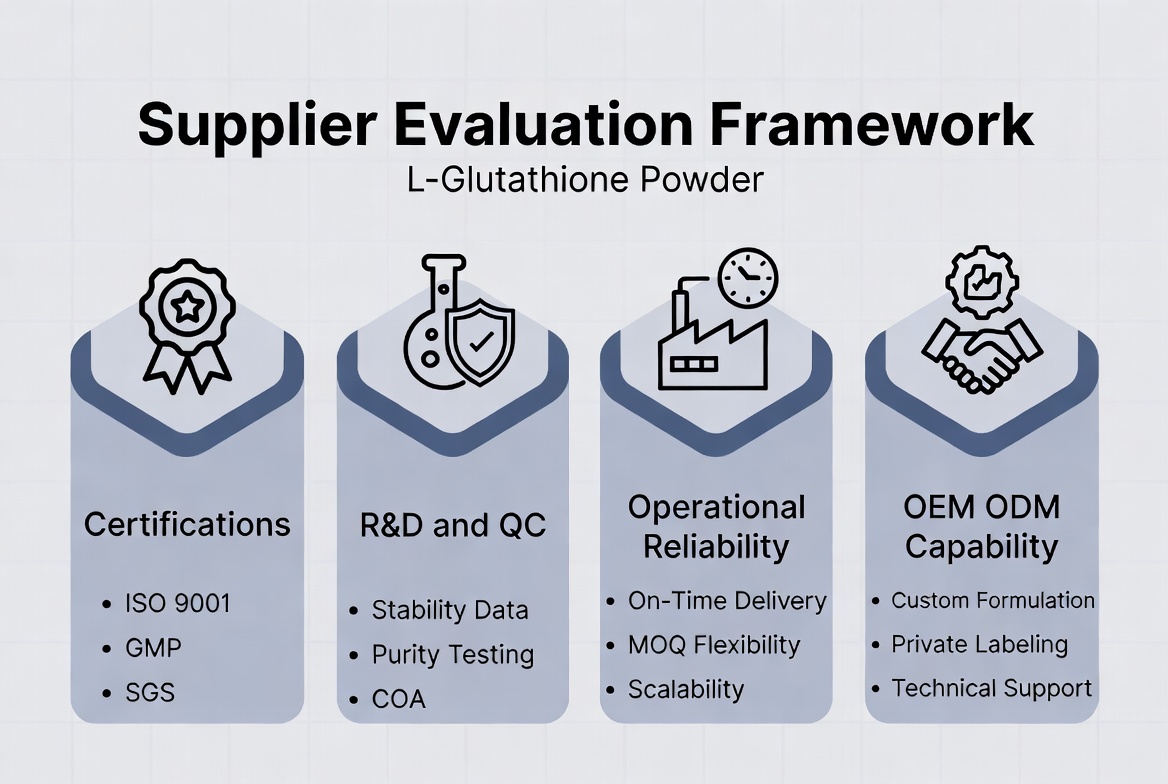
Professional buyers evaluating Chinese L glutathione powder manufacturers typically focus on four pillars: certifications, R&D and QC capabilities, operational reliability, and export compliance. Below is the framework this article uses to select and rank suppliers. [allanchem]
- Certifications and systems
- Valid ISO 9001 quality management system, plus cosmetics-specific standards like ISO 22716 or ISO 22000 where relevant. [datamintelligence]
- Halal, Kosher and sometimes FDA registration or D‑U‑N‑S numbers for global brand access. [datamintelligence]
- Verifiable certificates through accreditation bodies or IAF CertSearch, not only scanned PDFs. [iso-9001-checklist.co]
- R&D and QC capacity
- In‑house R&D for glutathione and related actives (peptides, liposomes), with pilot facilities and application labs. [industrysourcing]
- Documented QC procedures, batch COAs with key parameters (assay ≥ 98%, residual solvents, heavy metals, microbiology), and stability data for cosmetics and nutraceutical formats. [sgsystemsglobal]
- Operational and OEM strength
- GMP‑like production environment, clear capacity (e.g., tons/year of glutathione) and flexible MOQs for brand owners at different scales. [made-in-china]
- Lead times generally within 10–20 working days for export orders, with proven shipping workflows for Asia, Europe, and the Americas. [made-in-china]
- Export compliance and documentation
- Familiarity with HS 2930 organo‑sulphur classification and target‑market import requirements for glutathione. [customsmobile]
- Complete regulatory dossiers: SDS, TDS, IFRA (where applicable), and region‑specific statements (allergens, GMOs, residual solvents). [allanchem]
China sits at the center of the global glutathione supply chain due to its integrated amino acid and fermentation clusters and mature cosmetic‑ingredient industry. Many Chinese manufacturers combine traditional plant‑based actives with modern fermentation and bioprocessing, which fits well with the demand for high-purity, "cleaner" antioxidant ingredients in cosmetics and nutraceuticals. [chemicalbook]
Glutathione is typically classified under organo‑sulphur compounds in HS Chapter 29, and Chinese producers export heavily into North America, the EU, and Southeast Asia, leveraging zero or low tariffs in many markets. Recent market analyses indicate that the global glutathione market is growing at around 6–8% CAGR through 2033, with Asia‑Pacific (driven largely by China) holding the largest regional share. [fortunebusinessinsights]

This top‑10 list does not simply mirror directory rankings; it focuses on the needs of professional cosmetics and nutraceutical buyers. The following criteria were used: [alibaba]
- Product and specification scope
- Focus on reduced L glutathione (GSH) and cosmetic‑grade glutathione powder, with clear specifications and COA examples. [cneasychem]
- Availability of derivative formats (liposomal, encapsulated, or co‑active blends) for advanced formulations. [naturalfieldinc]
- Evidence of export and OEM capability
- Active export to multiple regions and visible participation in international trade platforms or exhibitions (e.g., PCHi, CPhI). [industrysourcing]
- OEM/ODM services for finished cosmetic products, not just raw materials. [datamintelligence]
- Compliance and certification transparency
- At least one recognized management system certification (ISO 9001, ISO 22000, or similar), plus cosmetic or food safety schemes where applicable. [linfordco]
- Membership in local industry associations (such as plant extract associations), which indicates alignment with regional best practices. [industrysourcing]
- Reputation signals
- Years in operation, breadth of customer base, and presence in more than one sales region. [chemicalbook]
- Evidence of stable lead times and service support for mid‑size brands and distributors. [alibaba]
Below is a curated list of prominent Chinese suppliers of L glutathione powder and related cosmetic ingredients, with emphasis on export‑ready, OEM‑friendly manufacturers. The descriptions are oriented toward professional buyers rather than end users. [cneasychem]
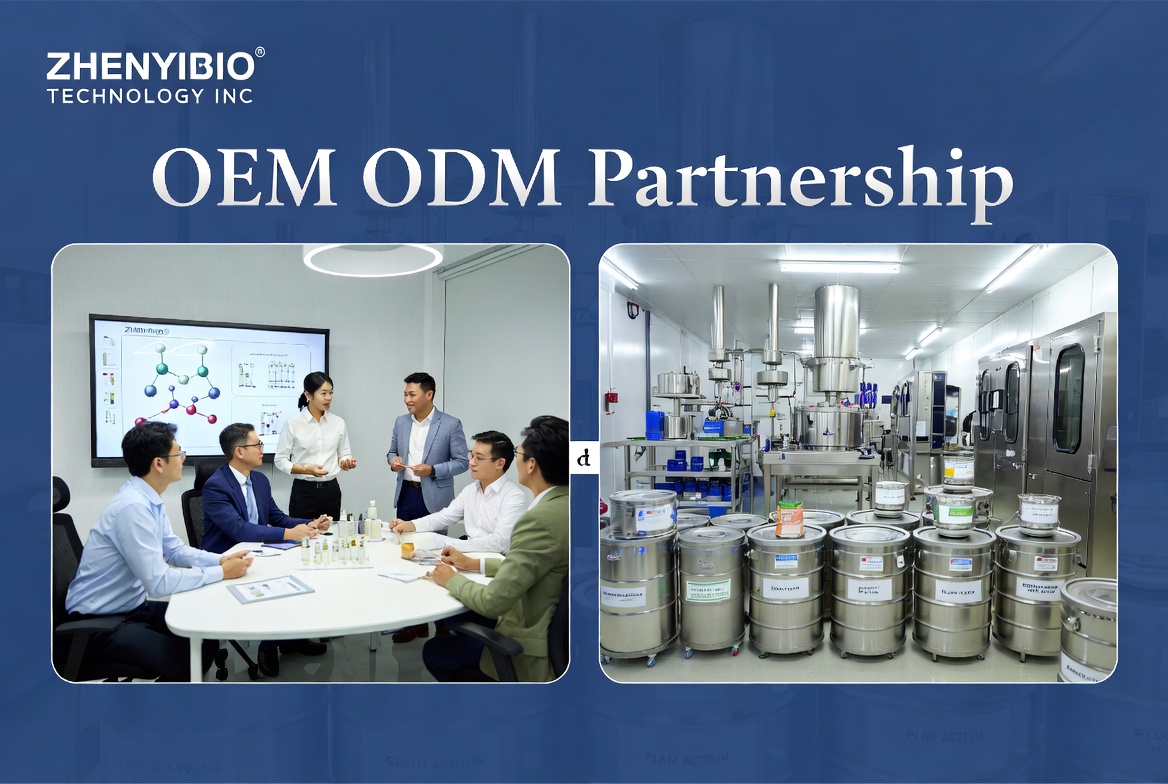
ZHENYIBIO TECHNOLOGY INC is a high‑tech enterprise specializing in natural plant active cosmetic raw materials, including glutathione, hyaluronic acid, polyglutamic acid, asiaticoside, peptides, and liposomes. Founded in 2008 in the Xi'an High‑tech Free Trade Area, it combines plant extract expertise with modern fermentation and bioprocessing to serve cosmetic brands worldwide. [datamintelligence]
Key strengths for L glutathione buyers include an in‑house R&D team, a dedicated planting base, and a GMP‑standard factory spanning raw materials to finished cosmetic products, which enables deep OEM/ODM collaboration for both small and mid‑size brands. The company holds ISO 9001 quality certification (updated to ISO 9001:2016), ISO 22000, FDA registration with a D‑U‑N‑S number, plus Halal and Kosher certifications, supporting access to regulated markets and multi‑regional export projects. [linfordco]
ZHENYIBIO's global footprint covers more than 50 countries across Asia, Europe, and the Americas, and it maintains long‑term relationships with distributors, end brands, and research institutions. For procurement managers, this combination of strong documentation, flexible MOQs, and efficient communication makes it particularly attractive for high‑value, R&D‑driven glutathione projects where custom formulations, liposomal forms, or plant‑based co‑actives are required. [naturalfieldinc]
Anhui GSH Bio‑Technology is a specialized producer of reduced L glutathione and related amino‑acid derivatives, with a strong focus on high‑purity cosmetic and nutraceutical grades. Its portfolio often includes 98–99% assay glutathione with tight controls on heavy metals and residual solvents, positioning it as a mainstream choice for brightening and antioxidant formulations. [cneasychem]
The company operates as both manufacturer and trading entity, providing OEM and ODM services for glutathione powder and downstream cosmetic ingredients. Buyers value its ability to supply bulk powder with consistent lead times and the availability of documentation aligned with international pharmacopeias and cosmetic standards. [allanchem]
Suzhou Easy Chemical positions itself as a high‑purity glutathione manufacturer offering ≥ 98% L‑glutathione reduced for skincare, supplements, and pharmaceutical applications. The company highlights in‑house production with strict quality control and "0% residual impurities" in marketing materials, reflecting a focus on purity and batch‑to‑batch consistency. [sgsystemsglobal]
From a buyer's perspective, Suzhou Easy Chemical is suitable for projects requiring pharmaceutical‑leaning documentation and more stringent impurity profiles, although MOQs may be higher than small‑batch cosmetic‑only suppliers. The firm's positioning across cosmetics and pharma also means it tends to be familiar with stringent COA and stability requirements for regulated markets. [linfordco]
Several Xi'an‑area companies listed on major B2B platforms supply glutathione alongside plant extracts, hyaluronic acid, and other cosmetic actives, benefiting from the region's plant‑extract industry clusters. Typical examples include companies branding themselves as "Purelife Biotech" or similar, offering glutathione, astaxanthin, and vitamins with 10–15 working day lead times for export orders. [made-in-china]
These manufacturers often hold ISO 9001 certification and operate as both factories and trading companies, giving them flexibility to source complementary actives for OEM and ODM projects. For buyers, Xi'an's ecosystem offers the advantage of combining glutathione with a wider botanical portfolio (e.g., centella, licorice, peptides), which is useful when building complete brightening or anti‑oxidation systems. [industrysourcing]
Guangzhou and the broader Guangdong region host multiple OEM/ODM companies supplying glutathione as part of capsules, tablets, and functional oral beauty products. Firms like Guangzhou‑based biotechnology factories typically offer integrated services from raw material procurement through finished dosage forms (softgels, sachets, oral liquids), with standard lead times around 15 working days for stock formulas. [alibaba]
These companies are particularly relevant if your project combines L glutathione powder with oral supplements or beauty drinks rather than standalone raw materials, though their raw glutathione may be sourced from upstream producers. Buyers should pay special attention to ISO 22000 or HACCP certifications when using such suppliers for ingestible products destined for the EU, US, or Japan. [fortunebusinessinsights]
The Wuhan area has developed a dense cluster of chemical and peptide suppliers that include glutathione among broader amino acid and cosmetic raw material portfolios. Companies in this cluster often position themselves as intermediates and API suppliers, offering glutathione for both cosmetic and laboratory applications, typically with OEM options for custom volumes. [chemicalbook]
Because some Wuhan‑based firms are primarily trading entities, procurement managers should differentiate between those with their own production facilities and those sourcing from third‑party factories. For high‑risk materials or regulated markets, buyers should prioritize suppliers that can provide factory audit reports or third‑party inspection records rather than relying solely on trade licenses. [allanchem]
Xi'an Natural Field is recognized as a leading producer of plant extracts and liposomal ingredients, including liposomal glutathione powders used in advanced supplement and cosmetic delivery systems. Its portfolio includes liposomal coenzyme Q10, curcumin, creatine, and other encapsulated actives, indicating strong process know‑how in liposome formation and stabilization. [naturalfieldinc]
This manufacturer is particularly relevant when you need enhanced bioavailability or stability, such as oral or transdermal glutathione systems that must withstand challenging storage or formulation conditions. Buyers should validate that the liposomal glutathione specifications (particle size distribution, encapsulation efficiency) match their formulation requirements and that stability data covers target markets' temperature and humidity profiles. [sgsystemsglobal]
Several multi‑category cosmetic raw material companies in China offer glutathione as part of broader portfolios that include vitamins, peptides, and plant extracts. These firms often act as "one‑stop" suppliers for formulators seeking multiple actives from a single source, and they may maintain warehouse stock in different regions for faster deliveries. [chemicalbook]
From a risk‑management standpoint, such suppliers reduce procurement complexity but can introduce traceability challenges if they switch upstream factories. Buyers should insist on clear source disclosure, updated SDS, and—where possible—specifying that glutathione must come from a named GMP‑level facility. [sgsystemsglobal]
Some Chinese pharmaceutical groups and API manufacturers offer glutathione in grades aligned with pharmacopoeial standards, alongside injectables or sterile dosage forms. These producers emphasize strict QC, validation, and documentation, making them suitable for high‑regulation applications or where glutathione may be used in quasi‑drug or medical device contexts. [made-in-china]
However, MOQs, prices, and lead times may be higher than purely cosmetic‑oriented suppliers, and they may be less flexible for small custom OEM projects. For cosmetic buyers, these suppliers are more relevant when licensing or cross‑border regulatory strategies require pharmacopeia‑grade ingredients to support claims or registrations. [fortunebusinessinsights]
Shanghai—particularly Fengxian District—has emerged as a major beauty and personal care manufacturing hub, attracting both domestic and foreign brands and raw material suppliers. Many companies here integrate glutathione into wider skincare systems, leveraging local infrastructure, logistics, and a dense network of contract manufacturers and R&D centers. [youtube]
While not all Shanghai‑cluster companies are primary glutathione producers, they are critical partners when you need end‑to‑end product development, from concept and formulation to packaging and export. Buyers working with Shanghai clusters should focus on factory visits or virtual tours and third‑party QC audits to ensure that rapid innovation cycles do not compromise batch consistency. [siteselection]
The table below summarizes practical differences between several major supplier archetypes mentioned above, including ZHENYIBIO TECHNOLOGY INC as a representative R&D‑driven OEM partner. [datamintelligence]
| Supplier type / example | Typical capacity & scope | MOQ & flexibility | Key certifications focus | OEM/ODM strengths |
|---|---|---|---|---|
| R&D‑driven cosmetic raw material factory (e.g., ZHENYIBIO, Xi’an) | Glutathione plus plant actives, peptides, liposomes for cosmetics. (datamintelligence) | Often supports small to mid MOQs for brands and distributors. (datamintelligence) | ISO 9001, ISO 22000, Halal, Kosher, FDA registration. (datamintelligence) | Deep formula co‑development; strong tech support and flexible customization. (datamintelligence) |
| Dedicated glutathione manufacturer (e.g., Anhui GSH, Suzhou Easy Chemical) | High‑purity L glutathione and derivatives for cosmetics and nutraceuticals. (made-in-china) | Medium MOQs; optimized for consistent bulk supply. (cneasychem) | Quality management and stringent impurity control, sometimes pharma‑leaning. (cneasychem) | Stable long‑term supply; less focus on full cosmetic product OEM. (cneasychem) |
| Nutraceutical & capsule OEM (e.g., Guangzhou OEMs) | Capsules, tablets, oral liquids with glutathione and co‑actives. (made-in-china) | Formulation‑based MOQs; finished product focused. (made-in-china) | Food safety schemes (ISO 22000, HACCP) and export documentation for ingestibles. (linfordco) | Full ODM for finished oral beauty products, private label services. (alibaba) |
| Liposomal specialty producer (e.g., Xi’an Natural Field) | Liposomal glutathione and multiple encapsulated bioactives. (naturalfieldinc) | Project‑specific; may require higher technical MOQs. (naturalfieldinc) | Process controls for liposome size, stability, and encapsulation. (naturalfieldinc) | Advanced delivery systems and innovation‑driven joint development. (naturalfieldinc) |
Sourcing L glutathione powder from China offers significant cost and innovation advantages but also exposes buyers to recurring pitfalls. Understanding these in advance is critical for long‑term supply stability. [alibaba]
- Assay and impurity discrepancies
- Some lower‑tier suppliers may advertise ≥ 99% purity while actual assay or impurity profiles fall short, especially for heavy metals and residual solvents. [allanchem]
- Mitigation: independently test the first 3–5 lots from any new supplier and compare results to COAs before approving COA‑based release. [sgsystemsglobal]
- Unstable color and odor in cosmetic formulations
- Poorly controlled glutathione can oxidize quickly, leading to color shifts and off‑odors in emulsions or serums. [sgsystemsglobal]
- Mitigation: request stability data in relevant formulations and storage conditions; prioritize suppliers with documented antioxidant system design experience. [allanchem]
- Documentation gaps and expired certifications
- Some factories show outdated ISO certificates or lack clear scope definitions, which can cause compliance issues in target markets. [iso-9001-checklist.co]
- Mitigation: always check certificate dates, scope, and accreditation bodies; verify via official accreditation or IAF databases when possible. [iso-9001-checklist.co]
- Hidden outsourcing
- A trading company may present itself as a manufacturer while reselling from multiple factories, complicating traceability and consistency. [alibaba]
- Mitigation: insist on knowing the actual manufacturing site, cross‑check business licenses via China's National Enterprise Credit Information System, and request factory images or third‑party audit reports. [alibaba]
One widely known but rarely written‑about insider issue in chemical and cosmetic sourcing is over‑reliance on supplier COAs without a structured verification program. In practice, some buyers approve suppliers solely on paper, only to discover variability or out‑of‑spec issues months later when product complaints arise. [allanchem]
A robust approach is to treat COAs as claims to be validated: test the first three consecutive lots, compare your lab results with the supplier's COA within defined tolerances, and only then mark the supplier‑material combination as approved for COA‑based release. After approval, maintain periodic re‑verification (e.g., 1 in 5 or 1 in 10 lots) and back this up with scheduled audits—especially for high‑risk markets or applications. [sgsystemsglobal]
For procurement managers, the goal is to reduce risk while securing competitive pricing and innovation support. The following checklist can be applied to any L glutathione powder manufacturer in China: [datamintelligence]
- Pre‑screening and document review
- Request ISO 9001, ISO 22000, and any cosmetic‑related certificates plus membership or endorsement from relevant industry associations. [linfordco]
- Verify certificates via accreditation bodies or tools like IAF CertSearch and ensure issue and expiry dates align with your contract period. [iso-9001-checklist.co]
- COAs, SDS, and QC data
- Ask for recent COAs (from multiple batches) and SDS with full parameter lists, methods, and specification limits. [allanchem]
- Check whether testing is done by accredited labs and whether batch identifiers, manufacture dates, and methods (USP, Ph.Eur., in‑house) are clearly indicated. [linfordco]
- Sampling and pilot production
- Run in‑house or third‑party testing on at least three lots before including the supplier in your Approved Vendor List (AVL). [sgsystemsglobal]
- For cosmetics, conduct pilot batch production to assess color, odor, stability, and compatibility with other actives and packaging. [allanchem]
- Factory verification and performance monitoring
- Where feasible, conduct on‑site audits or virtual tours focusing on raw material handling, GMP‑like practices, and packaging workflows. [alibaba]
- Track OTIF (on‑time, in‑full), complaint rates, and corrective actions over at least 6–12 months before consolidating volume. [alibaba]
- Logistics and incoterms
- Define HS codes, incoterms (FOB, CIF, DAP), and responsibilities for customs documentation upfront to avoid clearance delays. [trademo]
- Confirm that the supplier has experience shipping to your specific market and can provide references or shipment records. [made-in-china]
China's L glutathione powder industry is mature and export‑oriented, offering a spectrum of suppliers from bulk commodity manufacturers to highly specialized, R&D‑driven cosmetic raw material partners. For brands and distributors, working with a partner such as ZHENYIBIO TECHNOLOGY INC provides a balance of cost‑effectiveness, scientific support, and flexible OEM/ODM collaboration, particularly for plant‑based and liposomal brightening systems. [naturalfieldinc]
If you are currently shortlisting suppliers, consider starting with a structured pilot program with two to three manufacturers, validate their COAs through independent testing, and then shift volume toward the partner that demonstrates the best combination of quality, responsiveness, and long‑term reliability. [sgsystemsglobal]
1. How can I verify that a Chinese supplier's ISO 9001 certificate is valid and up to date?
Ask for the certificate of registration, then cross‑check the certification body and accreditation body via their official websites or IAF CertSearch. Verify the standard version, scope, and expiry date, and confirm that the certificate number and company name match the public records. [iso-9001-checklist.co]
2. What documentation should I require before approving a glutathione supplier?
At minimum, request ISO certificates, SDS, recent COAs from multiple batches, detailed specifications, and, for ingestible products, relevant food safety certifications such as ISO 22000 or HACCP. For cosmetic applications, ask for stability data, allergen statements, and region‑specific compliance declarations. [fortunebusinessinsights]
3. How do I ensure that the glutathione grade is suitable for cosmetics rather than industrial use?
Confirm that the COA includes cosmetic‑relevant parameters (microbial limits, heavy metals, residual solvents) and that the supplier specifically markets the product for cosmetic or personal care use. Verify that they follow cosmetic GMP principles and can provide ISO 22716 or equivalent documentation where required. [cneasychem]
4. What is the best way to manage supplier changes without disrupting my formulations?
Implement a change‑control process: require advance notice for any raw material, process, or site change, and re‑test initial batches from the new configuration. Keep a dual‑supplier strategy where at least two approved sources can meet your core specifications, especially for critical actives like glutathione. [fortunebusinessinsights]
5. How can I balance cost savings with quality when choosing a Chinese glutathione supplier?
Benchmark offers from multiple suppliers but normalize for assay, impurity profile, documentation depth, and service responsiveness, not just price per kilogram. Consider total cost of ownership—including QC rework, potential recalls, and brand risk—and prioritize suppliers with strong track records and verifiable certifications, even if their unit price is slightly higher. [made-in-china]