


Views: 212 Author: ZHENYIBIO Publish Time: 2026-08-01 Origin: Site
Content Menu
● Why Resorcinol Derivatives Dominate Brightening Formulas
● Head-to-Head: Potency, Solubility, and Formulation Behavior
● The Real Bottleneck: Solubility in Oil-in-Water Systems
● An Industry Case: Liposomal Delivery as a Solubility Solution
● Biofermentation: A Sustainable Path Forward for Brightening Actives
● Choosing the Right Active for Your Formulation Goals
● Building Brightening Formulas With Confidence
Choosing between 4-Butylresorcinol and 4-Hexylresorcinol comes down to one core trade-off: potency versus formulation ease, and both hinge on how well a chemist manages solubility in an oil-in-water system. As a raw material manufacturer working daily with global brand partners, we see this exact decision point on nearly every brightening serum brief that crosses our lab.

Resorcinol derivatives inhibit tyrosinase, the enzyme that converts L-tyrosine into melanin precursors, making them a preferred alternative to hydroquinone in modern brightening serums. Both 4-Butylresorcinol and 4-Hexylresorcinol belong to this family, but their alkyl chain length changes everything from potency to how they behave inside a water-based emulsion.
4-Butylresorcinol carries a shorter n-butyl chain, giving it an IC50 of roughly 13.5 to 21 μmol/L against human tyrosinase, among the lowest recorded for cosmetic actives. 4-Hexylresorcinol, with its longer hexyl chain, shows a considerably higher IC50 of around 94 μmol/L, meaning it requires a higher concentration to achieve comparable enzyme inhibition.
The two actives diverge sharply once you move from the beaker to a finished emulsion. A side-by-side comparison makes the practical differences clear for R&D teams evaluating either ingredient for a new launch.
| Attribute | 4-Butylresorcinol | 4-Hexylresorcinol |
|---|---|---|
| Tyrosinase IC50 | ~13.5–21 μmol/L (highly potent) | ~94 μmol/L (moderate potency) |
| Alkyl chain length | n-Butyl (shorter) | n-Hexyl (longer) |
| Lipophilicity (LogP) | ~2.4–2.8 | Higher, due to longer chain |
| Water solubility | Slightly soluble; needs glycol/ethanol carrier | Lower aqueous solubility, stronger oil-phase affinity |
| Typical use level | 0.1–0.3% (up to 1.0% for spot treatments) | Often 0.1–0.5%, adjusted for oil-phase loading |
| Clinical onset | Visible melanin index reduction by week 4, significant by week 8 | Slower onset reported versus 4-Butylresorcinol in comparative studies |
| Best-suited delivery | Glycol pre-dissolution, liposomes, nanoemulsion | Oil-phase incorporation, lipid carriers |
A clinical comparison published in the Journal of the European Academy of Dermatology and Venereology found that 4-Butylresorcinol outperformed 4-Hexylresorcinol in reducing the visible appearance of age spots at comparable use levels, with faster onset and stronger pigment reduction. This potency gap is the primary reason formulators lean toward 4-Butylresorcinol when speed of visible results is a marketing priority.

Both actives are phenolic compounds with limited aqueous solubility, which creates a genuine engineering challenge for oil-in-water serums where the continuous phase is water. If either ingredient is added directly into the water phase without proper carrier chemistry, it can crystallize out, cause turbidity, or unevenly distribute across the emulsion, undermining both stability and efficacy.
Practical steps our formulation team recommends for stable incorporation:
1. Pre-dissolve the active in propylene glycol, butylene glycol, or ethanol before adding it to either phase.
2. Select the correct phase — 4-Butylresorcinol tolerates glycol-carrier addition into the water phase more readily, while 4-Hexylresorcinol's higher lipophilicity often favors incorporation via the oil phase or an emulsifier-rich pre-mix.
3. Add during cool-down to minimize thermal degradation and oxidation of the phenolic ring structure.
4. Build in antioxidant protection using tocopherol and a metal-ion chelator such as EDTA, since both actives are prone to discoloration from oxidation.
5. Consider encapsulation — liposomal or nanoemulsion delivery systems have demonstrated encapsulation efficiencies above 80%, alongside strong 24-hour stability across varied storage temperatures.
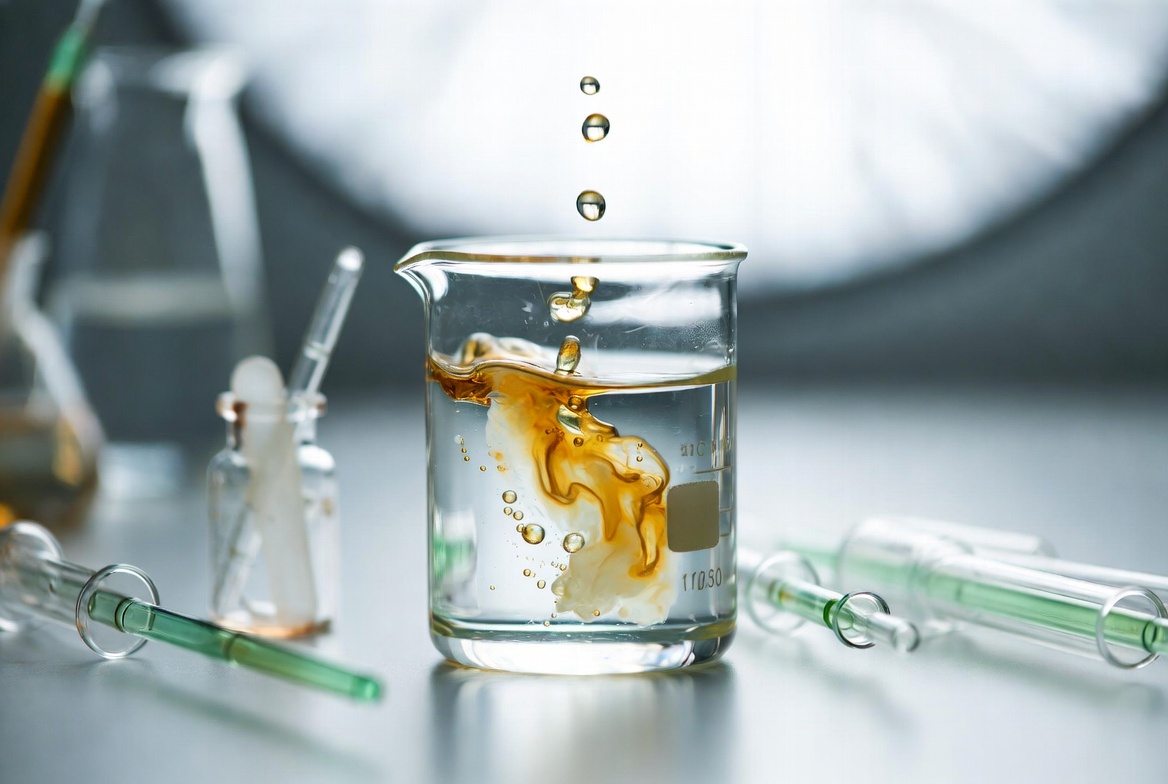
One of the more compelling industry solutions to this exact challenge is liposomal encapsulation. A patented preparation method combines caprylic/capric triglyceride, hydrogenated lecithin, and cholesterol with 4-Butylresorcinol to form a liposome that measurably improves solubility, skin permeability, and oxidation resistance compared to the free active. This kind of encapsulation technology directly resolves the water-solubility bottleneck that would otherwise limit an oil-in-water serum's shelf stability and sensory feel.
A landmark split-face clinical trial using a liposome-encapsulated 0.1% 4-Butylresorcinol cream reported statistically significant melanin index reduction at week 4 (p = 0.006), strengthening further by week 8 (p < 0.0005), with only mild, transient irritation reported. This gives formulators real clinical grounding for encapsulation-based solubility strategies, rather than relying on trial-and-error emulsification.
Green chemistry and biofermentation are reshaping how brightening actives reach the market, moving away from purely synthetic routes toward renewable, bio-based production platforms. Fermentation-derived active ingredients reduce manufacturing waste and environmental footprint while maintaining, and sometimes improving, batch-to-batch consistency compared with conventional synthesis.
For a manufacturer building tyrosinase-inhibitor portfolios, this shift matters. Combining traditional plant-derived brightening compounds with fermentation-optimized delivery systems, such as liposomes or nanoemulsions, allows a resorcinol derivative to perform at a lower use concentration while meeting sustainability expectations increasingly demanded by international brand partners.
Choose 4-Butylresorcinol when:
- Fast, visible melanin reduction is the priority within an 8-week claim window
- The brief calls for the lowest effective use concentration (0.1–0.3%)
- Regulatory positioning favors a hydroquinone-free, clinically documented active
Choose 4-Hexylresorcinol when:
- The formulation already leans oil-rich and benefits from a more lipophilic active
- A gentler, moderate-potency profile better suits sensitive-skin product lines
- Budget or regional sourcing constraints make it the more practical fit
Neither active should be treated as a simple drop-in ingredient. Both require dedicated pre-dissolution strategy, antioxidant protection, and phase-selection expertise to perform reliably inside an oil-in-water serum base.
Solubility challenges should never be the reason a promising brightening active gets shelved during development. With the right carrier system, encapsulation technology, and fermentation-supported sourcing, both 4-Butylresorcinol and 4-Hexylresorcinol can deliver stable, high-performing oil-in-water serums that meet global regulatory and consumer expectations.
Ready to move from concept to finished formula? Reach out to our technical team for a customized OEM or ODM prototype using naturally derived, biofermentation-enhanced brightening actives, supported by full documentation for your regulatory submissions.
Q1: Is 4-Butylresorcinol more effective than 4-Hexylresorcinol for hyperpigmentation?
Clinical comparisons show 4-Butylresorcinol achieves faster onset and stronger pigment reduction than 4-Hexylresorcinol at comparable use levels, largely due to its significantly lower tyrosinase IC50.
Q2: Why is solubility such a challenge in oil-in-water brightening serums?
Both actives are phenolic compounds with limited water solubility, so adding them directly to the aqueous phase without a glycol or ethanol carrier can cause crystallization, instability, or uneven distribution.
Q3: What is the recommended use concentration for 4-Butylresorcinol in serums?
Most all-face brightening serums use 0.1% to 0.3% 4-Butylresorcinol, with targeted spot treatments going up to 1.0% under appropriate safety review.
Q4: Can these actives be combined with other brightening ingredients?
Yes, both are commonly paired with niacinamide, vitamin C derivatives, azelaic acid, and botanical extracts to build multi-pathway brightening systems.
Q5: Are these resorcinol derivatives considered safer than hydroquinone?
Yes, they avoid the ochronosis risk and regulatory restrictions associated with long-term, high-dose hydroquinone use, while maintaining strong tyrosinase inhibition.
Q6: What formulation technology best resolves the solubility issue?
Liposomal encapsulation and nanoemulsion delivery systems have been shown to substantially improve solubility, skin permeability, and oxidative stability for these actives.
1. Flychem. "4-Butylresorcinol for Skin Brightening: Formulation Guide." https://flychem.com/blogs/articles/4-butylresorcinol-for-hyperpigmentation-complete-cosmetic-formulation-guide-nbsp-1
2. Kolbe, L., et al. "4-n-butylresorcinol, a highly effective tyrosinase inhibitor for the topical treatment of hyperpigmentation." Journal of the European Academy of Dermatology and Venereology, 2013. https://pubmed.ncbi.nlm.nih.gov/23205541/
3. Cosmetics Info. "4-Butylresorcinol: INCI Ingredient." https://cosmeticsinfo.org
4. "Plant-based ingredients transform from beauty trend to biotechnology-driven innovation." 2025. https://www.cosmeticsandtoiletries.com
5. "A kind of 4-butylresorcinol liposome and its preparation method and application." Patent filing, 2024. https://patents.google.com
6. "Bridging Science and Scale: Advanced OEM/ODM Cosmetic Manufacturing." 2024. https://www.cosmeticsbusiness.com


