Views: 211 Author: ZHENYIBIO Publish Time: 2026-07-28 Origin: Site
Content Menu
● Why This Comparison Matters in 50+ Skin
>> Key strengths of Calcium AKG
>> Key strengths of Phytosterols
● Which One Wins for Each Need
● New Formulation Insight for Brands
● How To Build A Better 50+ Formula
● FAQ
>> 1. Is Calcium AKG better for aging skin than phytosterols?
>> 2. Can phytosterols help dry mature skin?
>> 3. Can Calcium AKG be used in topical skincare?
>> 4. Which ingredient is better for sensitive skin?
>> 5. Can both ingredients be used in the same formula?
>> 6. What product type suits each ingredient best?
In mature skin, Calcium AKG and phytosterols solve different age-related problems, so the better choice depends on whether the priority is barrier loss or cellular energy decline. For brands serving 50+ consumers, the strongest formulas often combine both paths rather than treating them as rivals.
Skin aging in the 50+ group is not driven by one issue alone. Research shows that mitochondrial dysfunction contributes to aging skin physiology, while lipid depletion weakens the stratum corneum barrier and increases dryness and transepidermal water loss. That means a consumer may feel "dry," but the underlying cause can be a mix of impaired barrier lipids and reduced cellular resilience.
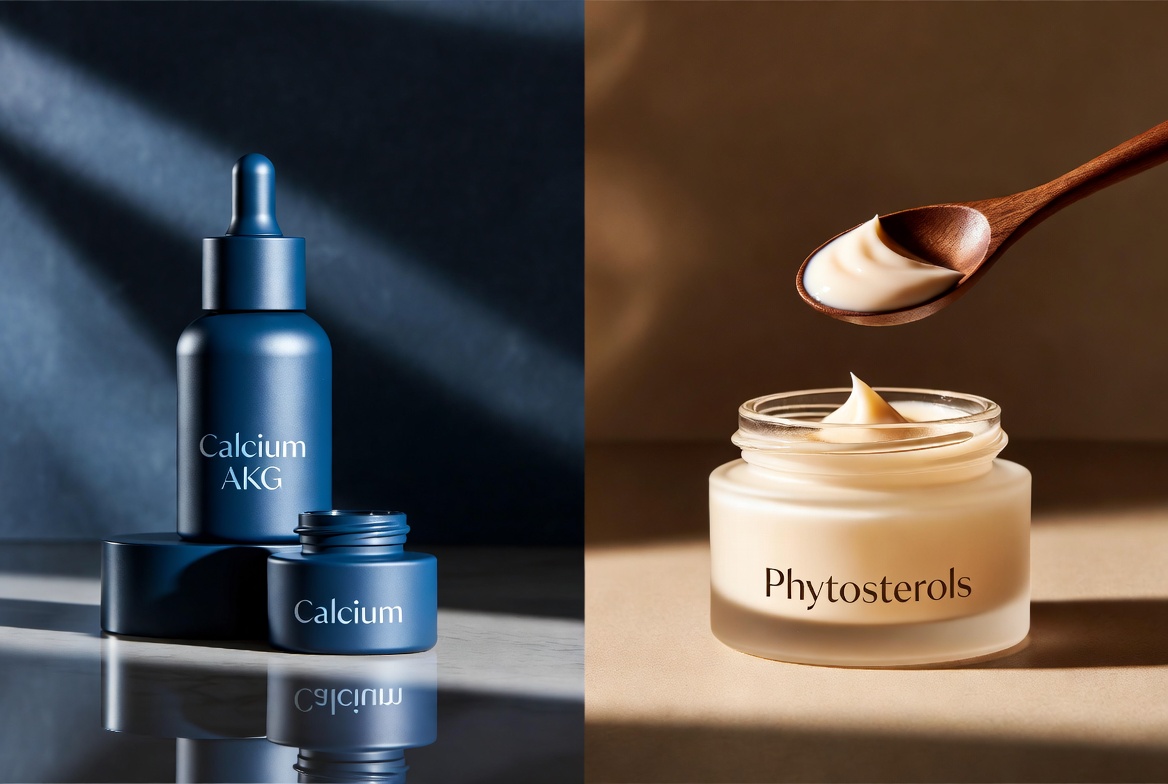
For product developers, this creates a clear segmentation opportunity. Phytosterols are positioned for barrier repair and moisture support, while Calcium AKG is positioned for energy metabolism, skin hydration, and age-supportive performance claims in topical and broader wellness formats.

Calcium AKG is the calcium salt of alpha-ketoglutarate, a key intermediate in cellular energy metabolism. In skin-focused research, Alpha-KG has shown beneficial effects on hydration and barrier function, with fermentation described as an effective way to enhance performance in formulation contexts. Broader longevity literature also links AKG to pathways related to metabolism and healthspan, which is why it is gaining attention in anti-aging discussions.
From an ingredient strategy perspective, Calcium AKG is best understood as an energy-support ingredient. It is relevant when the story centers on tired-looking skin, reduced recovery capacity, and the biological wear associated with aging rather than only surface dryness. In practice, this makes it attractive for serums, essences, and supplement-adjacent beauty formats where a science-forward narrative matters.
- Supports cellular energy pathways linked to mitochondrial function.
- Has published evidence suggesting benefits for skin hydration and barrier function.
- Fits a premium, science-led positioning for mature-skin innovation.
Phytosterols are plant-derived sterol compounds structurally similar to cholesterol, which helps explain their compatibility with skin barrier biology. They are especially relevant when the skin feels rough, tight, reactive, or visibly dehydrated, because they help reinforce the lipid barrier and reduce moisture loss. Literature and ingredient reviews describe them as useful for improving hydration, calming inflammation, and supporting repair after irritation.
For 50+ skin, phytosterols are highly practical because epidermal lipid decline is common with age and environmental stress. They are particularly strong in creams, lotions, balms, and recovery formulas where the user expects immediate comfort and a softer skin feel. If Calcium AKG speaks to the skin's "engine," phytosterols speak to the skin's shield.
- Help reinforce the moisture barrier and support lipid replenishment.
- Can reduce dryness-related discomfort and improve skin comfort.
- Are well suited to sensitive, dry, and mature skin formulas.
| Criterion | Calcium AKG | Phytosterols |
|---|---|---|
| Main target | Cellular energy decline and resilience | Epidermal lipid depletion and barrier weakness |
| Best user need | Dull, tired-looking, aging skin | Dry, tight, or compromised skin barrier |
| Core benefit story | Mitochondrial support, hydration support, vitality | Lipid restoration, barrier repair, moisture retention |
| Best format | Serum, essence, premium active blend | Cream, lotion, balm, barrier repair formula |
| Sensory expectation | More "treatment" oriented | More "comfort" oriented |
If the goal is to address epidermal lipid depletion, phytosterols are the more direct answer because they mimic and replenish barrier lipids. They are the better fit for dry, sensitive, or compromised mature skin where comfort and moisture retention are immediate priorities.
If the goal is to address mitochondrial decline, Calcium AKG is the more relevant choice because its value proposition centers on energy metabolism and skin vitality. It may be especially useful in modern anti-aging formulas that try to go beyond surface hydration and target the cellular "feel" of aging skin.
A strong 50+ formula does not need to choose only one biological pathway. In real-world product architecture, the best performance often comes from pairing a barrier-first ingredient with an energy-support ingredient. That is why a mature-skin regimen might use phytosterols in a rich cream and Calcium AKG in a lightweight serum or morning essence.
For international brands, wholesalers, and manufacturers, this dual-track strategy also improves messaging. One line can emphasize "restore the barrier," while another can emphasize "support cellular vitality," allowing cleaner product segmentation and easier consumer understanding. This is especially valuable in OEM and ODM development where differentiation often comes from how ingredients are combined and explained.
1. Start with the primary skin complaint.
- If it is dryness, flaking, or tightness, prioritize phytosterols.
- If it is dullness, fatigue, or age-related vitality loss, prioritize Calcium AKG.
2. Match the ingredient to the texture.
- Use phytosterols in creams, balms, and leave-on repair products.
- Use Calcium AKG in lighter leave-on formats or treatment layers.
3. Support the claim with a broader system.
- Pair phytosterols with ceramides, humectants, or soothing agents for barrier recovery.
- Pair Calcium AKG with fermentation-based actives or energy-support ingredients for a more advanced anti-aging story.
4. Keep the language consumer-friendly.
- Say "supports moisture barrier" instead of overcomplicating the benefit.
- Say "supports skin vitality" instead of leading with technical metabolism language.
As a manufacturer working with plant-derived actives and biotech-enhanced solutions, ZHENYIBIO is well positioned to translate these two pathways into export-ready products. The market increasingly rewards formulas that are not only natural, but also scientifically framed and sensorially elegant. That is exactly where a barrier-plus-energy concept becomes commercially strong.
For brands targeting mature consumers, the winning question is not "which ingredient is better?" but "which biological gap does this SKU need to solve?" Phytosterols solve the barrier problem; Calcium AKG solves the vitality problem.
Not universally. Calcium AKG is more relevant for energy and vitality support, while phytosterols are more direct for barrier repair and lipid replenishment.
Yes. Phytosterols are commonly used to reinforce the skin barrier and improve moisture retention in dry or sensitive skin.
Yes. Published skin research indicates benefits for hydration and barrier function, and it is being explored in topical formats.
Phytosterols are often the better first choice because they are closely tied to barrier support and comfort.
Yes. They can complement each other by addressing different aspects of aging skin: barrier loss and cellular energy decline.
Phytosterols suit creams, lotions, and balms, while Calcium AKG suits serums and premium treatment products.
- [Calcium AKG skin hydration and barrier function study]
- [The study of skin hydration, anti-wrinkles function ...]
- [Mitochondria in skin health, aging, and disease]
- [Mitochondria's Role in Skin Ageing]
- [The outer frontier: the importance of lipid metabolism in the skin]
- [Topical application of lipids to correct abnormalities in the stratum corneum]
- [Explaining the Science of Phytosterols in Skin Care]
- [The Power of Sterols for Skin Barrier Repair]
- [Calcium Alpha-Ketoglutarate: Benefits & Longevity]
- [Why Alpha-Ketoglutarate Is Gaining Ground in Longevity ...]