


Views: 263 Author: ZHENYIBIO Publish Time: 2026-09-27 Origin: Site
Content Menu
● Ectoin vs. Sodium Phytate at a Glance
>> Ectoin: A Barrier-Focused Active
>> Sodium Phytate: A Metal-Binding Support Ingredient
● What the Evidence Can Support
>> Can They Work Better Together?
● A Practical Development Plan
>> Define the Claim Before Selecting Tests
>> Build a Four-Prototype Test Matrix
>> Check Raw Materials and Claim Language
● Which Ingredient Fits Your Brand?
● Develop a Claim You Can Defend
>> Is Ectoin Better Than Sodium Phytate for PM2.5-Exposed Skin?
>> Does Sodium Phytate Remove Heavy Metals from Skin?
>> Can Ectoin and Sodium Phytate Be Used in the Same Serum?
>> What Concentration of Sodium Phytate Should a Formulator Start With?
>> Do Ectoin Studies Prove Protection Against City Air Pollution?
>> Is Sodium Phytate a Preservative?
>> What Should a Brand Ask an OEM or ODM Partner to Prove?
Ectoin vs. sodium phytate is not a contest between two interchangeable anti-pollution ingredients. Ectoin is best understood as a skin-barrier-supporting active. Sodium phytate is primarily a metal-binding formulation ingredient. For skincare brands developing products for pollution-exposed consumers, the most credible approach may be to use both—while testing what the finished formula actually does.

PM2.5 refers to airborne particles with diameters of 2.5 micrometers or less. Their small size matters, but size is only part of the story. Fine particles can carry a changing mixture of metals, organic compounds, and other substances. What reaches the skin in one city or season may differ from what reaches it in another.
Research links particulate exposure to oxidative stress, inflammation, and impaired skin-barrier function. In experimental skin models, PM2.5 has reduced the expression of filaggrin, a protein important to the epidermal barrier, and increased transepidermal water loss. Reviews also describe associations between particulate exposure and visible signs such as uneven pigmentation and skin aging. These findings explain the interest in anti-pollution skincare, but they do not prove that any one cosmetic ingredient prevents all pollution-related damage.
Heavy metals require equally careful language. Some particles contain redox-active metals, including iron and copper, that can contribute to oxidative reactions. Others carry pollutants that act through different pathways. Binding a dissolved metal ion is not the same as removing a whole airborne particle, and supporting a stressed barrier is not the same as preventing exposure.
For a brand team, that distinction shapes the brief. Does the product need to maintain comfortable, hydrated skin? Reduce metal-driven instability in a botanical formula? Show less particle adhesion after application? Each is a different objective and calls for a different test.
| Decision point | Ectoin | Sodium phytate |
|---|---|---|
| Primary role | Supports hydration and barrier-focused skincare | Chelates available metal ions, chiefly to protect formula stability |
| How it works | Helps stabilize biological structures through its interaction with water | Binds metal ions that might otherwise contribute to unwanted reactions |
| Most relevant pollution concern | Skin stress and barrier disruption associated with environmental exposure | Metal-related oxidation in the product; potential skin-surface claims need separate proof |
| Strength of directly relevant evidence | Human studies support benefits in impaired-barrier formulations, but do not establish broad real-world PM2.5 protection | Established cosmetic chelating function, but limited basis for assuming a finished product removes metals from skin |
| Best use in a product brief | A prominent active in a barrier-care story | A supporting ingredient when trace metals threaten formula performance |
| Key claim to avoid without testing | “Blocks PM2.5 from entering skin” | “Detoxifies skin of heavy metals” |
This comparison is deliberately about functions and evidence, not an overall winner. The ingredients act at different points in the product-and-skin system. A formulator should decide what problem the finished product must solve before choosing either one.
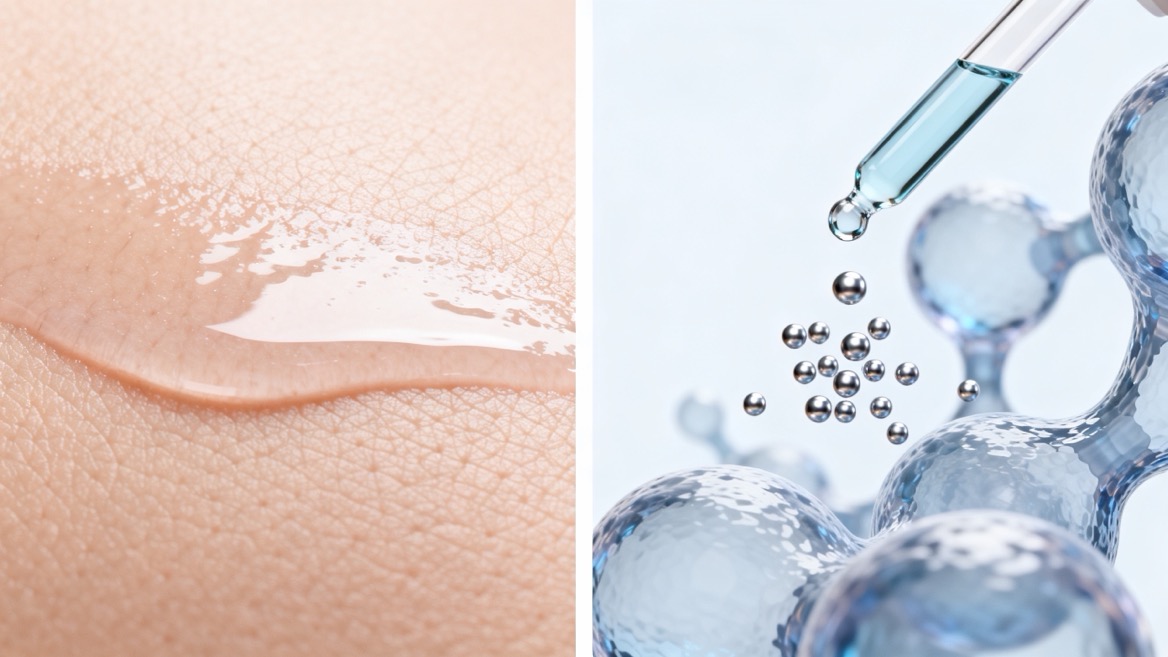
Ectoin is a compound produced naturally by microorganisms adapted to stressful environments. In topical skincare, its appeal lies in its relationship with water and its ability to support structures involved in barrier function. That makes it relevant to formulas designed for skin that feels dry, uncomfortable, or stressed by its surroundings.
The human evidence deserves a precise reading. A systematic review identified six clinical studies of ectoin-containing topical formulations for inflammatory conditions involving an impaired skin barrier. Formulations containing 5.5%–7% ectoin were associated with improvements in dryness and other assessed symptoms. The studies involved complete creams or emollients, often used alongside other care, and their certainty varied. They were not direct trials showing that ectoin prevents PM2.5 damage in everyday urban conditions.
From a product-development perspective, ectoin therefore offers a stronger foundation for claims about hydration, comfort, and barrier support than for sweeping statements about a "pollution shield." A proposed use level for a new serum should come from that ingredient's supplier guidance and finished-formula testing; results from one studied cream should not be transferred automatically to a different formula.
Sodium phytate is a salt of phytic acid. Cosmetic ingredient references identify its function as chelating: it binds metal ions that could affect a product's stability or appearance. This is particularly useful when a formula contains materials vulnerable to discoloration or other unwanted changes associated with available metal ions.
That role has practical value in botanical skincare. Plant-derived inputs, colorants, processing water, and other materials can complicate a formula's stability. A chelator helps the development team manage one part of that challenge. It does not replace clean inputs, appropriate water quality, stability testing, or a preservation system.
Industry formulation guidance describes 0.05%–0.2% as a common starting range for phytic acid or sodium phytate, with the actual amount dependent on the supplied grade and formula. This is a development reference, not a universal effective dose and not evidence of skin protection at that level. Solubility, pH, texture, and compatibility all still need to be checked.
The strongest article is not the one with the boldest promise. It is the one that keeps mechanism, observation, and finished-product proof separate.
| Statement | Responsible interpretation |
|---|---|
| “PM2.5 can stress the skin barrier.” | Supported by experimental work and broader reviews, with variation across models and exposure conditions. |
| “Ectoin supports compromised skin.” | Supported by studies of ectoin-containing formulations; results depend on the complete product and population studied. |
| “Sodium phytate binds metal ions.” | An established cosmetic ingredient function, especially relevant to formula stability. |
| “This cream protects users from urban PM2.5.” | A product-specific claim that requires appropriate testing of that cream. |
| “This serum removes heavy metals from skin.” | A distinct removal claim that cannot be inferred from the presence of a chelator alone. |
There is another important limit: PM2.5 is not one standardized ingredient. Its composition can vary by source and location. A promising result against one laboratory challenge may not predict performance against every real-world mixture. An effective development program should define the pollutant challenge and state exactly which outcome it measures.
Yes, as a formulation strategy—not as an assumed clinical result. Ectoin and sodium phytate address different needs. Ectoin can anchor a barrier-care concept. Sodium phytate can help control available metal ions in a formula where that control improves stability. Their combination is worth evaluating when both needs appear in the same brief.
Consider a lightweight serum containing a botanical extract. The brand wants a comfortable feel for urban users, while its chemist sees a risk of color change during storage. Ectoin might be selected for the skin-facing objective; sodium phytate might be screened for the stability objective. The team should then compare prototypes rather than claim that the two ingredients have proven synergy.
That distinction matters commercially. Two complementary mechanisms do not automatically create a stronger anti-pollution claim. A combined formula must still demonstrate consumer-relevant performance, acceptable stability, and a tolerable skin feel.
Start with a sentence the brand might reasonably want to put on its product page. "Helps hydrate pollution-stressed skin" calls for different evidence from "reduces metal deposition on skin." If the proposed claim is too vague to test, refine it before making a prototype.
A useful sequence for an OEM or ODM project is:
1. Set the primary objective. Choose barrier comfort, formula stability, reduced particle adhesion, or another measurable outcome.
2. Screen ingredients individually. Compare a base formula with versions containing ectoin, sodium phytate, and both.
3. Check formulation behavior. Monitor appearance, odor, pH, texture, and other relevant stability indicators under a suitable study plan.
4. Match tests to claims. Use appropriate skin-barrier measures for barrier claims and defined metal or particulate challenges for pollution-related claims.
5. Review the complete evidence. Assess whether results from the final packaged product support the exact wording proposed for its market.

A simple matrix can make a development discussion far more useful:
| Prototype | Ectoin | Sodium phytate | Question it helps answer |
|---|---|---|---|
| A: Base | No | No | How does the core formula perform? |
| B: Barrier concept | Yes | No | What changes when ectoin is added? |
| C: Chelator concept | No | Yes | Does sodium phytate improve stability or other defined outcomes? |
| D: Combined concept | Yes | Yes | Does the combination outperform the relevant single-ingredient versions? |
This is a proposed test design, not a report of completed ZHENYIBIO trials. It helps separate each ingredient's contribution from the performance of the base. Without that comparison, a good result from Prototype D cannot show which ingredient—or which part of the formula—produced it.
For a barrier-focused concept, a study might examine hydration, transepidermal water loss, and user-reported comfort. For a metal-focused concept, the team might evaluate oxidation-related changes in the product and design a separate, controlled experiment if it intends to make a skin-surface metal claim. The measurements must fit the claim; a stable serum alone does not prove protected skin.
The sourcing decision affects the validity of the finished-product story. Ask for the INCI name, specification, batch documentation, recommended use conditions, and relevant quality information for each proposed grade. If botanical origin or fermentation is part of the brand narrative, verify the origin of the particular material supplied rather than inferring it from an ingredient's general description.
It also helps to sort draft language into three categories:
- Ingredient fact: "Sodium phytate is a chelating ingredient."
- Development rationale: "Ectoin is being evaluated for a barrier-care serum."
- Finished-product result: "This serum improved a measured outcome under specified test conditions."
Only the last category describes the performance of the final product. Keeping those categories separate makes a technical brief clearer for formulators, buyers, and brand teams—and reduces the risk of making promises the data cannot carry.
Choose ectoin when the main consumer need is barrier-focused care: a hydrating product for skin that encounters daily environmental stress. It is a sensible ingredient to evaluate for comfort-led urban skincare, provided the wording reflects the evidence generated for the finished formula.
Choose sodium phytate when free metal ions are a concern in product development. Its established chelating role makes it relevant to the stability of certain formulations. Do not turn that formulation role into a claim of removing pollution from the body without direct evidence.
Evaluate both when the brief calls for barrier support and tighter control of metal-related formula changes. The combined route may make practical sense for a botanical serum, but it is a hypothesis to test, not a shortcut to an anti-pollution claim.
For a brand, wholesaler, or manufacturer, the most useful question is therefore not "Which ingredient sounds more protective?" It is "What result can our finished product demonstrate?" That question leads to a clearer specification, a more efficient development program, and claims that customers can understand.
ZHENYIBIO TECHNOLOGY INC works with brands, wholesalers, and manufacturers developing cosmetic ingredient and product solutions. If your team is planning an ectoin serum, a botanical anti-pollution concept, or a formula that may benefit from sodium phytate, share your target market, product format, and intended claims. Ask ZHENYIBIO to scope an OEM/ODM prototype-and-testing plan that compares the right ingredients against the outcomes your customers will actually value.
Ectoin is the better fit for a barrier-care concept, because research on ectoin-containing topical products addresses skin dryness and impaired-barrier conditions. That does not mean it has been proven to block all PM2.5 effects. Sodium phytate has a different, primarily chelating role.
Its ability to bind metal ions does not, by itself, establish that a cosmetic removes deposited metals from skin. A removal claim needs a suitable test on the finished product, using a clearly defined metal challenge and measurement method.
They can be evaluated together because their proposed functions differ. The development team must still check the chosen grades, concentrations, pH, texture, stability, and final performance. Compatibility and benefit should be demonstrated in the actual formula.
Industry guidance lists 0.05%–0.2% as a common formulation range for phytic acid or sodium phytate. Treat it as a starting point only. Follow the selected supplier's guidance and confirm performance in the full formula.
No. Clinical studies summarized in the ectoin review concern ectoin-containing products used for impaired-barrier skin conditions. They support interest in ectoin for barrier-focused development, but should not be presented as direct proof that a new cosmetic prevents real-world urban pollution damage.
No. It is a chelating ingredient. Managing available metal ions may help a formula's overall performance, but sodium phytate should not be treated as a replacement for an appropriate preservation system or preservation testing.
Ask which finished-product result supports the planned claim. Request the test method, control formula, defined challenge where relevant, measured outcomes, and the data behind the proposed wording. Ingredient literature is useful for selecting a direction; it is not a substitute for evidence about the product you will sell.
1. U.S. Environmental Protection Agency. [*Particulate Matter (PM) Basics*]. Definition and composition of PM2.5. [epa]
2. Dijkhoff, I. M., et al. ["Impact of Airborne Particulate Matter on Skin: A Systematic Review from Epidemiology to In Vitro Studies."] *Particle and Fibre Toxicology*, 2020. Pollution composition, skin mechanisms, and evidence limitations. [link.springer]
3. Kim, B. E., et al. ["Particulate Matter Causes Skin Barrier Dysfunction."] *JCI Insight*, 2021. PM2.5, filaggrin, and barrier measurements. [pmc.ncbi.nlm.nih]
4. Paik, K., et al. ["Particulate Matter and Its Molecular Effects on Skin: Implications for Various Skin Diseases."] *International Journal of Molecular Sciences*, 2024. Review of particulate-associated skin mechanisms and research gaps. [mdpi]
5. Kauth, M., and Trusova, O. V. ["Topical Ectoine Application in Children and Adults to Treat Inflammatory Diseases Associated with an Impaired Skin Barrier: A Systematic Review."] *Dermatology and Therapy*, 2022. Human studies of ectoin-containing topical formulations. [pmc.ncbi.nlm.nih]
6. COSMILE Europe. [*Sodium Phytate: Ingredient Profile*]. Cosmetic function, substance description, and origin information. [cosmileeurope]
7. Carli, B. ["How to Use Chelating Agents in Cosmetic Formulas."] *Personal Care Science*, 2026. Practical formulation guidance and typical sodium phytate use range. [personalcarescience.com]
8. ZHENYIBIO TECHNOLOGY INC. [*About Us*]. Company background and cosmetic raw-material focus. [zhenyibio]


