Views: 226 Author: ZHENYIBIO Publish Time: 2026-09-01 Origin: Site
Content Menu
● Why Botanical Brighteners Change Color
● Sodium Phytate vs. Citric Acid at a Glance
● Sodium Phytate for Oxidation-Prone Botanical Systems
>> Where Sodium Phytate Adds the Most Value
>> Advantages of Sodium Phytate
● Citric Acid for pH-Controlled Brightening Formulas
>> Why pH Can Matter More Than Chelation
>> Formulation Risks With Citric Acid
● Comparative Efficacy: Which Ingredient Better Protects Color?
>> Use Sodium Phytate When Metal Ions Drive Discoloration
>> Use Citric Acid When pH Is the Primary Variable
● The Most Effective Strategy: Use Both Intelligently
● Practical Development Protocol for Color Stability
>> Step 1: Define the Target Color Standard
>> Step 2: Evaluate the Botanical Risk Profile
>> Step 3: Run a Controlled Comparison
>> Step 4: Test Under Realistic Stress
>> Step 5: Confirm Sensory and Regulatory Fit
● Expert Formulation Insight: Color Stability Is a System Property
● FAQ
>> 1. Is sodium phytate better than citric acid for preventing botanical extracts from turning brown?
>> 2. Can sodium phytate and citric acid be used together in a skincare formula?
>> 3. Does citric acid stabilize the color of natural pigments?
>> 4. Is sodium phytate suitable for natural and plant-based cosmetic positioning?
>> 5. Can a chelator replace antioxidants in a botanical brightening serum?
>> 6. What should be tested when developing a color-stable botanical brightening product?
>> 7. Why does a botanical formula look stable in the lab but discolor after export shipping?
Color-sensitive botanical brighteners can lose their visual appeal and perceived potency long before a product reaches the consumer. For formulators working with plant-derived extracts, antioxidant-rich fruit materials, polyphenols, flavonoids, and naturally tinted actives, the choice between sodium phytate vs. citric acid can materially influence color retention, oxidative stability, pH control, and batch-to-batch consistency.
At ZHENYIBIO TECHNOLOGY INC, we work at the intersection of traditional botanical knowledge and modern biotechnology. From an ingredient-development perspective, the central question is not simply whether sodium phytate or citric acid is "better." The practical question is: which material best addresses the specific cause of discoloration in a given botanical brightening formula? In many cases, the strongest formulation strategy uses each ingredient for the task it performs best.

Botanical brightening products are often visually vulnerable because many natural actives contain molecules that react easily with oxygen, light, heat, trace metals, and changes in pH.
A formula containing licorice extract, mulberry extract, bearberry extract, turmeric-derived materials, vitamin C derivatives, green tea polyphenols, resveratrol, anthocyanin-rich fruit extracts, or fermented botanical filtrates may gradually shift from pale yellow to brown, pink to gray, or clear to hazy. These changes may not always mean the active ingredient has completely failed, but they can reduce consumer confidence and signal broader stability problems.
The most common color-change drivers include:
- Iron and copper contamination from water, processing equipment, mineral-rich botanicals, packaging, or raw materials
- Oxidation of polyphenols, flavonoids, unsaturated lipids, and other plant-derived compounds
- pH drift, which can alter the visible color of naturally occurring pigments
- Light exposure, especially in clear packaging
- Elevated storage temperature during shipping or shelf-life testing
- Interactions between botanical extracts and preservatives, thickeners, salts, or emulsifiers
- Natural variation in harvested plant material and fermentation-derived ingredients
Chelating agents play an important role because trace metals can accelerate oxidation. When metals such as iron or copper remain free in the water phase, they may catalyze reactions that darken a formula, destabilize fragrance, reduce antioxidant performance, or affect preservation robustness. Sodium phytate and citric acid can both bind certain metal ions, but they do so with different strengths, formulation behaviors, and commercial advantages.
| Evaluation factor | Sodium phytate | Citric acid |
|---|---|---|
| Primary formulation role | Natural chelator and stability-supporting ingredient | pH adjuster, buffer component, mild chelator, AHA at higher levels |
| Main benefit for botanical brighteners | Stronger support against metal-catalyzed oxidation, especially where iron and copper are concerns | Establishes and maintains a suitable acidic pH range for pH-sensitive botanicals |
| Typical strategic use | Color-sensitive extracts, natural emulsions, antioxidant serums, botanical toners, fermented systems | pH adjustment, buffer design, mild chelation, preservative-system support |
| Metal-management capability | Generally more appropriate when trace-metal control is a primary stability requirement | Useful as a secondary or supportive chelation measure |
| Natural positioning | Plant-derived, commonly sourced from phytate-rich plant materials | Common organic acid associated with citrus and fermentation |
| Formulation consideration | May require pH adjustment depending on grade and use level | Can lower pH rapidly; excessive use can affect sensory profile and skin compatibility |
| Best fit | Formulas vulnerable to oxidation-driven yellowing, browning, or hue drift | Formulas where pH precision is the leading control point |
| Commercial profile | Higher-value performance ingredient for premium natural systems | Cost-efficient multifunctional processing ingredient |
The short formulation answer: sodium phytate is usually the more targeted option when trace metals are a principal driver of discoloration, while citric acid is often indispensable when the key issue is pH management. Citric acid also offers chelating activity, but it is generally treated as a multifunctional acidifier and buffer rather than the primary metal-control tool in demanding botanical systems.

Sodium phytate is the sodium salt of phytic acid, a naturally occurring compound associated with plant seeds, grains, and bran fractions. In personal-care formulations, it is valued mainly for its ability to bind metal ions that can interfere with product stability.
For a botanical brightening serum, cream, essence, or mask, this function matters because many plant actives are sensitive to oxidation. Trace iron and copper can accelerate undesirable reactions involving phenolic compounds, natural pigments, fragrance components, oils, and antioxidant systems. Sodium phytate helps reduce the availability of these reactive metal ions.
Sodium phytate is particularly relevant when a formula includes:
- Polyphenol-rich botanical extracts, such as green tea, grape, pomegranate, berry, and certain root extracts
- Fermented botanical ingredients, where raw-material complexity and mineral carryover may be higher
- Natural colorants or naturally tinted plant extracts
- Vitamin C or antioxidant blends that require protection from metal-catalyzed oxidation
- Hydrosols, aloe-based systems, floral waters, and plant juices
- Essential oils or oxidation-sensitive aromatic materials
- Natural emulsions with unrefined oils, seed extracts, waxes, or bio-based emulsifiers
- Mineral-containing ingredients, including clays and botanical powders
In practical development work, I would not view sodium phytate as a "preservative replacement." It does not replace an appropriately designed preservation system, antioxidant package, packaging strategy, or stability-testing program. Instead, it can make those systems more reliable by reducing metal-driven stress within the formula. Chelators may also support preservative performance indirectly by controlling minerals that could otherwise reduce system efficiency.
Better fit for natural-positioned formulas. Brands seeking plant-derived and biodegradable ingredient stories often prefer sodium phytate over conventional synthetic chelators.
More focused metal control. It is widely used where iron and copper management is important for minimizing oxidative instability.
Useful in color-sensitive emulsions. In botanical creams and emulsions, color shifts may arise from a combination of oxidation, raw-material variability, and metal contamination. Sodium phytate can address one of the most important hidden triggers.
Supports antioxidant strategies. A botanical antioxidant may struggle to perform efficiently if the formula contains catalytic trace metals. Reducing metal activity helps the broader antioxidant system work under less stress.
Compatible with premium active concepts. Sodium phytate is often aligned with fermented, naturally derived, clean-positioned, and botanical innovation narratives.
Sodium phytate is not a universal solution. It cannot compensate for poor-quality water, unstable packaging, excessive headspace oxygen, inappropriate emulsification, insufficient antioxidant protection, or an inherently unstable botanical extract.
It may also require more careful cost control than citric acid. For high-volume, price-sensitive products, formulators need to balance stability performance against target manufacturing cost.
Most importantly, sodium phytate should be selected based on the entire formula—not added simply because a product contains a botanical extract. A low-risk rinse-off cleanser with a stable extract profile may not require the same chelation approach as a transparent antioxidant serum designed for 24-month global distribution.
Citric acid is one of the most versatile acids used in personal care. It is widely applied for pH adjustment, buffering, mild chelation, and—at suitable concentrations in appropriate products—exfoliation-related positioning.
For color-sensitive botanical brighteners, citric acid's greatest value is frequently its ability to bring a formulation into an intended pH range and help maintain that range. This matters because the color, solubility, sensory profile, preservative compatibility, and chemical behavior of many botanical ingredients depend heavily on pH. Citric acid has a first dissociation constant around pKa 3.13, reflecting its role as a useful acidifying and buffering material in acidic formulation systems.
Certain naturally colored compounds are visibly pH-responsive. Anthocyanin-containing materials, for example, may shift in hue as pH changes. Other botanical extracts may become darker, less stable, less soluble, or more prone to odor change if the final product drifts outside its preferred pH range.
Citric acid is especially useful when the formulator needs to:
- Lower the pH of a water-based serum, toner, gel, or essence
- Improve pH consistency across batches with variable botanical raw materials
- Support a preservative system designed for an acidic pH window
- Build a mild buffer system with an appropriate citrate salt
- Improve product clarity or reduce instability linked to an overly alkaline environment
- Fine-tune pH after sodium phytate, fermentation ingredients, or alkaline processing aids are added
Citric acid can also bind metal ions. However, in a complex formula containing highly oxidation-sensitive botanical actives, mineral-rich water, and global supply-chain stress, relying on citric acid alone may be insufficient if the principal issue is metal-catalyzed oxidation.
Highly efficient pH adjustment. Small additions can have a meaningful effect on the pH of many water-based systems.
Widely available and cost-effective. It is a familiar ingredient across skincare, haircare, cleansing, and personal-care manufacturing.
Multifunctional formulation value. It can contribute to pH control, buffering, chelation, and product stability.
Useful for acidic botanical systems. Products positioned around vitamin C, fruit-derived materials, exfoliating acids, or acid-stable brightening ingredients may already require citric acid for pH design.
Supports visual stability through pH management. If a botanical's color is pH-sensitive, careful citric acid adjustment can be the first and most important intervention.
Citric acid must be used with discipline. Lowering pH too aggressively can destabilize some emulsions, reduce viscosity, alter the performance of certain thickeners, affect active compatibility, or create a less comfortable sensory experience in leave-on products.
A low pH is not automatically a stable pH. Formulators should verify whether the system has adequate buffer capacity and assess pH again after aging, freeze-thaw cycling, heat exposure, and compatibility testing with final packaging.
The answer depends on the cause of the color instability.
If a formula turns yellow, brown, or gray because trace metals are catalyzing oxidative reactions, sodium phytate is usually the stronger starting point. If a formula changes shade because its botanical pigments respond to pH movement, citric acid may be the more immediate solution.
Choose sodium phytate as the lead chelation strategy when you observe:
- Darkening after heat aging despite stable initial pH
- Greater discoloration in batches made with different water sources
- Strong sensitivity in polyphenol-rich, antioxidant-rich, or fermented botanical blends
- Oxidation-related odor change alongside color drift
- Color deterioration after contact with mineral-rich raw materials or equipment
- Instability in transparent or lightly colored premium serums
For example, imagine a pale amber botanical brightening serum containing fermented rice filtrate, licorice extract, green tea extract, and an antioxidant complex. If the pH remains stable but the serum darkens significantly under elevated-temperature storage, the root cause may be oxidation rather than pH drift. In this case, sodium phytate should be evaluated as part of a broader protection system with suitable antioxidants, oxygen-conscious filling conditions, and light-protective packaging.
Prioritize citric acid when you observe:
- A noticeable color shift immediately after pH adjustment
- Batch-to-batch color inconsistency caused by botanical raw-material variation
- A preservative system that only performs optimally in an acidic window
- Viscosity changes associated with an overly high or drifting pH
- A botanical pigment that visibly changes hue as pH rises or falls
- A need to correct pH after adding sodium phytate or alkaline ingredients
For instance, a fruit-extract toner containing pH-responsive pigments may look bright and consistent at pH 4.5 but appear duller or less stable when pH rises toward neutral. Here, citric acid and an appropriate citrate buffer system can provide a direct route to stronger color control.
For many advanced botanical brightening products, the choice is not sodium phytate or citric acid. It is sodium phytate and citric acid, each assigned a distinct technical role.
A robust formulation concept may use:
1. Sodium phytate to bind trace metals and reduce oxidation pressure
2. Citric acid to bring the formula to its target pH
3. Citrate buffering where appropriate to reduce pH drift over time
4. Antioxidants selected for the botanical active package and emulsion type
5. Low-metal process water and carefully controlled raw-material specifications
6. Packaging protection, such as opaque airless pumps or UV-conscious containers
7. Stability testing that measures not only pH and microbiology, but also color objectively
This combined approach is especially relevant for OEM and ODM projects serving global markets. Products may experience long lead times, summer container conditions, variable water quality, and different consumer storage environments. A formula that appears stable in a short laboratory screen can still develop unacceptable color changes during commercial distribution.
A professional development program should identify the source of discoloration before selecting the solution. The following workflow can help brands and manufacturers make a defensible decision.
Create a clear specification for the initial product color, allowable variation, and end-of-shelf-life appearance. "Light yellow" is not precise enough for quality control.
Use a documented standard such as:
- Visual reference retained under controlled lighting
- Instrumental color measurement using L*, a*, and b* values
- Clear acceptance limits for fresh batch, accelerated-aging batch, and retained sample
- Product photographs taken under standardized conditions
Review every botanical input for color, polyphenol content, mineral contamination risk, supplier variability, extraction solvent, and prior stability history.
High-risk materials often include:
- Dark-colored plant extracts
- Fruit extracts and berry-derived ingredients
- Fermented filtrates
- Herbal powders and suspensions
- Unrefined oils and waxes
- Aloe, hydrosols, floral waters, and plant juices
- Iron-containing clays or mineral materials
Prepare matched pilot batches:
- Control formula with no added chelator
- Formula with citric acid used for target pH
- Formula with sodium phytate at the proposed use level
- Formula containing sodium phytate plus citric acid for pH control
Keep all other inputs, processing conditions, packaging, headspace, and storage conditions identical. Record pH, viscosity, odor, microbial performance, and instrumental color values at each time point.
Evaluate samples at ambient storage, elevated temperature, light exposure where relevant, freeze-thaw cycles, and final-packaging compatibility conditions.
Do not assess only "whether the color changed." Evaluate:
- How quickly the color shifts
- How large the measured color difference becomes
- Whether pH moves during aging
- Whether odor or viscosity changes occur at the same time
- Whether the color shift is reversible or progressive
- Whether the final package reduces or worsens the problem
A technically stable formula must still meet the desired user experience, label claim framework, market requirements, and safety assessment process. A successful brightening formula should look stable, feel elegant, maintain fragrance integrity, and remain appropriate for intended use.
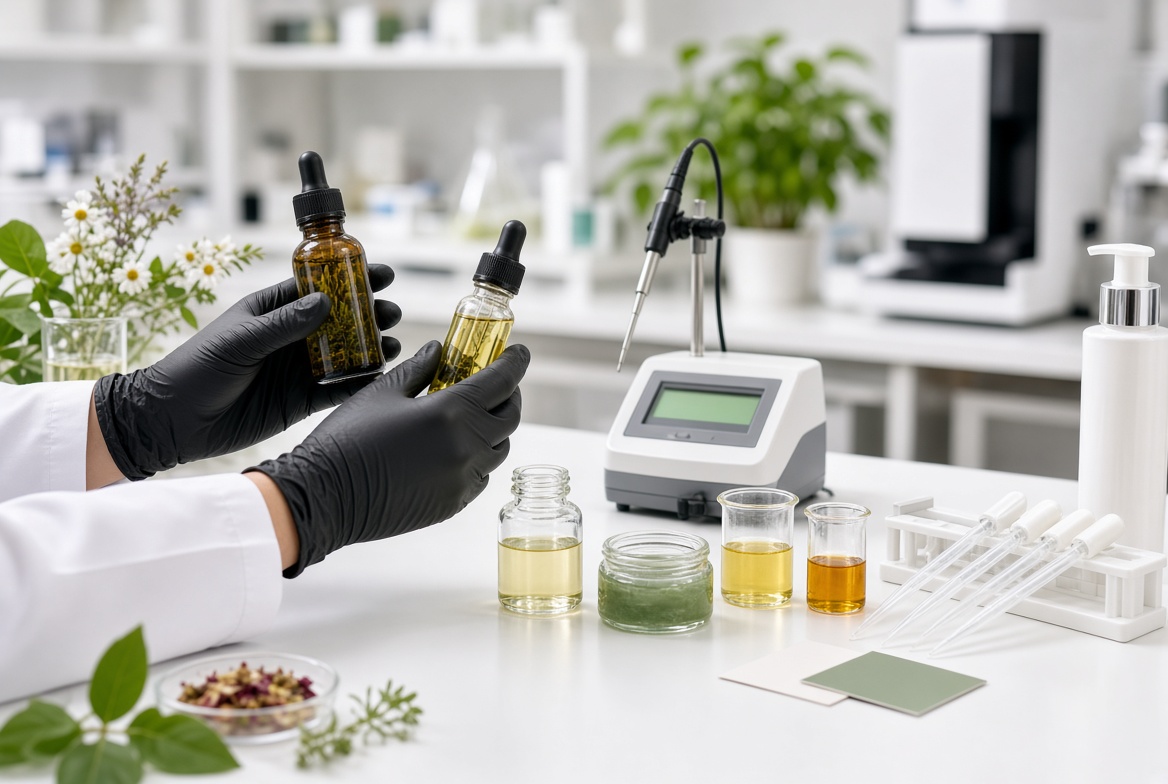
One of the most common development mistakes is treating discoloration as an ingredient-level problem only. In reality, the visible color of a botanical brightening product is the outcome of a complete system.
A chelator cannot fully protect a formula that is repeatedly exposed to oxygen, light, high temperature, and unstable raw materials. Likewise, a perfect pH target cannot stop darkening if iron or copper contamination is continuously catalyzing oxidation.
From our perspective as a manufacturer focused on plant active ingredients and fermentation-enabled innovation, the best results come from connecting raw-material selection, extraction quality, fermentation controls, formula architecture, processing conditions, packaging, and stability validation.
For global beauty brands, this means asking suppliers and manufacturing partners better questions:
- What is the botanical extract's color specification and seasonal variation range?
- Has the material been tested for trace-metal content?
- Which pH range best preserves its color and functional profile?
- Does the ingredient darken under heat, oxygen, or UV exposure?
- Is the product designed for clear packaging, airless packaging, or opaque packaging?
- Has the chelation strategy been validated in the final formula rather than only in a raw-material solution?
These questions can prevent costly reformulation, rejected batches, inconsistent retail appearance, and weakened consumer trust.
For color-sensitive botanical brighteners, sodium phytate is generally the more strategic ingredient when oxidation and trace-metal contamination are the dominant causes of instability. Citric acid is usually the more essential ingredient when the formula requires precise pH control, buffering support, and cost-effective multifunctionality.
The strongest commercial formulas frequently combine both:
- Sodium phytate for metal-ion management
- Citric acid for pH adjustment and buffer design
- Antioxidants and protective packaging for complete stability support
ZHENYIBIO TECHNOLOGY INC supports international beauty brands, wholesalers, and manufacturers with plant-active ingredients, biotechnology-informed development, and flexible OEM/ODM collaboration. If you are developing a botanical brightening serum, essence, mask, cream, or toner with challenging color stability requirements, contact our technical team to discuss ingredient selection, prototype development, stability strategy, and scalable manufacturing options.
In many oxidation-prone formulas, yes. Sodium phytate is commonly selected when trace metals such as iron and copper are believed to accelerate browning or oxidative color drift. Citric acid can provide some chelation, but its principal formulation value is often pH adjustment and buffering support.
Yes. A common strategy is to use sodium phytate for metal control and citric acid to adjust the final pH. The final design should be validated through stability, compatibility, preservative, and sensory testing.
Citric acid can help when the pigment or botanical extract is sensitive to pH. By setting and maintaining a suitable acidic pH range, it may reduce visible hue shifts. However, it may not adequately solve discoloration caused primarily by metal-catalyzed oxidation.
Sodium phytate is commonly described as a plant-derived chelating ingredient and is frequently used in natural-positioned cosmetic systems. Specific certification and claim suitability should always be confirmed against the supplier documentation and the target market's requirements.
No. Chelators and antioxidants perform different functions. Chelators reduce the activity of metal ions that can promote degradation, while antioxidants help manage oxidation through other mechanisms. Many color-sensitive botanical systems benefit from both.
At minimum, test pH, color values, odor, viscosity, microbiological quality, package compatibility, and active-content stability where an analytical method is available. Conduct testing at normal storage, elevated temperature, light exposure where relevant, and freeze-thaw conditions.
Commercial distribution can introduce prolonged heat exposure, vibration, oxygen transfer, seasonal temperature swings, and light exposure. Raw-material variation and packaging differences can also become more apparent at production scale. Stability evaluation should reflect the intended shipping route, climate exposure, and packaging format.
1. [Chelating Agents in Cosmetic Ingredients — Patsnap Eureka]
2. [Citric Acid Uses & Applications — Lab Alley]
3. [Sodium Phytate Ingredient Profile — INCIDecoder]
4. [Cosphaderm® PA-12 — UL Prospector]
5. [All About Citric Acid in Cosmetics & Personal Care — New Directions Aromatics]
6. [Sodium Phytate: Ultimate Chelating Agent in Skincare? — Formula Chemistry]
7. [Citric Acid in Cosmetics and Personal Care Products — Chemical Store]
8. [Chelating Agents in Cosmetics: What They Do, When to Use — MBC Cosmetics Academy]