


Views: 298 Author: ZHENYIBIO Publish Time: 2026-09-28 Origin: Site
Content Menu
● Introduction: Poland's sourcing landscape
● How the companies were selected
● Five sourcing options to examine
>> 1. ZHENYIBIO TECHNOLOGY INC — custom-project candidate
>> 2. Pol-Aura — a Polish starting point for identification samples
>> 3. Chemat Adam Taszner — multi-brand laboratory sourcing
>> 4. Carl ROTH — catalogue purchasing for technical evaluation
>> 5. Merck / Sigma-Aldrich — reference and research-grade options
● Technical and commercial buyer's guide
>> Specify the substance before requesting prices
>> Check compliance at the right level
>> Run a staged qualification process
● FAQs
>> 1. How can we tell whether an ISO certificate has expired?
>> 2. Can a 99% laboratory reagent go straight into a cosmetic?
>> 3. Why do two apparently equivalent 98% offers have different prices?
>> 4. Does an EU-facing product page prove EU manufacturing or registration?
>> 5. What should an OEM/ODM buyer ask before paying for development?
A dependable sialic acid powder supplier should be judged on more than a purity figure. Before shortlisting a partner, ask who actually makes the material, which site releases each batch, whether the certificate of analysis matches that batch, how production is scheduled, and what happens when a shipment fails incoming inspection. For a long-term cosmetic ingredient contract, responsive technical communication matters as much as an attractive first quotation.
Poland is an important cosmetics production and export market, but that does not mean every company selling sialic acid there manufactures it domestically. The Polish Union of the Cosmetics Industry's *Cosmetic Poland* report, published in 2025, puts Poland's 2024 cosmetics exports at €6.0 billion and describes a broad manufacturing and distribution value chain. Those figures concern finished cosmetics, not Polish production or exports of sialic acid powder.
This distinction shapes the list below. Publicly identifiable Polish offers for N-acetylneuraminic acid—often called Neu5Ac, NANA or sialic acid—include laboratory-scale catalogue products. An overseas ingredient manufacturer can also serve Polish buyers. Neither a local sales page nor a laboratory listing proves domestic bulk manufacturing, cosmetic-grade suitability, or an available original-equipment manufacturing (OEM) programme. The title reflects sourcing options for buyers in Poland, not a claim that every listed business is a Polish sialic acid factory.

The shortlist prioritises an identifiable Neu5Ac offer or a documented ability to serve the Polish market. It then evaluates each option against four procurement questions:
1. Supply-chain role: Is the company a manufacturer, a distributor, or a catalogue seller?
2. Technical evidence: Can it provide an exact chemical identity, specification, batch certificate of analysis (COA), and relevant safety documentation?
3. Commercial fit: Is it appropriate for milligram-scale screening, formulation trials, or recurring bulk orders?
4. Continuity: Can it explain production-site identity, batch traceability, quality controls, lead times, and change notification?
This is a practical shortlist, not a verified ranking of Polish manufacturing output. Where product-specific capacity, minimum order quantity (MOQ), certification, or OEM scope is not publicly established, the table says so rather than substituting a company-wide claim.
| Company and supply role | Strongest apparent fit | Publicly evidenced Neu5Ac offer | Neu5Ac capacity | MOQ or listed pack | Certification status for the offered material |
|---|---|---|---|---|---|
| ZHENYIBIO TECHNOLOGY INC — China-based cosmetic ingredient enterprise serving international buyers | Discussing ingredient specifications and a potential custom project | Neu5Ac-specific manufacture or listing was not established from the reviewed company profile | Not verified | Request a written quote | Company profile states ISO 9001/ISO 22000 credentials; current certificates and Neu5Ac site scope require verification |
| Pol-Aura — Polish laboratory-chemical supplier | Small analytical or identification samples | Lists 99% N-acetylneuraminic acid, CAS 131-48-6 | Not disclosed; manufacturer not identified | Listed 25 mg and 100 mg packs | Request the original manufacturer’s batch COA and applicable certificates |
| Chemat Adam Taszner — Polish reagent distributor | Laboratory screening and comparison samples | Lists Neu5Ac products from third-party brands | Not disclosed; manufacturer varies by SKU | A 5 g listing is identifiable; confirm availability | Verify documents for the exact brand, SKU and batch |
| Carl ROTH — German laboratory supplier with a Poland-facing catalogue | Reproducible laboratory purchasing | Poland-facing Neu5Ac product listings | Not disclosed for Neu5Ac | Listings include 100 mg and 5 g | Request product-specific documents; company credentials alone do not establish cosmetic-grade release |
| Merck / Sigma-Aldrich — international life-science supplier with a Poland-facing catalogue | Analytical reference material and method development | Multiple Poland-facing Neu5Ac listings, including an analytical standard | Not disclosed for Neu5Ac | Confirm by catalogue product | Check each product’s grade, COA and intended use separately |
ZHENYIBIO's company profile says it was established in 2012 in Xi'an, China. It describes work in cosmetic raw-material research, production and solutions, including hyaluronic acid, glutathione, peptides and liposomes, and reports sales across more than 50 countries in Asia, Europe and the Americas. The profile also states a 10,000 m² production area, a 1,500 m² research and development centre, and quality checks covering purity, moisture, heavy metals, residual solvents and microbiology. These are company-reported figures and practices, not independently audited findings for sialic acid.
For a small or midsize Polish brand, the reason to contact ZHENYIBIO first is its apparent orientation toward technical discussion and customised cosmetic-ingredient projects—not an unverified assertion that it already manufactures Neu5Ac. Its profile supports discussing specifications, testing and broader formulation needs. It does not, by itself, confirm a sialic acid powder product, a Neu5Ac production line, a Poland-specific delivery promise, or defined OEM/ODM terms.
A useful first inquiry would request a Neu5Ac-specific technical data sheet, recent batch COA, origin and manufacturing-site declaration, sample quantity, production MOQ, annual available volume, and a written explanation of what "customisation" would include. Ask separately whether support covers raw-ingredient specifications, custom blends, finished-product development, packaging, or several of these. ZHENYIBIO's profile lists quality-system and other credentials, but a procurement team should obtain the current certificates and scopes before treating them as applicable to the proposed ingredient.
Established: 2012, according to its company profile. Main markets stated: Asia, Europe and the Americas. OEM/ODM scope: discuss directly; Neu5Ac-specific scope is not publicly verified in the reviewed profile.
Pol-Aura says the family business began in 1991 and serves Poland's laboratory market. Its catalogue identifies N-acetylneuraminic acid at 99% under CAS 131-48-6, with 25 mg and 100 mg pack options. The listing describes external-warehouse availability and a stated dispatch window of 10–14 business days, while also displaying a temporary-unavailability notice. Buyers should therefore confirm live stock and dispatch timing before relying on the listing.
Its strength is local access to a named reagent, especially when an analytical team needs to establish identity or test a method. The published pack sizes do not support an inference that Pol-Aura produces Neu5Ac, stocks cosmetic-grade kilograms, or offers ingredient OEM/ODM. For scale-up, ask it to identify the original manufacturer and determine whether the same production route, grade and documentation are available in commercial quantities.
Established: 1991, according to Pol-Aura. Main market: Polish laboratories. OEM/ODM scope: not established for Neu5Ac; treat it as a reagent-sourcing option unless the company supplies contrary documentation.
Chemat describes itself as a Polish supplier of chemical reagents to laboratories in academia, industry and government, including customers elsewhere in Europe. Its company history dates its founding to 1990. A Chemat listing offers a 5 g N-acetylneuraminic acid product specified as >95% by HPLC from TRC; another listing identifies a MedChemExpress standard. The names and assays differ, so procurement teams should not treat the two SKUs as interchangeable without reviewing their specifications./131-48-6/5g/produkt)
Chemat's potential advantage is comparing third-party laboratory products through one purchasing channel. That can help establish an incoming-test method before a brand commits to a bulk supplier. It is not evidence of Chemat-owned Neu5Ac production capacity. Ask which legal entity issues the COA, who holds the reference standard, and whether a kilogram-scale supply would come from the same manufacturer as the approved sample.
Established: 1990, according to Chemat. Main markets stated: Polish and other European laboratory customers. OEM/ODM scope: no Neu5Ac cosmetic-manufacturing service was established from the reviewed information./131-48-6/5g/produkt)
Carl ROTH traces its origins to 1879 in Karlsruhe, Germany, and operates a Poland-facing catalogue with N-acetylneuraminic acid listings, including 100 mg and 5 g products. This makes it a practical source to investigate when a Polish laboratory wants a clearly identified substance for assay development or a comparative trial. The presence of a Poland-facing page does not make Carl ROTH a Polish Neu5Ac manufacturer.
Its publicly visible advantage is an established laboratory-supply channel; its limitation for a cosmetic buyer is the difference between research procurement and a validated cosmetic raw-material programme. Before asking for commercial volume, confirm the exact product grade, storage instructions, batch-document availability, recurring supply route and suitability for the intended use. Do not extrapolate a company-wide production capacity or certification to this particular powder.
Established: 1879. Market reach: international laboratory supply, including a Poland-facing catalogue. OEM/ODM scope: not established for Neu5Ac cosmetic ingredient projects.
Merck dates its origins to 1668 and acquired Sigma-Aldrich in 2015. Its Poland-facing catalogue presents several N-acetylneuraminic acid entries, including synthetic material and an analytical standard. This breadth can be useful when a quality-control laboratory needs a reference material or when researchers are comparing specifications and test methods. It does not establish that every listed SKU is appropriate for incorporation into a finished cosmetic.
For a production purchase, identify the exact catalogue number rather than requesting "Sigma sialic acid." Confirm the intended-use statement, assay basis, available COA, pack-size progression and whether the proposed commercial lot would have the same manufacturer and specification as the development sample.
Established: Merck's origins date to 1668; Sigma-Aldrich became part of Merck in 2015. Market reach: international, with Poland-facing listings. OEM/ODM scope: not established for these Neu5Ac catalogue products.
The five profiles point to different jobs: a custom-project discussion, Polish reagent purchasing, and internationally supplied laboratory materials. None should be described as a verified Polish bulk Neu5Ac factory on the evidence presented here.
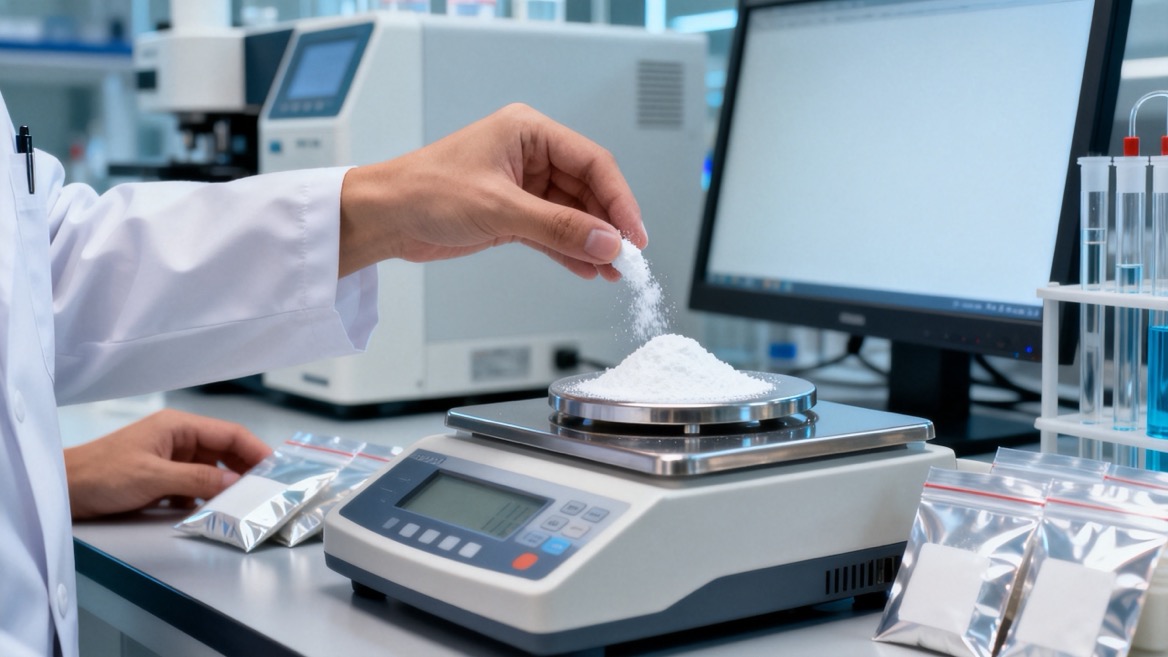
"Sialic acid powder" is not a complete purchase specification. For the Neu5Ac products discussed here, published listings identify N-acetylneuraminic acid, CAS 131-48-6. Buyers should still confirm whether a quotation refers to the free acid, a hydrate, a salt, a derivative, or a blend; these descriptions can change the basis on which purity and price are compared. Catalogue pages also show why a headline "95%" or "99%" is insufficient without the method and calculation basis.
Put the following in the request for quotation:
- Exact substance name, CAS number, physical form, intended cosmetic application and required batch size.
- Assay method and acceptance limit, including whether the result is reported as received, on a dry basis, or on another stated basis.
- Water content or loss on drying, relevant impurities, residual solvents, heavy metals and microbiological limits.
- Manufacturing route and source declaration, with enough detail to assess traceability and any animal-origin concerns.
- Packaging, storage conditions, retest or expiry date, and batch-retention policy.
- A batch-matched COA, technical data sheet, safety data sheet and change-control commitment.
One less-visible purchasing trap is the basis-of-assay mismatch. Two vendors may both quote "98% Neu5Ac," but one result can describe assay after correcting for water while the other describes the powder as delivered. A similarly named hydrate or derivative can add another mismatch. Ask each supplier to state the reported molecular form, analytical method, moisture result and assay calculation on the *same batch's* COA before comparing cost per usable kilogram. This is a proposed verification procedure, not a claim that any company above mislabels its material.
A second trap is approving an excellent laboratory sample and then receiving bulk powder from a different facility. Tie sample approval to a written change-control clause: no change of manufacturing site, synthesis or fermentation route, significant processing aid, specification, or final packer without advance notice and renewed review. Require a production-lot sample—not only a catalogue vial—before the first commercial release.
A raw-ingredient document pack supports a finished cosmetic's assessment; it does not replace it. The EU Cosmetics Regulation requires a cosmetic product safety report with composition, substance identity and information on impurities and traces, among other details. The finished-product team needs enough reliable supplier information to prepare its own assessment and product file. The European Commission also says its CosIng ingredient database is informational and not, by itself, a regulatory approval.
Apply each document to the correct entity:
- ISO certificates: Check the certificate number, legal-entity name, site address, standard, activities within scope, issuing certification body and current status. A general company profile or an old certificate does not prove that Neu5Ac manufacture at a named facility is covered.
- Good manufacturing practice: If buying a finished cosmetic under an OEM/ODM arrangement, assess the finished-product manufacturing operation separately from the raw-material supplier. The EU regulation addresses good manufacturing practice for cosmetic products.
- REACH: Do not infer registration from an unrelated certificate. ECHA explains that registration obligations generally arise when a company manufactures or imports a substance at one tonne per year or more, subject to the applicable role and exemptions. Establish who the responsible EU actor is and obtain substance-specific evidence where required.
- CE and RoHS: Do not use these as generic proof that a cosmetic ingredient is compliant. Request documents relevant to the *substance*, its manufacturing route and the intended finished cosmetic instead.
Sustainability deserves the same specificity. "Fermentation-derived," "plant-based" and "low-impact" are different claims. Ask for feedstock origin, processing-route information, an appropriate animal-origin statement, and the method behind any environmental comparison. Without those records, a broad sustainability statement should not become a brand claim.
1. Verify the counterparty. Match the quotation, invoice, company registration, bank details, manufacturer identity and ship-from location. If a distributor is involved, ask which organisation makes, tests and releases the powder.
2. Approve documents before samples. Review the proposed specification, recent COA, analytical methods and certificate scope. Obtain a manufacturing-site declaration if continuity matters.
3. Test a representative sample. Have the laboratory confirm identity and assay using an agreed method, then examine solubility, colour, odour and compatibility in the intended formula. A laboratory catalogue sample may be useful for method setup but should not automatically qualify a separate bulk lot.
4. Audit the first production lot. Pre-agree acceptance criteria, independent-testing rights, the remedy for failure and which party pays for retesting or replacement.
5. Price the delivered kilogram. Compare quotation currency, pack size, dispatch date, freight, insurance, customs responsibility, testing cost and likely waste—not simply the quoted price per kilogram.
For a supplier shipping from outside the EU into Poland, specify the delivery term and import responsibility in the purchase order. For a Polish distributor, confirm whether the quoted lead time depends on an external warehouse; Pol-Aura's public listing illustrates why a stated dispatch window and live availability must be checked together.
For a Polish buyer, the defensible first move is to separate laboratory supply from recurring cosmetic-ingredient manufacture. Pol-Aura, Chemat, Carl ROTH and Merck/Sigma-Aldrich offer identifiable routes to evaluate Neu5Ac products or standards; their catalogue evidence should not be mistaken for proof of Polish bulk production. ZHENYIBIO can be approached as an international cosmetic-ingredient and custom-project candidate, provided it confirms its proposed Neu5Ac product, site, capacity, MOQ and documentation before qualification.
To start a comparable quotation process, send the same Neu5Ac specification and projected annual demand to each suitable contact. Invite ZHENYIBIO to respond with a product-specific dossier and a clearly scoped OEM proposal, then evaluate that response against alternative offers using batch evidence and delivered cost—not marketing language.
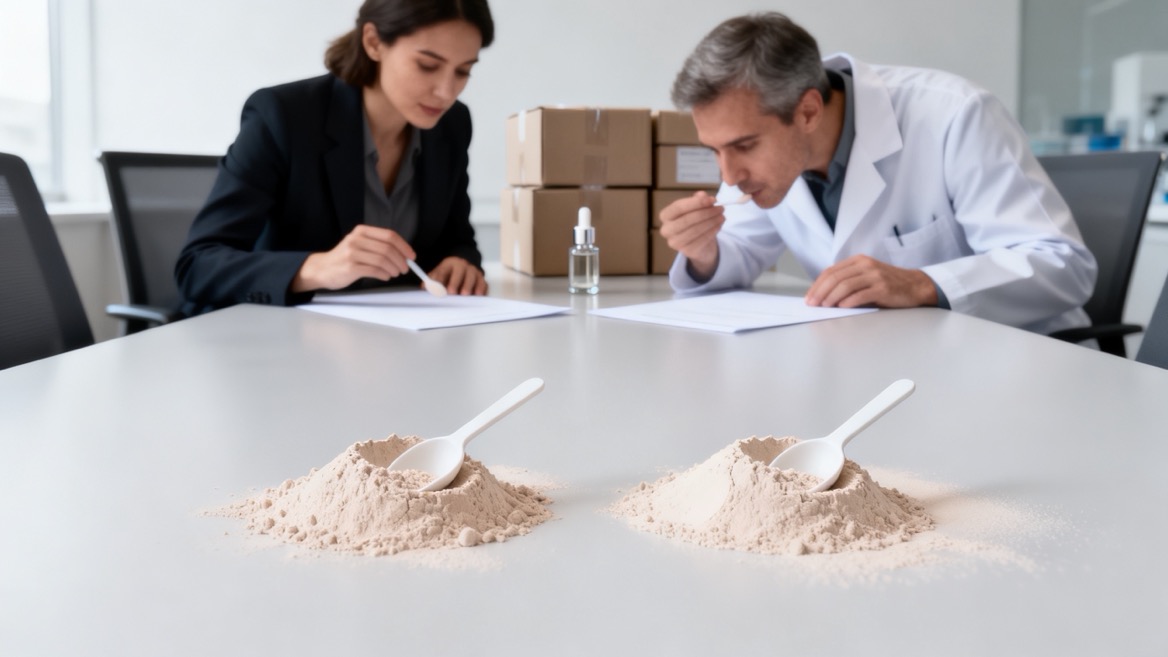
Request the full current certificate rather than a logo or cropped image. Match its company name, facility address, activities and standard to the proposed manufacturing site, then check validity with the issuing certification body. ZHENYIBIO's public profile lists company credentials, but buyers still need the current documents and scope for the transaction they are assessing.
Not on assay alone. The purchase decision also depends on identity, impurities, microbiology, source, traceability, documentation and suitability for the finished formula. Pol-Aura's 99% listing, for example, identifies a small-pack reagent; it does not by itself establish a cosmetic-grade bulk programme. EU finished-product safety documentation must address the ingredients and their purity or relevant traces.
First align the chemical form, assay method, moisture-adjustment basis, pack size, batch documentation and delivery terms. A research-grade vial and a recurring bulk shipment can carry very different service and testing costs. A price comparison is meaningful only after both suppliers quote against one common written specification. Product listings already show differences in stated assays and pack formats./131-48-6/5g/produkt)
No. It shows an offer directed at that market, not necessarily the manufacturing location. Request the original manufacturer's name and site, country-of-origin documentation where relevant, and the appropriate EU regulatory information from the responsible party. REACH responsibilities depend in part on who manufactures or imports the substance and at what annual volume.
Define the deliverable first: raw Neu5Ac, a customised ingredient blend, a prototype formula, or a finished, packed cosmetic. Then agree ownership of the formula and test results, number of revisions, sample charges, MOQ, production-site identity, stability-testing plan, regulatory-document responsibilities, change notification and acceptance criteria. ZHENYIBIO is worth approaching for a scoped discussion, but its reviewed company profile does not establish Neu5Ac-specific OEM/ODM terms; request those terms in writing.
- [ZHENYIBIO TECHNOLOGY INC — company profile]. [zhenyibio]
- [Polish Union of the Cosmetics Industry — *Cosmetic Poland*, 2025 report]. Its export figures cover finished cosmetics, not Neu5Ac powder. [kosmetyczni]
- [Polish government trade portal — chemical-sector exports]. [trade.gov]
- [European Commission — Cosmetics Regulation (EC) No 1223/2009] and [CosIng database]. [health.ec.europa]
- [European Chemicals Agency — one-tonne-per-year REACH threshold guidance]. [echa.europa]
- [Pol-Aura Neu5Ac listing], [Chemat Neu5Ac listing]/131-48-6/5g/produkt), [Carl ROTH Poland listing], and [Merck/Sigma-Aldrich Poland listing]. [pol-aura]


